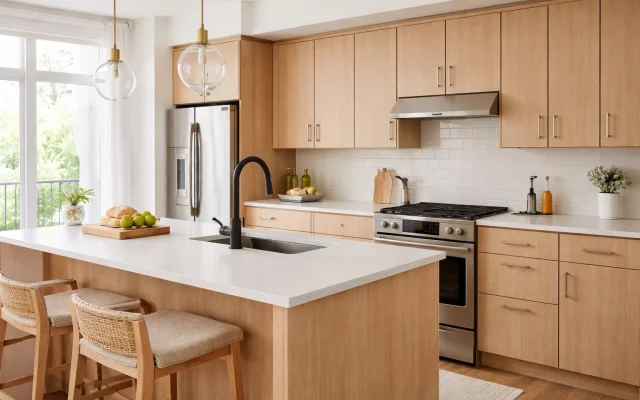
Small apartment kitchens demand smart systems. Every inch counts. Without a deliberate layout strategy, countertops become dumping grounds and cabinets turn into black holes.
These tips go beyond “buy a drawer organizer.” They focus on structural habits and spatial logic that actually work in compact kitchens.
Audit Your Kitchen Zones First
Before buying anything, map your kitchen into three zones: prep, cooking, and storage. Each zone should hold only what belongs there. Knives near the cutting board. Oils and spices near the stove. Dishes near the sink or dishwasher.
This zoning approach eliminates the most common problem in small kitchens: items stored where they’re grabbed, not where they’re used.
Use Vertical Space Aggressively
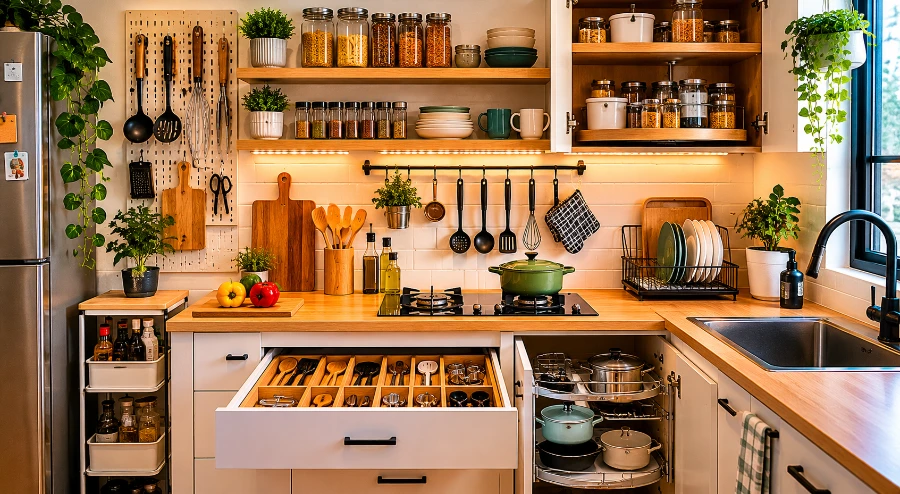
Wall space is almost always underused. Install floating shelves above the counter for everyday items. Use a magnetic knife strip instead of a knife block to free up counter real estate. Mount a pegboard on an open wall for hanging utensils, small pots, and lids.
Vertical organization also applies inside cabinets. Add stackable shelf risers to double the usable surface area inside a single cabinet. These cost less than $20 and immediately create visible storage layers.
Tackle Corner Cabinets with the Right Hardware
Corner cabinets are notoriously inefficient. Most people end up stuffing them and forgetting what’s inside. The fix is choosing the right internal system before the space becomes a problem.
Lazy Susans, pull-out drawers, and D-shaped shelves are the three most effective solutions. For a detailed breakdown of how to maximize this specific storage problem, this guide on how to organize a corner wall cabinet covers the options clearly, including what works best based on cabinet depth and door configuration.
Prioritize Drawer Organization Over Cabinet Stacking
Cabinets encourage stacking. Drawers encourage categorizing. If your apartment kitchen has limited drawer space, consider converting one lower cabinet into a pull-out drawer system using inexpensive slide-out shelf inserts.
For existing drawers, use rigid dividers instead of soft organizers. Rigid dividers hold position when you’re rummaging. Assign one drawer exclusively to cooking tools, another to dry prep items like peelers and graters. Label the drawer fronts until the system becomes habit.
Declutter Based on Frequency of Use
This is where most kitchen organization breaks down. People keep too much. Apply a simple rule:
- Daily use items live on the counter or in the top shelf of a cabinet
- Weekly use items go in mid-level cabinets or accessible drawers
- Rarely used items (holiday cookware, specialty appliances) go in the highest shelf or a separate storage area
- Items unused in 6+ months should be donated or discarded
According to a survey by the National Association of Productivity and Organizing Professionals, clutter is cited as one of the top sources of stress in the home environment. In a small kitchen, that stress compounds quickly because there’s nowhere for the chaos to hide.
Standardize Food Storage Containers
Mismatched containers waste more space than people realize. Lids fall, shapes don’t stack, and cabinet space gets used inefficiently.
Switching to a single system of square or rectangular containers accomplishes several things:
- Stacks flush without toppling
- Fits side by side with no wasted gaps
- Allows lids to be stored in one flat stack
Glass containers are heavier but more durable. BPA-free plastic is lighter and better for freezer use. Whichever you choose, commit to one shape and one brand.
Keep the Counter Clear by Default
Countertops in small kitchens serve as both workspace and visual signal. A cluttered counter makes the entire kitchen feel smaller and harder to work in.
The default state of your counter should be empty. Only items used daily earn permanent counter space. Everything else gets a home in a cabinet or drawer.
This is a discipline issue as much as an organization one. The system only works if items return to their assigned spots after use.
Final Thought
A well-organized small kitchen is not about having less. It is about knowing exactly where everything is. Systems that reduce decisions and eliminate searching will save time every single day.
Start with one zone. Fix that. Then move to the next.
Frequently Asked Questions (FAQs)
Start by creating dedicated zones for prep, cooking, and storage so items are kept where they are used most often.
Use vertical space with shelves, pegboards, magnetic strips, and cabinet risers to maximize unused areas.
Yes, open shelves can make a kitchen feel larger while providing easy access to frequently used items.
Only keep daily-use items on the counter and return everything else to designated storage spaces after use.
Store them on higher shelves, in deep cabinets, or in another storage area to free up prime kitchen space.
A quick review every few months helps prevent unnecessary items from accumulating and taking up valuable space.
Square or rectangular containers from the same product line stack efficiently and reduce wasted cabinet space.
Install solutions such as Lazy Susans, pull-out shelves, or rotating organizers to improve accessibility.
Well-organized drawers make items easier to find and prevent the stacking and clutter common in cabinets.
Yes, a well-organized kitchen reduces searching, speeds up meal preparation, and makes daily cleanup much easier.