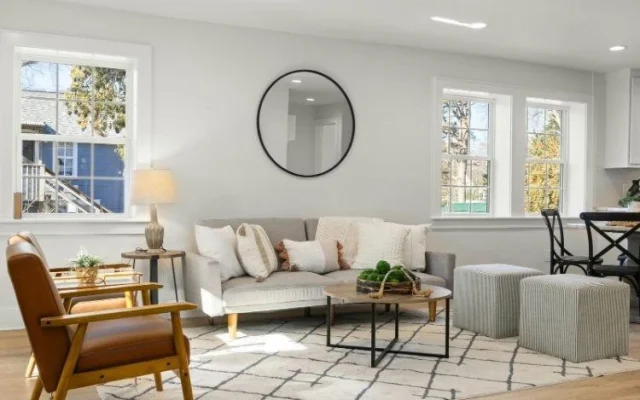
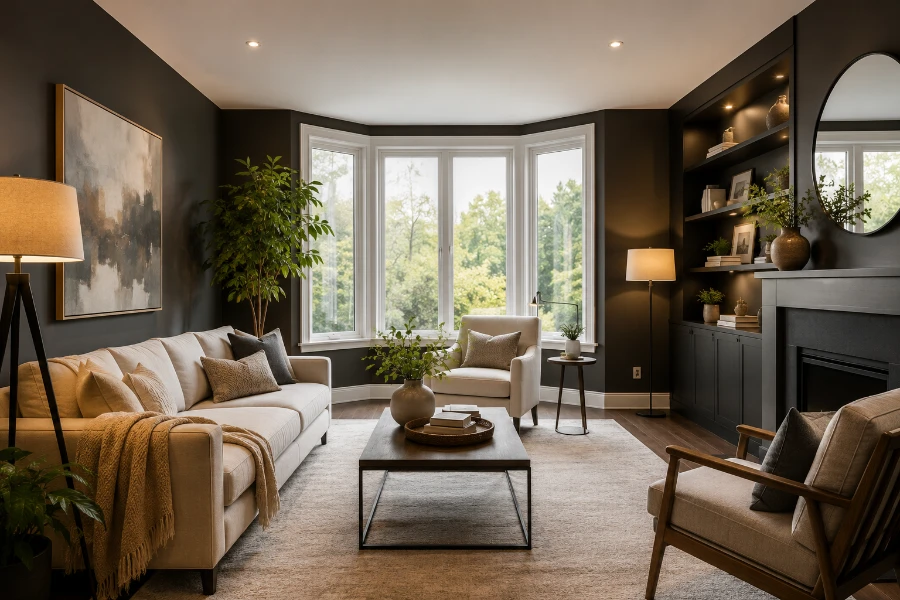

A dark living room can seem smaller because low light hides the room’s depth, makes corners fade away, and makes furniture look heavier than it is. The quickest way to make it feel bigger is to spread light more evenly, clear sightlines, and get rid of anything blocking natural light.
You do not always have to tear down walls, build an addition, or redo your whole main floor. In many homes, a smart mix of better lighting, lighter colours, thoughtful furniture placement, new window treatments, or sometimes a different window style can do the trick.
From a renovation expert’s view, the shape of a window is just as important as its size. Bay and Ecoline bow windows, for example, let a living room catch daylight from different angles, which helps in rooms that feel flat, narrow, or shaded most of the day. The main thing is to pick a window style that fits the wall, faces the right direction, meets insulation needs, and suits how you use the room.
Find Out Why the Living Room Feels Dark Before Spending Money
There are many reasons a living room might feel dark. The mistake is to treat every dark room the same way.
Sometimes, the issue is not enough natural light. A north-facing room, a lot with lots of shade, a deep porch, big trees, a balcony overhang, or a nearby building can all block daylight, even at noon. In other cases, the window might just be too small for the space or have thick frames that cut down on the amount of clear glass.
Other times, there is enough daylight, but the room’s interior makes it feel darker. Heavy curtains, dark floors, big sectionals, tall bookshelves, and a single weak ceiling light can all make a good room feel closed in.
Use this quick check before opting for any major upgrades:
| What You Notice | Likely Cause | Best First Move |
| Your room is dark even at midday | Limited natural light | Review window size, coverings, exterior shade, and glass area |
| Your room is fine by day but flat at night | Poor artificial lighting | Add layered lighting at different heights |
| Your room feels cramped despite enough light | Furniture scale or layout | Open sightlines and reduce visual weight |
| Your room looks dull after repainting | Wrong undertone or low reflectance | Test warmer, higher-LRV colours |
| Your window wall feels cold or drafty | Old or inefficient windows | Check seals, frames, glazing, and installation quality |
A dark living room often feels smaller because there is not enough daylight, lighting is in the wrong spots, finishes are too dark, windows are blocked, or furniture breaks up the view.
Replace One Ceiling Light With Layered Lighting
A single ceiling light rarely makes a living room feel cozy. It might light up the middle, but the corners stay dark. This contrast makes the room seem smaller because you cannot see the full width and depth of the space.
A better lighting plan uses several light sources:
- Ambient lighting for general brightness, such as recessed lights, flush mounts, or a soft central fixture.
- Task lighting near reading chairs, sofas, desks, or side tables.
- Accent lighting to brighten shelves, artwork, corners, or textured walls.
The aim is not to make the room super bright. Instead, you want to get rid of dark spots.
For example, if a living room has just one ceiling light and a dark corner by the sofa, it can feel narrow. Try adding a floor lamp behind the seating area, a table lamp near the window, and a small accent light by the darkest wall. The room will feel wider right away because you can see the edges again.
A common mistake is picking a much brighter bulb instead of adding more light sources. Just making it brighter can cause glare. Using different types of lighting adds depth.
For a cozy, relaxed living room, many people like bulbs that give off warm white light. Cooler light can work in modern rooms, but it might make beige, cream, wood, and warm grey finishes look harsher than you expect.
Choose Colours That Reflect Light Without Making the Room Feel Cold
“Paint it white” is not always the best advice. In a dark living room, pure white can look grey, flat, or unfinished because it needs enough light to look its best.
A better idea is to pick light colours with warm undertones. Soft cream, warm white, pale greige, light taupe, and gentle beige usually work better than bright white in rooms with little light.
One helpful metric to consider is LRV, which stands for Light Reflectance Value. LRV tells you how much light a colour reflects, on a scale from 0 to 100. Lower numbers mean less light is reflected, and higher numbers mean more.
For dark living rooms, try paint samples with a higher LRV, but do not pick just by the number. The undertone is important too. A cool, high-LRV white can still feel cold in a north-facing room, while a warmer off-white might look softer and brighter.
Practical rules that usually work:
- Keep the ceiling lighter than the walls.
- Avoid very dark rugs if the floor already absorbs light.
- Use warm light neutrals instead of icy whites in shaded rooms.
- Test paint on at least two walls before committing.
- Check the sample in morning, afternoon, and evening light.
In short, the best colours for a dark living room are warm whites, soft creams, pale greige, and light taupe. These shades reflect light and help the room feel cozy, not cold.
Make Furniture Work With the Light, Not Against It
Furniture can really change how a dark living room feels.
The main problem is usually not how many pieces you have, but where they are and how heavy they look. A big sofa with a skirted base, dark fabric, and thick arms can make the room feel heavier. But a sofa of the same size with raised legs, slimmer arms, and lighter fabric can feel much less bulky.
Start by looking at the window wall. If tall bookshelves, plants, heavy curtains, or the back of a sofa are blocking the brightest part of the room, move them first. Natural light should flow into the room, not stop at the window.
In a narrow living room, do not push every piece of furniture against the wall just because the space is small. This often leaves an awkward, empty strip in the middle, making the room feel stiff. Instead, set up a clear seating area with open walkways.
Good choices for darker rooms include:
- Sofas and chairs with visible legs.
- Slim coffee tables instead of block-style tables.
- Lighter wood tones instead of heavy dark finishes.
- Glass or open-frame side tables.
- A rug that defines the seating area without absorbing too much light.
- Lower furniture near windows to keep sightlines open.
A good test is to stand at the entrance of the room. If the first thing you see is the side of a big sofa, a dark cabinet, or a messy corner, the room will feel smaller before anyone even sits down.
Use Mirrors Only Where They Reflect Something Worth Seeing
Experienced homeowners often suggest using mirrors in dark rooms, but where you place them matters more than their size.
A mirror is helpful when it reflects daylight, a lamp, plants, artwork, or an open area of the room. It does not help much if it just reflects clutter, a blank dark wall, a TV, or a crowded shelf.
The best placements are usually:
- Opposite a window, if the reflected view is pleasant.
- Adjacent to a window, where it can bounce light sideways.
- Behind or near a lamp, to multiply evening light.
- Above a console in a narrow living room, it reflects the open space.
One big mirror usually looks neater than lots of small mirrors spread around the room. Too many shiny surfaces can make the space feel busy, especially in a small living room.
Reflective surfaces can help, too, but use them sparingly. A glass coffee table, shiny hardware, framed art, or a metallic lamp base can brighten a room without making it look like a showroom.
Expert tip from pro homeowners: A mirror does not make its own light. It only bounces around what is already there. If your room has very little natural light, adding more lighting or improving the windows will make a bigger difference.
Know When Window Upgrades Make More Sense Than Décor Changes
Décor can help spread light, but it cannot add much daylight if the room has a small, badly placed, or old window. This is when homeowners need to be realistic about what cosmetic changes can do.
Window performance also affects comfort. According to most research, heat gain and heat loss through windows account for 25% to 30% of residential heating and cooling energy use.
This does not mean every dark living room needs new windows. It just means you should think about the windows if the room shows several of these signs at the same time:
- The room is dark, even with the coverings open.
- The glass area is small compared with the wall.
- The window feels drafty or cold nearby.
- Condensation appears between panes.
- The frame is bulky, reducing the visible glass.
- The layout would benefit from a wider view or more angled light.
Different window styles fix different problems. A big-picture window offers a clear view and plenty of daylight, but it does not open. Casement windows let in fresh air and usually feature a lot of clear glass.
Bay windows add depth and can create a small seating or display spot. If your living room wall can handle it, bow windows bring in light from several angles and add a gentle curve instead of a flat shape.
However, projected windows are not easy décor upgrades. Bay and bow windows might need a careful look at the structure, good insulation, proper finishing outside, and skilled installation. If the details are not done well, you could end up with drafts, water leaks, or comfort issues.
Window ratings are important too. The U-factor shows how well a window keeps heat from escaping or coming in, and lower numbers usually mean better insulation. The Solar Heat Gain Coefficient, or SHGC, tells you how much solar heat gets through the window, which affects glare, overheating, and comfort depending on your climate.
All in all, consider upgrading your windows if the living room is still dark during the day, feels cold near the glass, has old frames, or lacks enough clear glass for the room’s size.
Compare the Most Practical Upgrades Before Choosing One
The best fix depends on why the room is dark, not just on what is trendy online. A room with poor evening light needs a different solution than one with a tiny window. A shaded living room in a cold climate needs a different plan than a west-facing room that gets too hot in summer.
The best order is usually simple:
- Remove anything blocking the windows.
- Replace heavy coverings with lighter treatments.
- Add layered lighting.
- Repaint large dark surfaces if needed.
- Adjust furniture placement.
- Add mirrors or reflective accents.
- Review window replacement or enlargement if the room still feels dark during the day.
Do not go straight to the most expensive fix before you try the simple solutions. But also, do not spend a lot on lamps, paint, mirrors, and new furniture if the real problem is a small, outdated window on the only outside wall.
Frequently Asked Questions (FAQs)
You can make a dark living room feel larger by adding layered lighting, using light-reflective paint colours, rearranging furniture, and keeping windows unobstructed.
Warm whites, soft creams, pale greige, and light taupe usually work best because they reflect light without making the room feel cold or sterile.
Yes, but placement matters. Mirrors work best when they reflect windows, lighting, or open areas instead of dark walls or clutter.
The room may have limited natural light because of small windows, exterior shade, heavy window coverings, or old window frames that reduce visible glass space.
Usually not. A combination of ambient, task, and accent lighting creates better depth and helps eliminate dark corners that make rooms feel smaller.
Absolutely. Large furniture blocking windows or interrupting sightlines can make a room feel cramped, even if the room itself is fairly large.
Not always. Pure white can appear grey or cold in low-light spaces, so warmer light neutrals are often a better choice.
LRV stands for Light Reflectance Value, which measures how much light a paint colour reflects. Higher LRV colours generally help brighten darker rooms.
You should consider new windows if the room stays dark during the day, feels drafty near the glass, or has old frames with limited visible glass area.
Yes. Bay and bow windows can bring in daylight from multiple angles, helping the room feel brighter, wider, and more open.