
Mold can develop in places that homeowners and renters rarely inspect. Behind drywall, beneath flooring, around air conditioning systems, and inside poorly ventilated spaces, excess moisture can create conditions that allow mold to grow. For Dallas property owners, choosing a reliable mold inspection company is an important step toward identifying these problems before they lead to extensive damage.
Finding the top mold inspection companies in Dallas for accurate indoor air testing involves more than comparing prices. A qualified inspector should understand moisture intrusion, use appropriate testing methods, explain laboratory results, and provide recommendations based on the property’s actual condition.
Texas also regulates professional mold assessment and remediation. The Texas Department of Licensing and Regulation (TDLR) oversees applicable licenses and establishes requirements intended to protect consumers.
This guide examines five mold inspection providers serving Dallas and the surrounding Dallas-Fort Worth area. It also explains what mold testing involves, how much inspections may cost, and what to look for before hiring an inspector.
Why Professional Mold Inspection Matters in Dallas
Dallas properties experience several conditions that can contribute to moisture problems, including intense summer heat, heavy thunderstorms, plumbing leaks, roof damage, and air conditioning condensation.
Although outdoor humidity can be high, indoor mold growth is primarily associated with moisture that accumulates or remains trapped inside a building.
Common problem areas include:
- Bathrooms with inadequate ventilation.
- Kitchens with leaking sinks or appliances.
- Attics affected by roof leaks or condensation.
- Crawlspaces with persistent ground moisture.
- Walls surrounding plumbing lines.
- Carpeting or flooring affected by previous flooding.
- HVAC components with condensate drainage problems.
Mold spores occur naturally in outdoor and indoor environments. Their presence alone does not necessarily indicate a serious contamination problem.
However, when moisture allows mold to grow on building materials, property damage and indoor air quality concerns may develop.
The Environmental Protection Agency recommends maintaining indoor relative humidity below 60%, ideally between 30% and 50%. It also emphasizes that controlling moisture is the most important part of preventing mold growth.
A professional mold assessment can help determine whether a suspected problem requires further investigation, corrective maintenance, or specialized remediation.
How We Evaluated Mold Inspection Companies in Dallas
The companies featured below were selected for comparison based on their published services, inspection approaches, accessibility, and relevance to Dallas-area property owners.
Rather than relying exclusively on promotional claims, homeowners should evaluate providers using several practical criteria.
Texas Licensing and Professional Qualifications
Texas regulates professional mold assessment through TDLR. Depending on their responsibilities, individuals may hold Mold Assessment Technician or Mold Assessment Consultant credentials, while qualifying businesses may require a Mold Assessment Company license.
A Mold Assessment Consultant can perform specialized assessment activities and prepare mold remediation protocols.
Before scheduling, verify the relevant credentials through the TDLR license verification system.
Testing Methods and Equipment
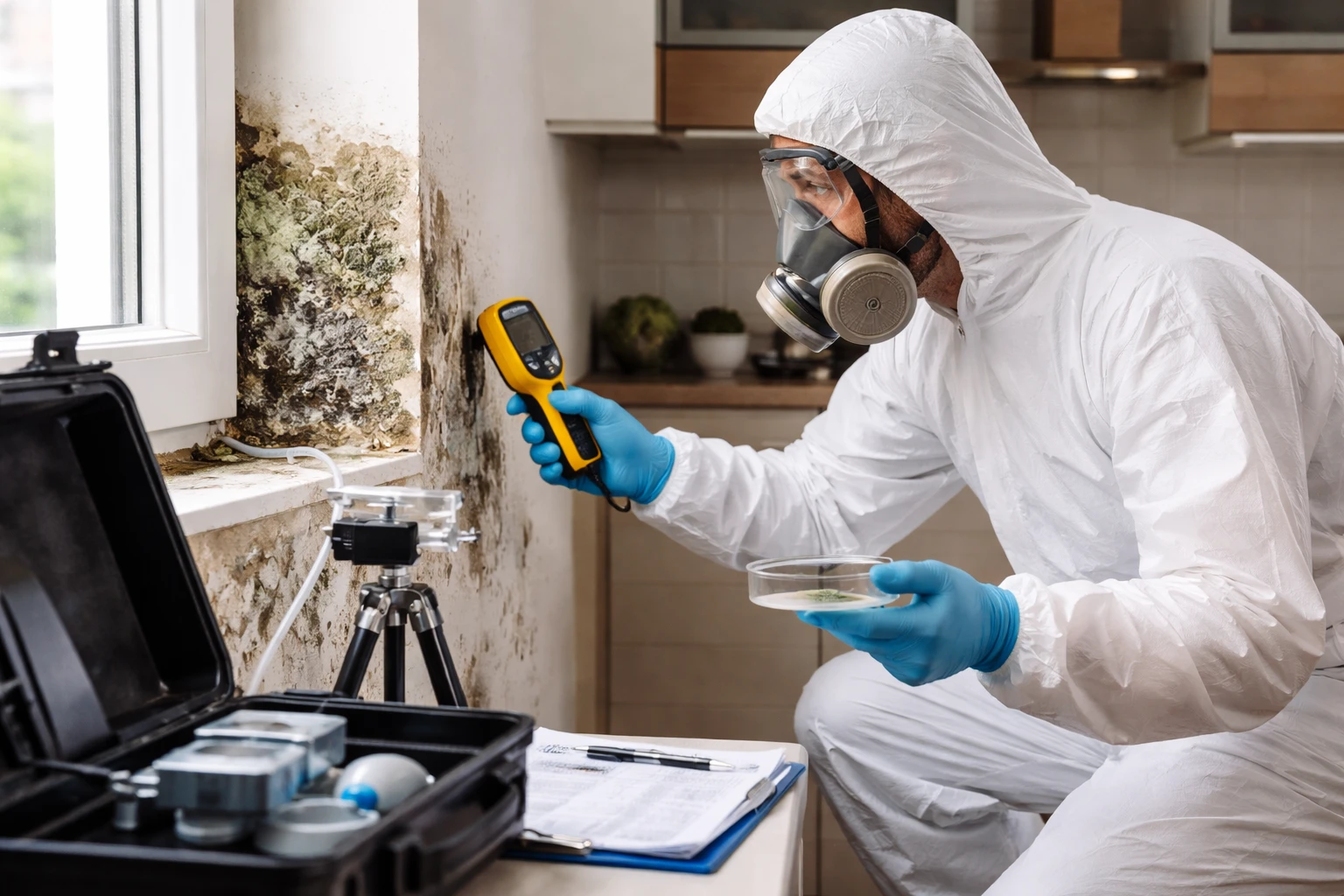
A thorough mold investigation may involve visual inspection, moisture measurements, infrared imaging, air sampling, surface sampling, or investigation of concealed spaces.
Not every property requires every method.
An experienced inspector should explain why each proposed test is necessary and how the findings will influence recommendations.
Independent Laboratory Analysis
When laboratory samples are appropriate, ask whether they will be analyzed by a properly licensed laboratory.
Independent laboratory results can provide useful information about collected samples, although they should always be interpreted alongside inspection findings.
Separation Between Assessment and Remediation
Texas law generally prohibits a license holder from performing both mold assessment and mold remediation on the same project. It also restricts overlapping ownership interests between assessment and remediation entities working on that project.
Certain statutory exemptions apply.
This separation helps address conflicts of interest and gives consumers greater confidence in the assessment process.
Reporting, Pricing, and Availability
A useful inspection report should explain what was observed, identify moisture problems, present relevant test results, and recommend appropriate next steps.
Transparent pricing, reasonable turnaround times, and clear communication also matter.
Comparison of Top Mold Inspection Companies in Dallas
| Company | Notable strength | Suitable for |
|---|---|---|
| Mold Testing and Removal | Independent testing, quick scheduling, and coordinated referrals | Homeowners needing prompt inspection |
| Dallas Mold Consultants | Assessment-only services and remediation protocols | Buyers, sellers, landlords, and homeowners |
| Barrett Environmental | Environmental science expertise and advanced inspection tools | Complex or potentially concealed mold problems |
| Woodward Environmental | Published flat-fee inspection pricing | Budget-conscious residential and commercial clients |
| Indoor Science | Broader indoor environmental and air quality assessments | Commercial and specialized IAQ concerns |
Note: These are editorial comparisons, not a verified ranking based on independent testing. Service offerings, prices, staffing, and license status may change. Verify current details directly before booking.
1. Mold Testing and Removal
Mold Testing and Removal provides mold inspection and testing services in Dallas, Fort Worth, and Philadelphia.
Its Dallas operation lists an office at 2031 John West Road, Suite 119, Dallas, TX 75228, and advertises appointments for homeowners and businesses throughout the surrounding area.
The company emphasizes independent inspection rather than performing mold removal itself.
Inspection and Testing Services
Its published services include visual examinations, moisture mapping, thermal imaging, indoor air sampling, and surface testing.
When samples are warranted, they are sent to an independent laboratory. The company also prepares written reports describing its findings and recommended actions.
According to its website, a typical inspection takes approximately 60 to 90 minutes, depending on property conditions.
The company advertises report delivery within approximately 48 hours and same-day scheduling when appointments are available.
What Makes This Company Worth Considering?
One advantage is its clearly described inspection process.
Instead of leaving clients uncertain about what happens next, the company outlines how the inspection, laboratory analysis, reporting, and follow-up procedures work.
Its website also lists a starting inspection price of $400, with additional sampling charges when required.
For properties needing remediation, the company says it can refer clients to separate remediation partners and provide follow-up clearance assessments.
Property owners should confirm that all parties involved satisfy Texas conflict-of-interest requirements.
Best for: Dallas homeowners seeking responsive scheduling, documented laboratory testing, and assistance coordinating the next steps.
Key advantage: Clearly published inspection procedures, starting prices, and report turnaround expectations.
2. Dallas Mold Consultants
Dallas Mold Consultants focuses on independent mold inspections and indoor environmental assessments.
The company states that it does not perform mold removal, helping separate its testing recommendations from remediation contracting.
This approach can appeal to homeowners, landlords, and prospective buyers who want a professional evaluation before making expensive repair decisions.
Inspection and Testing Services
Dallas Mold Consultants offers services involving mold sampling, moisture investigations, remediation protocols, and post-remediation clearance assessments.
Depending on property conditions, inspections may include:
- Indoor air sampling.
- Surface swab testing.
- Wall cavity investigations.
- Inspection of attics and other potentially affected areas.
- Evaluation of moisture damage.
- Laboratory analysis.
The company states that samples are submitted to an independent TDLR-licensed laboratory and that results are generally available within 24 to 48 hours.
Its reports may include photographs, testing findings, and recommendations for addressing identified contamination.
Remediation Protocols and Clearance Testing
If the inspection identifies a problem requiring licensed remediation, Dallas Mold Consultants can prepare a written protocol outlining the required work.
A separate remediation contractor can then use the protocol to develop a work plan.
After the cleanup, the assessor may conduct a post-remediation evaluation to determine whether the project meets applicable clearance criteria.
For qualifying projects, this documentation contributes to the Texas Certificate of Mold Damage Remediation process.
Best for: Homeowners, landlords, property buyers, and sellers who want assessment-only services and written guidance.
Key advantage: A focus on independent testing, remediation planning, and post-remediation evaluation.
3. Barrett Environmental
Barrett Environmental is based in McKinney and serves residential and commercial clients throughout the Dallas-Fort Worth area.
Founded in 2019, the company approaches mold inspection through environmental science, moisture investigation, and indoor air quality assessment.
Its published company information identifies Tate Barrett, Ph.D., as the owner and an environmental scientist.
The company lists Texas Mold Assessment Company license ACO1273 and Mold Assessment Consultant license MAC1681 for Dr. Barrett. These numbers should be independently checked with TDLR before scheduling.
Advanced Inspection Methods
Barrett Environmental combines conventional inspection techniques with specialized equipment.
Its services may involve:
- Visual assessment of potentially affected building materials.
- Moisture measurements.
- Infrared thermal imaging.
- Robotic sampling equipment.
- Indoor air quality monitoring.
- Evaluation of ventilation conditions.
- Investigations of concealed moisture problems.
The company also advertises the assistance of Scout, a trained mold detection dog.
Although such tools may help identify areas for further investigation, a detection dog’s indication or a technology-based screening result should not be treated as laboratory confirmation of mold contamination.
Broader Indoor Air Quality Assessment
Barrett Environmental also examines concerns beyond visible mold.
Its published services describe environmental monitoring involving temperature, relative humidity, ventilation, carbon dioxide, particulate matter, and certain chemical pollutants.
This broader approach can be useful when occupants report persistent odors or indoor environmental concerns without an obvious source.
Best for: Dallas-area homeowners and commercial property managers dealing with complicated moisture conditions or suspected hidden mold.
Key advantage: Environmental science expertise combined with a variety of investigative technologies.
4. Woodward Environmental
Woodward Environmental serves Dallas, Fort Worth, and surrounding North Texas communities.
The company offers mold inspections along with other environmental testing services, making it an option for property owners who want to evaluate different indoor environmental concerns.
One of its most distinguishing features is its publicly advertised inspection pricing.
Published Mold Inspection Pricing
According to the company’s mold inspection page, its advertised rates include:
| Inspection type | Published price |
|---|---|
| Residential mold inspection | $495 |
| Commercial mold inspection | $595 |
The company states that these prices cover qualifying properties up to 3,000 square feet within its service area.
Property owners should confirm whether their building qualifies and whether specialized testing or travel affects the final price.
Mold and Indoor Air Quality Services
Woodward Environmental advertises inspections involving air quality measurements and evaluation of potential mold contamination.
Its broader services also include testing for concerns such as radon, lead-based paint, and electromagnetic fields.
An important consideration is understanding which services are included in a standard mold inspection and which require additional arrangements.
For example, screening for airborne particles or volatile organic compounds does not automatically confirm the presence of mold.
Laboratory analysis and investigation of moisture conditions may still be necessary.
Why Consider Woodward Environmental?
Predictable pricing can make comparing inspection providers easier.
For homeowners preparing a renovation, buying a property, or investigating a persistent moisture problem, knowing the expected inspection cost upfront can help with budgeting.
However, customers should request a written scope of services before booking.
Best for: Residential and commercial property owners who prefer advertised flat-fee pricing.
Key advantage: Straightforward published inspection rates for qualifying properties.
5. Indoor Science
Website: https://indoorscience.com/
Indoor Science specializes in evaluating indoor environmental conditions, including mold, moisture, ventilation, and other air quality concerns.
Its work extends beyond traditional residential mold sampling.
The company’s published technical resources describe an approach that begins with understanding the property, identifying possible contamination sources, and selecting appropriate investigative methods.
Unlike providers that emphasize collecting a predetermined number of samples, this approach focuses on determining which tests can answer the client’s specific questions.
Mold Inspection Services
Indoor Science describes several investigative techniques, including:
- Visual examination of suspected mold growth.
- Moisture measurements.
- Infrared imaging.
- Borescope investigations of concealed spaces.
- Surface sampling.
- Airborne mold spore sampling.
- Evaluation of water-damaged materials.
The company emphasizes that inspectors should understand building conditions before deciding where and whether sampling is necessary.
Comprehensive Indoor Air Quality Testing
Indoor Science also provides broader indoor environmental evaluations.
Depending on the project, these may involve ventilation, airborne particles, volatile organic compounds, and other potential contaminants.
Such services can be valuable in commercial buildings, offices, multifamily properties, and other facilities with complicated indoor environmental concerns.
For Dallas property owners, however, one important step is to confirm the company’s current local service availability and the Texas licensing credentials of the individuals assigned to the project.
Its general service descriptions do not, by themselves, establish that every specialized service is available through a Dallas-based team.
Best for: Commercial property owners, facility managers, and clients seeking more detailed indoor environmental investigations.
Key advantage: A technically focused approach that considers multiple possible contributors to poor indoor air quality.
What Happens During a Professional Mold Inspection?
Understanding the inspection process can help property owners make informed decisions.
Although procedures vary, a professional mold assessment generally follows several stages.
Initial Consultation
The inspector first gathers information about the suspected problem.
You may be asked about plumbing leaks, flooding, roof damage, musty odors, previous repairs, or visible discoloration.
The history of the property can help identify where moisture may have accumulated.
Visual Inspection
Next, the inspector examines accessible areas for evidence of moisture intrusion or suspicious growth.
Potential warning signs include water staining, deteriorated drywall, warped flooring, condensation, and damaged building materials.
A thorough investigation considers the possible source of moisture rather than focusing only on visible staining.
Moisture Measurements
Inspectors may use moisture meters to identify elevated moisture in walls, flooring, or other materials.
Infrared cameras can also highlight temperature differences that warrant closer investigation.
However, thermal imaging does not directly identify mold. Temperature patterns must be interpreted carefully and confirmed through appropriate follow-up methods.
Air and Surface Sampling
If testing will provide useful additional information, the inspector may collect samples from selected locations.
Air samples can help characterize airborne fungal particles during the sampling period.
Surface samples may help identify suspected growth on specific materials.
The inspector should explain why each sample is needed.
Laboratory Analysis and Reporting
Collected samples may be analyzed by a qualified laboratory.
The inspector then evaluates the findings together with visible conditions, moisture readings, the building’s history, and any other relevant evidence.
The final report should explain the results in understandable language and identify recommended next steps.
Comparing Mold Inspection Methods
| Inspection method | Primary purpose | Important limitation |
|---|---|---|
| Visual inspection | Identify visible growth and moisture damage | Cannot reveal every concealed problem |
| Moisture meter | Detect elevated moisture in materials | Does not directly identify mold |
| Infrared imaging | Identify temperature patterns that may indicate moisture | Requires careful interpretation |
| Air sampling | Evaluate airborne fungal particles | Reflects conditions during sampling |
| Surface sampling | Analyze material collected from suspected growth | Represents only the sampled location |
| Borescope inspection | Examine selected concealed spaces | Cannot inspect every hidden area |
| Post-remediation assessment | Evaluate cleanup against established criteria | Does not guarantee mold will never return |
The most appropriate inspection combines methods based on the circumstances rather than assuming that more tests always produce better answers.
Is Mold Air Testing Always Necessary?
Not every suspected mold problem requires laboratory air testing.
The EPA explains that visible mold growth often provides sufficient evidence to justify cleaning up the contamination and correcting the underlying moisture problem.
In those situations, additional sampling may not change the recommended action.
Testing may be more useful when the source of contamination is uncertain, concealed growth is suspected, documentation is needed for a property transaction, or an assessor must evaluate a remediation project.
Understanding Mold Spore Counts
A laboratory report may describe different fungal groups and their concentrations in collected samples.
Inspectors sometimes compare indoor samples with outdoor reference samples.
However, there is no universally accepted federal numerical limit that establishes whether a particular indoor mold spore concentration is safe or unsafe.
Consequently, a single number should not determine whether a building requires remediation.
Air sampling also has limitations because airborne concentrations can fluctuate with ventilation, occupant activity, weather, and other factors.
A qualified professional should interpret results within the property’s overall conditions.
How Much Does a Mold Inspection Cost in Dallas?
Mold inspection prices vary depending on the building’s size, the complexity of the problem, accessibility, testing requirements, and the number of laboratory samples collected.
Published company pricing provides useful reference points.
For example, Mold Testing and Removal advertises a starting price of approximately $400, while Woodward Environmental advertises $495 for qualifying residential inspections and $595 for qualifying commercial inspections.
These are company-published prices, not guaranteed market-wide averages.
Larger properties or specialized investigations may cost more.
Factors That Affect Inspection Costs
Property size: A larger building generally requires more time to examine, particularly when multiple rooms or HVAC systems are involved.
Number of samples: Additional air, surface, or concealed-space samples may increase laboratory and collection charges.
Accessibility: Crawlspaces, attics, high ceilings, and enclosed structural cavities may require more extensive investigation.
Report requirements: Detailed documentation for remediation, insurance, or commercial property management may involve additional professional work.
Urgency: Expedited scheduling or laboratory processing may carry additional fees.
Before signing an agreement, request a written estimate identifying the inspection fee, included samples, optional services, and report delivery schedule.
Texas Mold Inspection Laws Property Owners Should Understand
Texas establishes specific rules for professional mold assessment and remediation under Chapter 1958 of the Texas Occupations Code and associated TDLR regulations.
Understanding these requirements can help consumers avoid improper contracting arrangements.
Licensing Requirements
Professional mold assessors and remediation contractors generally must hold the appropriate Texas licenses unless a statutory exemption applies.
Not every activity involving mold requires a professional license. Exemptions may apply to particular property owners, smaller remediation projects, and certain construction-related activities.
For this reason, it is more accurate to review the applicable licensing requirements than to assume that every inspection or minor cleaning activity requires a Mold Assessment Consultant.
Assessment and Remediation Must Be Separated
Texas generally prohibits the same license holder from conducting both assessment and remediation on the same project.
The law also addresses ownership conflicts between the businesses performing these services.
Consumers should ask who will assess the problem, who will conduct remediation, and who will evaluate the completed work.
The 25-Square-Foot Rule
Texas provides a licensing exemption for certain mold remediation work involving less than 25 contiguous square feet of affected surface area.
However, the exemption does not eliminate all requirements for licensed remediation professionals who undertake smaller projects.
Property owners should consult TDLR guidance before deciding how the work must be handled.
Certificate of Mold Damage Remediation
For applicable licensed remediation projects, the remediator must provide a Certificate of Mold Damage Remediation within the statutory timeframe.
The certificate includes an assessment-related statement concerning whether the identified contamination was remediated according to the established requirements.
When selling a property, Texas law requires owners to provide buyers with copies of relevant certificates issued during the preceding five years.
This documentation can be particularly important in real estate transactions.
Questions to Ask Before Hiring a Dallas Mold Inspector
Choosing a mold inspection company should involve a short conversation about credentials, procedures, costs, and expected deliverables.
Ask prospective inspectors:
- What Texas mold assessment licenses do you and your company hold?
- Will the inspection include an evaluation of potential moisture sources?
- Which testing methods do you recommend for my property, and why?
- Are laboratory samples necessary, or would a visual assessment be sufficient?
- Which laboratory will analyze the samples?
- What information will appear in the written report?
- Will I receive photographs, moisture readings, and laboratory findings?
- Can you prepare a remediation protocol if professional cleanup is required?
- Do you provide post-remediation assessment and clearance services?
- What is the complete estimated cost, including optional sampling?
A reputable inspector should be able to answer these questions without pressuring the customer into unnecessary testing.
Warning Signs of an Unreliable Mold Inspection Company
Not every provider advertising mold testing offers the same level of professional service.
Be cautious when a company:
- Refuses to provide applicable license information.
- Guarantees that it can detect every hidden mold problem.
- Claims one laboratory result proves a building is completely safe.
- Recommends extensive demolition without explaining the supporting evidence.
- Cannot identify the laboratory used for sample analysis.
- Provides only a verbal opinion when a written report was promised.
- Encourages immediate remediation without clearly documenting the problem.
- Offers conflicting assessment and remediation arrangements that may violate Texas rules.
Another warning sign is a company that focuses heavily on frightening claims about “toxic black mold” rather than explaining actual building conditions.
Mold deserves attention, but recommendations should be based on credible observations, appropriate testing, and established professional practices.
What Should You Do If Mold Is Found?
Discovering mold does not automatically mean that an entire building requires extensive demolition.
The appropriate response depends on the location, extent of growth, affected materials, and underlying moisture problem.
First, identify and correct the water source.
Cleaning mold without repairing a leak or addressing persistent humidity often results in the problem returning.
Next, determine whether affected materials can be cleaned or must be removed.
Nonporous surfaces may sometimes be cleaned successfully, while heavily contaminated porous materials such as drywall, insulation, and carpeting can require replacement.
For significant contamination, concealed problems, or work falling under Texas licensing requirements, consult qualified professionals.
If licensed remediation is necessary, the assessment and remediation process should follow applicable Texas rules.
Afterward, keep copies of inspection reports, remediation documentation, photographs, and relevant certificates.
Renters should promptly report suspected mold and moisture problems to their property manager or landlord in writing. For additional guidance, see what to do about mold in your apartment.
How to Reduce Mold Problems in Dallas Homes and Apartments
Prevention generally costs less than correcting extensive moisture damage.
Although no building can be guaranteed completely mold-free, consistent maintenance can significantly reduce the conditions that encourage growth.
Control Indoor Humidity
Monitor indoor relative humidity and use air conditioning or dehumidification when necessary.
Aim for the EPA’s recommended range of approximately 30% to 50% when practical.
Repair Leaks Promptly
Inspect plumbing fixtures, water heaters, roofs, and areas surrounding windows for leaks.
Address water intrusion as soon as it occurs.
Keep HVAC Systems Maintained
Air conditioning systems can develop condensation problems when drain lines clog or equipment is not maintained properly.
Regular servicing can help identify conditions that contribute to unwanted moisture.
Improve Ventilation
Use bathroom exhaust fans and appropriate kitchen ventilation.
Ventilation can help reduce moisture accumulation, especially in spaces where bathing or cooking regularly adds humidity.
Dry Water-Damaged Materials Quickly
The EPA recommends drying wet materials within approximately 24 to 48 hours when possible.
Prompt action reduces the opportunity for mold growth after leaks and flooding.
Monitor Previously Damaged Areas
A repaired leak should not be forgotten entirely.
Periodically check affected walls, ceilings, and floors for returning stains, dampness, or deterioration.
Final Thoughts
Choosing among the top mold inspection companies in Dallas for accurate indoor air testing requires attention to professional qualifications, appropriate inspection methods, transparent pricing, and understandable reporting.
Mold Testing and Removal offers a structured inspection process and rapid scheduling options. Dallas Mold Consultants focuses on independent assessments and remediation documentation. Barrett Environmental combines scientific expertise with specialized investigative technologies. Woodward Environmental provides published inspection pricing, while Indoor Science offers a broader indoor environmental assessment approach.
Each provider offers different strengths, and the right choice depends on the property and the suspected problem.
Before booking, verify the applicable Texas licenses, request a written scope of work, and confirm which tests are genuinely necessary.
Most importantly, remember that reliable mold inspection is not simply about obtaining air sample results. It is about understanding moisture problems, identifying affected materials, and determining what actions will help protect the building from further damage.
Frequently Asked Questions (FAQs)
1. How do I find a reliable mold inspection company in Dallas?
Look for qualified inspectors with appropriate TDLR credentials, relevant experience, clear testing procedures, and detailed written reports. Verify licensing independently before scheduling.
2. How much does professional mold inspection cost in Dallas?
Prices vary by property size and testing scope. Some Dallas-area companies advertise starting prices between $400 and $500 for qualifying residential inspections, while complex evaluations may cost more.
3. Is mold air testing necessary if I can already see mold?
Not always. The EPA states that sampling is generally unnecessary when visible mold is present, although a professional assessment may still help establish the extent of damage and appropriate remediation procedures.
4. What is the difference between mold inspection and mold remediation?
Mold inspection evaluates conditions and identifies potential contamination, while remediation involves removing or treating contaminated materials and addressing the underlying problem.
5. Do mold inspectors need a license in Texas?
Professional mold assessment generally requires appropriate TDLR licensing unless an exemption applies. The required license depends on the type of work and the individual’s responsibilities.
6. How long does a professional mold inspection take?
Many residential inspections can be completed within a few hours, but the timeframe depends on building size, accessibility, and the extent of investigation required.
7. Can mold grow behind walls without being visible?
Yes. Hidden moisture from leaking pipes, roof damage, or condensation can allow mold to develop in concealed areas. Professional inspections may use moisture meters, infrared imaging, and targeted investigations to locate suspected problems.
8. What is post-remediation mold clearance testing?
Post-remediation assessment evaluates whether mold cleanup meets the criteria established for the project. It may involve visual examination, moisture measurements, and appropriate sampling.
9. What is a Certificate of Mold Damage Remediation in Texas?
It is documentation associated with qualifying licensed mold remediation work. Texas requires sellers to provide buyers with copies of applicable certificates issued during the five years preceding a property sale.
10. Can mold come back after professional remediation?
Yes. Mold can return when leaks, condensation, or other moisture sources remain unresolved. Effective remediation should address both contamination and the conditions that allowed it to develop.