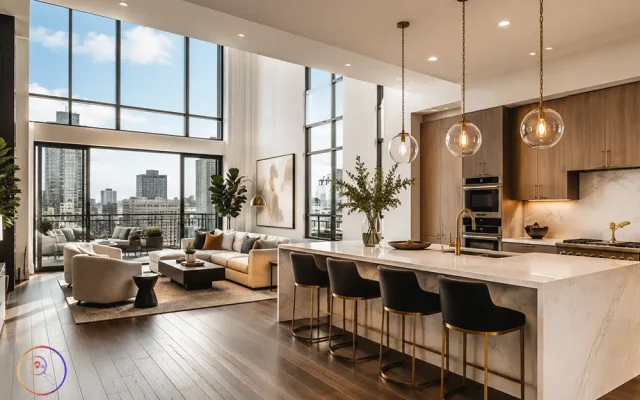
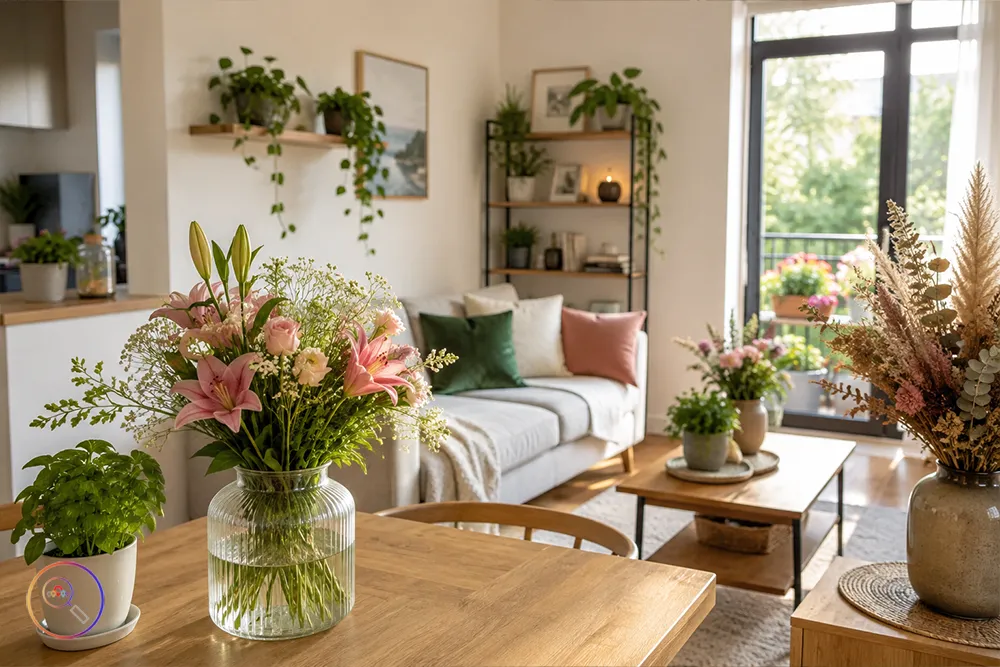

Rental apartments often come with decorating limitations. You may not be able to repaint the walls, replace fixtures, install permanent shelving, or make other major changes without permission. Fortunately, creating a comfortable and personalized apartment does not always require renovations.
Flowers and plants are particularly useful because they add color, texture, height, and personality without permanently changing the apartment. They can soften an otherwise neutral living room, brighten a kitchen counter, or make a small balcony feel like an extension of the home.
More importantly for renters, most floral décor is portable. When your lease ends, the arrangements, planters, vases, and containers can simply move with you.
The key is choosing floral ideas that make sense for apartment living. Space, natural light, maintenance, pets, lease restrictions, and budget should all influence what you bring into your home.
Here are six practical ways to decorate a rental apartment with flowers while keeping costs and permanent changes to a minimum.
Why Flowers Work Especially Well in Rental Apartments
Rental apartments are often designed with broad appeal in mind. Neutral walls, standard flooring, simple cabinetry, and understated fixtures make apartments easier to maintain and lease, but those same characteristics can sometimes make a new apartment feel impersonal.
Flowers provide an easy way to introduce individuality.
A colorful arrangement on the dining table can become a focal point in an otherwise neutral room. A tall plant can fill an awkward corner. Small flowering plants can make a windowsill feel intentional rather than empty.
Unlike many decorative upgrades, floral arrangements generally do not require alterations to the property.
They can also change with your preferences.
Instead of committing to a permanent color scheme, you could use yellow flowers during spring, greenery during summer, warmer dried arrangements during fall, and simple branches or seasonal stems during winter.
This flexibility is especially useful if you enjoy refreshing your apartment throughout the year.
Start With a Rent-Safe Decorating Approach
Before purchasing plants or flowers, think about three characteristics:
- Portability: Can you easily take the item to your next apartment?
- Reversibility: Can you remove it without damaging walls, flooring, countertops, or other surfaces?
- Ongoing cost: Will maintaining or replacing it fit comfortably within your decorating budget?
These questions are useful beyond floral décor.
For example, a flowering plant sitting in a ceramic pot is highly portable and requires no modification to the apartment. A planter mounted directly into drywall is different because installing it could require anchors, screws, or repairs when you move.
Apartment residents should also review their lease or community policies before mounting planters, placing containers on balcony railings, or making changes to outdoor areas.
Portable arrangements are usually the simplest choice.
Idea 1: Create One Rotating Fresh-Flower Display
Fresh flowers can make an apartment feel brighter almost immediately, but frequently replacing arrangements throughout several rooms can become expensive.
Instead, concentrate your budget in one location.
Good spots include:
- A dining table
- Kitchen island
- Entry console
- Living room side table
- Bedroom dresser
- Bathroom counter
Choose the location where an arrangement will be visible most often.
Then use one vase as your primary container and rotate inexpensive seasonal stems through it. You do not necessarily need a large bouquet. A few carefully arranged stems can have more impact than several small arrangements scattered across the apartment.
If you decide to purchase flowers online, the same principle applies: choose an arrangement appropriate for the scale of your apartment and the surface where it will be displayed rather than simply choosing the largest bouquet.
Make Fresh Flowers Last Longer
Basic maintenance can extend the useful life of an arrangement.
Trim stems before placing them in water, remove leaves that would sit below the waterline, and keep the vase clean. Refreshing the water regularly also helps prevent it from becoming cloudy.
Location matters too.
Putting flowers directly beside a sunny apartment window may seem attractive, but intense heat can shorten the life of some cut flowers. A bright area away from strong direct sunlight may work better.
Air-conditioning vents should also be considered because constant airflow can dry flowers more quickly.
Use the Vase as Part of the Décor
When flowers are temporary, the vase becomes the permanent decorating element.
Instead of buying a different vase for every bouquet, choose one or two versatile containers that complement the rest of the apartment.
Clear glass works with almost anything. Neutral ceramic provides more visual weight, while narrow bud vases work well on smaller surfaces where a large arrangement would overwhelm the room.
This approach helps keep both spending and clutter under control.
Idea 2: Choose Flowering Houseplants for Longer-Term Color
If repeatedly replacing cut flowers does not fit your budget or lifestyle, flowering houseplants can provide a longer-lasting alternative.
Depending on the light conditions in your apartment, possibilities include orchids, African violets, kalanchoe, anthuriums, and other compact flowering plants.
The important part is matching the plant to the apartment rather than purchasing based solely on appearance.
Before bringing a plant home, look at:
| Apartment Condition | What to Consider |
|---|---|
| Bright window | Plants that tolerate stronger indirect light |
| Limited natural light | Lower-light varieties or supplemental plant lighting |
| Small windowsill | Compact plants with controlled growth |
| Frequent travel | Plants that tolerate longer periods between watering |
| Pets | Species considered appropriate around the animals in your home |
| Limited floor space | Small tabletop or windowsill plants |
Plants are sometimes discussed as a way of improving indoor air, although renters should primarily choose them for their decorative qualities rather than expecting a few houseplants to substantially change an apartment’s overall air quality.
Be Careful When Decorating With Pets
Not every attractive houseplant is appropriate for an apartment with pets.
Some common flowering plants can be harmful if eaten by cats or dogs. Before purchasing any plant, check whether the specific species is suitable for the animals living in your apartment.
Placement alone may not always solve the problem. Cats, in particular, can reach shelves and windowsills that initially seem inaccessible.
Pet households may therefore benefit from researching plant safety before deciding which varieties to bring home.
Idea 3: Use Dried and Preserved Flowers in Low-Maintenance Areas
Dried arrangements are useful in spaces where maintaining fresh flowers is inconvenient.
They require no watering, are easy to move, and can remain decorative for a long period when kept in appropriate conditions.
Dried materials might include:
- Lavender
- Wheat
- Bunny tail grass
- Preserved eucalyptus
- Dried hydrangeas
- Palm leaves
- Seed pods
- Decorative branches
They are especially practical for shelves, entryways, home-office areas, guest rooms, and other locations where you want visual texture without another maintenance task.
Mix Shapes Instead of Adding More Stems
A fuller arrangement does not necessarily require dozens of individual pieces.
Try combining three basic shapes:
- Something tall to establish height.
- Something fuller to create visual weight.
- Something lighter or finer to fill gaps.
This creates contrast without overcrowding the container.
For smaller apartments, restrained arrangements can actually be more effective. Oversized décor can quickly make a compact room feel cluttered.
Think About Dust and Humidity
Dried arrangements still require occasional care.
Dust can accumulate on textured stems, while excessive bathroom humidity can affect certain dried materials. Place them somewhere relatively dry and gently clean them periodically.
If an apartment already has many decorative objects, one larger dried arrangement may work better than adding several smaller ones.
Idea 4: Turn a Windowsill Herb Garden Into Living Décor
Flowers do not have to be purely decorative.
A small herb garden can introduce greenery to the apartment while also providing ingredients for cooking.
Depending on growing conditions, herbs such as basil, chives, thyme, rosemary, and mint may work in containers. Some herbs will also flower when allowed to mature.
The most important consideration is sunlight.
Observe your apartment before buying plants. A window receiving several hours of strong light will offer very different growing conditions from a shaded window facing another building.
Make the Containers Feel Intentional
One of the easiest ways to make several inexpensive plants look cohesive is to coordinate their containers.
They do not need to be identical.
You might use pots with the same material but different shapes, or containers in similar tones and different heights. Setting several small pots on a tray can also visually group them while helping protect the windowsill from water and loose soil.
That protection is particularly important in a rental.
Use saucers or trays beneath containers so excess water does not damage wood, painted surfaces, or flooring.
Keep the Garden Proportional to Your Kitchen
It can be tempting to start with several varieties at once.
In a compact apartment kitchen, however, three healthy herb plants often look better than eight crowded containers competing for light.
Start small and add plants only if you have enough space to maintain them properly.
Idea 5: Use Faux Flowers Where Real Plants Are Impractical
Some apartment spaces simply are not suitable for living plants.
Interior bathrooms may have no windows. Hallways can be dark. Shelves close to heating or cooling vents may create difficult conditions. Frequent travelers may also struggle to maintain live plants consistently.
Faux florals can be useful in these locations.
The goal is not necessarily to make an artificial arrangement indistinguishable from a fresh bouquet. Instead, treat it as another decorative material, much like artwork, textiles, or ceramics.
Keep Faux Arrangements Simple
Large artificial bouquets containing too many colors and flower varieties can overwhelm a small apartment.
A simpler combination generally integrates more easily with existing décor.
Consider:
- A few tall stems in a narrow floor vase
- One type of flower repeated several times
- Neutral branches in a ceramic vessel
- A small arrangement for a windowless bathroom
- Green foliage on a bookshelf or entry table
You can also change individual stems seasonally without replacing the entire arrangement.
Pay Attention to Scale
Scale is particularly important in apartments.
A dramatic floor arrangement may look impressive in a spacious living room but interfere with movement in a studio. Likewise, large centerpieces can consume valuable dining or kitchen-counter space.
Before purchasing an arrangement, consider how much functional surface area it will occupy.
Apartment décor should support daily life rather than compete with it.
Idea 6: Build a Small Balcony Container Garden
A private balcony or patio can add valuable living space to an apartment, and container plants can make that area feel more inviting.
However, balcony gardening needs a little more planning than placing flowers indoors.
Start by checking the rules for your apartment community.
Policies may address:
- Hanging containers
- Planters attached to railings
- Water drainage
- Maximum object heights
- Balcony weight or storage restrictions
- Items placed outside railings
- Fire-safety requirements
Even when plants are permitted, keeping everything in freestanding containers is usually the most renter-friendly approach.
Match Flowers to the Balcony’s Conditions
Before buying plants, determine how much sunlight the balcony receives.
A west-facing balcony exposed to strong afternoon sun is very different from a shaded balcony surrounded by neighboring buildings.
Wind matters as well.
Upper-floor balconies can experience stronger winds that dry plants quickly or knock over lightweight pots. Heavier containers or low-growing plants may be more practical in those locations.
Protect the Surface Below the Pot
Water management is particularly important on balconies.
Use saucers where appropriate and avoid allowing water or soil to drain onto neighboring balconies. Take care not to create slippery surfaces or stains.
A small outdoor rug rated for exterior use can visually define the garden area, but it should not trap moisture against the balcony surface.
How to Choose the Right Floral Idea for Your Apartment
Not every approach is appropriate for every renter.
Your schedule, apartment layout, lighting, and decorating habits should guide the decision.
| Floral Idea | Typical Maintenance | Portability | Space Needed | Good Fit For |
|---|---|---|---|---|
| Fresh stems | Moderate | Excellent | Very little | Renters who enjoy frequent décor changes |
| Flowering houseplants | Moderate | Excellent | Small to medium | Residents who enjoy caring for plants |
| Dried florals | Very low | Excellent | Very little | Low-maintenance decorating |
| Herb garden | Moderate | Excellent | Sunny windowsill | Renters who enjoy cooking |
| Faux florals | Very low | Excellent | Flexible | Dark rooms or frequent travelers |
| Balcony containers | Moderate to high | Good | Outdoor space | Apartments with usable balconies or patios |
You also do not have to choose just one.
A small apartment might have fresh stems on the dining table, a herb pot beside the kitchen window, and a dried arrangement in the bedroom.
The important thing is avoiding visual clutter.
Use Flowers to Define Spaces in Open-Plan Apartments
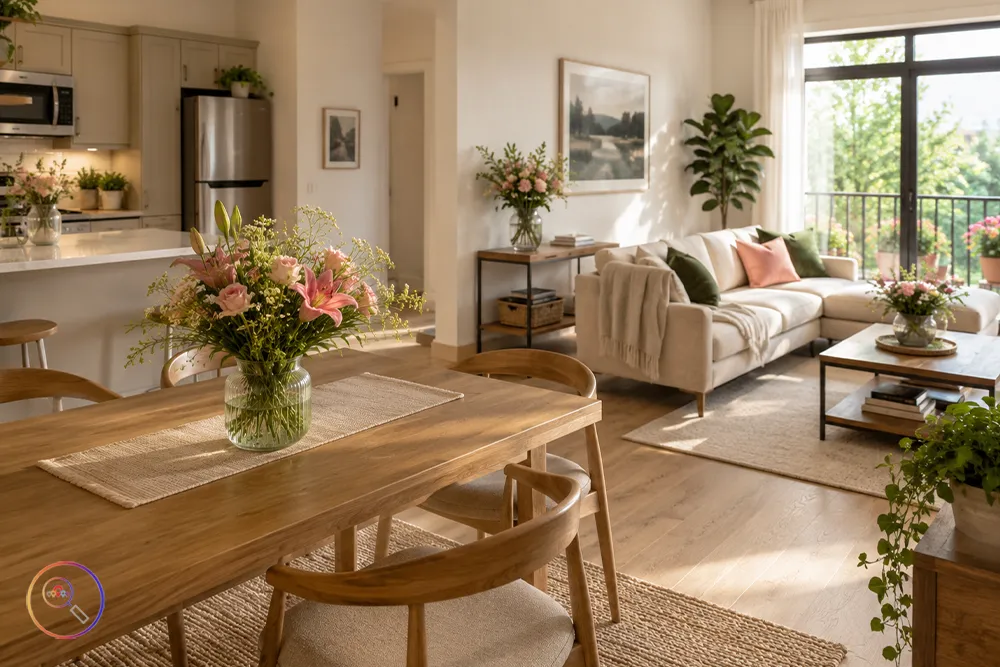
Many apartments combine the kitchen, dining room, and living room into a single open area. Flowers can subtly separate those zones without taking up additional floor space.
For example, a low arrangement on a dining table emphasizes the eating area, while a taller plant beside a chair can visually mark the edge of the living area.
Small floral elements can also draw attention toward particular features.
If your apartment has large windows, placing greenery nearby can emphasize the natural light. If the entryway lacks architectural detail, a vase on a narrow console can create a clear arrival point.
This is particularly helpful in studio apartments where there may be few physical boundaries between different functions.
Coordinate Florals With the Apartment You Already Have
It is easy to treat flowers as isolated decorations, but they look more intentional when they relate to the colors and materials already in the room.
If your apartment has warm wood tones, terracotta, muted greens, cream ceramics, and natural-looking arrangements can complement them.
A more contemporary apartment with black fixtures, cool flooring, or white cabinetry might work well with clear glass, simple green foliage, and restrained arrangements.
You do not need perfect color matching.
Repeating one or two colors or materials is usually enough to make the décor feel connected.
Don’t Sacrifice Valuable Apartment Space for Décor
Square footage matters.
In a large house, an occasional decorative table may not affect functionality. In an apartment, every surface can have a purpose.
That makes it worth asking whether floral décor is improving the room or simply occupying space.
Look for underused locations:
- Window ledges
- Narrow console tables
- Corners beside furniture
- The top of a dresser
- A small section of a kitchen island
- Balcony corners
- Bookshelves with sufficient clearance
Avoid putting arrangements where they interfere with cooking, block television screens, obstruct walkways, or consume the only useful workspace in a room.
Decorating an apartment successfully often means doing more with fewer objects.
A Simple Floral Budget for Apartment Renters
You do not need to furnish the entire apartment with plants at once.
A gradual approach makes it easier to determine which ideas actually work with your lifestyle.
For example:
| Stage | What to Add | Goal |
|---|---|---|
| First | One vase or small plant | Establish a focal point |
| Second | One additional arrangement in another room | Create visual continuity |
| Third | A functional herb or balcony plant | Add useful greenery |
| Later | Replace or rotate individual pieces | Refresh without accumulating clutter |
Starting slowly also reduces the likelihood of purchasing plants that do not suit your apartment’s light conditions.
What to Consider When Choosing a New Apartment
For renters who enjoy plants and natural décor, some apartment features can make floral decorating much easier.
During an apartment tour, consider:
- How much natural light enters the unit
- Which direction major windows face
- Whether windowsills are deep enough for small containers
- Whether there is usable balcony or patio space
- Where floor plants could fit without blocking walkways
- Whether the lease has restrictions concerning balcony plants
- Whether flooring and surfaces are easy to protect from moisture
These details may seem minor during an apartment search, but they can substantially affect how comfortable and personalized the space feels once you move in.
Someone with dozens of houseplants may prioritize natural light much more heavily than someone who prefers dried or faux arrangements.
Your decorating habits are part of your lifestyle, so they are worth considering when evaluating an apartment.
How to Start Without Overdecorating
You do not need to transform the entire apartment over a weekend.
A simpler process usually produces better results:
- Choose one visible location. Start with the dining table, kitchen counter, windowsill, dresser, or entryway.
- Determine the light conditions. This is essential if you plan to use living plants.
- Set a small initial budget. One arrangement is enough to see whether you like the effect.
- Protect rental surfaces. Use trays, saucers, pads, or other appropriate barriers beneath containers.
- Live with the arrangement for a while. See how it affects everyday movement and maintenance.
- Add another element only when there is a reason. Avoid filling empty space simply because it is empty.
This gradual method works particularly well in smaller apartments because it keeps the room from becoming visually crowded.
Make Your Rental Feel More Like Home Without Making Permanent Changes
Rental restrictions do not have to result in an apartment that feels temporary or generic.
Plants and flowers offer renters a flexible way to introduce color, texture, personality, and seasonal change without remodeling the property. Fresh stems can refresh a room for a week or two. Flowering houseplants can become long-term décor. Dried and faux arrangements work in locations where maintaining living plants would be difficult, while herbs and balcony containers can combine decoration with everyday function.
The most effective approach is usually the simplest.
Choose plants and arrangements appropriate for your apartment’s light, layout, available surfaces, lease requirements, and your willingness to maintain them. Protect floors and furniture from moisture, consider pets when selecting plant varieties, and favor pieces you can easily take with you when you move.
A rental does not need major renovations to feel personal.
Sometimes one thoughtfully placed vase, windowsill garden, or flowering plant is enough to make an apartment feel more comfortable, intentional, and unmistakably yours.
Helpful Finds for Fresh and Faux Florals
Flowers are the cheapest way to make an apartment feel finished. Our picks:
- Ceramic Vase Set – the base for every arrangement.
- Realistic Faux Eucalyptus – greenery that never wilts.
- Dried Pampas Grass – one stem fills a corner.
- Floral Shears – for anyone buying fresh bunches.
Rise Apartments is a participant in the Amazon Services LLC Associates Program. As an Amazon Associate we earn from qualifying purchases made through the links above, at no extra cost to you.