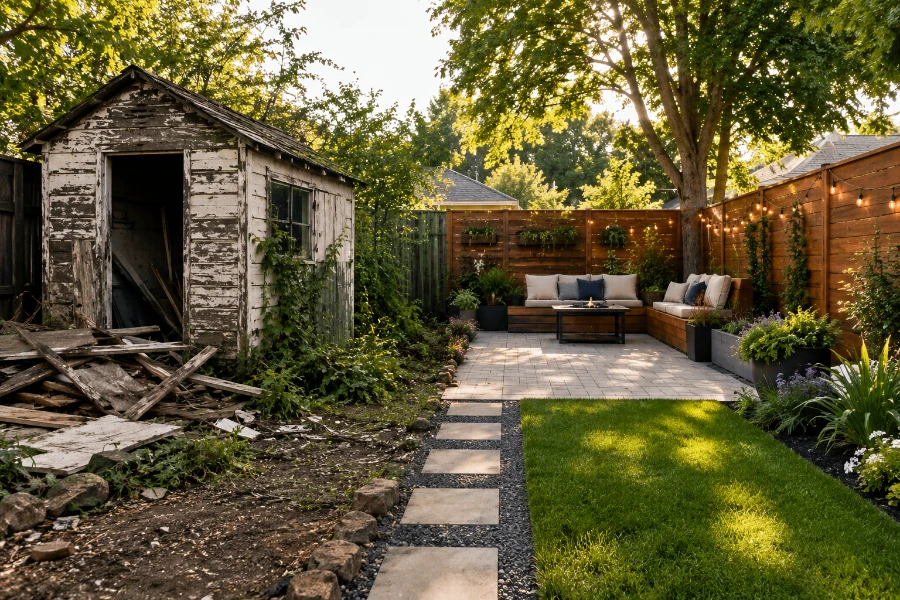

A small backyard does not have to limit your outdoor living possibilities. In fact, some of the most inviting outdoor retreats begin with surprisingly little square footage. The secret often lies in strategic yard demolition—removing outdated structures, unnecessary hardscaping, and other obstacles to make room for a more functional backyard.
Many homeowners focus on what they can add to their outdoor spaces. They picture patios, garden beds, fire pits, and comfortable seating areas. However, the most effective transformation sometimes begins with removing what no longer serves a purpose.
An aging storage shed, cracked concrete walkway, oversized planter, or deteriorating deck can consume valuable space. Clearing these features opens new opportunities for landscaping, outdoor entertaining, and everyday relaxation.
With thoughtful demolition, careful planning, and space-saving design choices, even a modest backyard can become a comfortable and attractive outdoor oasis.
Why Strategic Yard Demolition Makes a Difference
When outdoor space is limited, every square foot matters. A large structure that seems relatively harmless in a spacious property can dominate a compact backyard.
Strategic yard demolition focuses on identifying and removing features that restrict movement, reduce functionality, or create unnecessary maintenance.
Rather than clearing everything indiscriminately, homeowners evaluate which existing elements contribute to the property’s usability and which prevent the space from reaching its potential.
For example, a storage shed that occupies an entire corner might be replaced with a smaller storage solution and a seating area. An unused concrete pad could become a garden or a permeable patio.
The objective is not simply to make the yard empty. It is to create space that can serve a better purpose.
Benefits of Removing Unnecessary Backyard Structures
Removing outdated outdoor features can provide several advantages:
- More usable square footage: Reclaim space previously occupied by unnecessary structures.
- Improved natural lighting: Eliminate bulky obstacles that shade gardens and seating areas.
- Better airflow: Open up narrow sections and reduce the enclosed feeling of a crowded yard.
- Easier maintenance: Reduce the number of deteriorating surfaces and hard-to-reach corners.
- Greater design flexibility: Create opportunities for patios, gardens, and outdoor entertainment.
- Improved safety: Remove unstable structures, damaged materials, and potential hazards.
- A cleaner appearance: Establish visual continuity throughout the backyard.
Although demolition alone does not guarantee an increase in property value, removing visibly neglected structures may improve the property’s overall presentation.
Clearing Obstacles to Reclaim Valuable Backyard Space
One of the most effective ways to improve a small backyard is to remove structures that have outlived their usefulness.
Old sheds, unused workshops, deteriorating playhouses, and damaged decks often take up more room than homeowners realize.
These structures can also conceal problems such as rotting wood, pest activity, moisture damage, and cracked foundations.
For homeowners dealing with an aging outdoor building, professional Lancaster shed demolition can provide a practical starting point for reclaiming space. Proper removal helps address the risks associated with unstable materials while clearing the area for future improvements.
Signs an Outdoor Structure May Need Removal
| Warning sign | Potential concern | Recommended action |
|---|---|---|
| Rotting wood | Reduced structural strength | Evaluate repair versus removal |
| Sagging roof | Potential structural failure | Restrict access and arrange an inspection |
| Extensive water damage | Decay and possible mold growth | Investigate moisture sources |
| Pest infestation | Damage to nearby structures | Address pests before demolition |
| Cracked concrete foundation | Uneven surfaces or drainage issues | Evaluate foundation removal |
| Unused storage building | Valuable space occupied unnecessarily | Consider a smaller storage alternative |
| Leaning walls | Instability and safety concerns | Seek professional assessment |
Not every older structure needs demolition. Some can be repaired, relocated, or repurposed.
However, when repair costs become excessive or the structure prevents a practical backyard layout, removal may be the better long-term investment.
What Should You Remove First?
Before beginning a backyard renovation, identify which features have the greatest impact on the space.
Start by walking around the property and asking three questions:
- Does this feature serve a necessary purpose?
- Could the same function be accomplished with less space?
- Would removing it improve access, safety, or usability?
An unused storage shed might be an obvious candidate. Other features deserve closer consideration.
Old Concrete Patios and Walkways
Large concrete surfaces sometimes occupy areas that would be better suited for plants, seating, or drainage improvements.
Cracked or uneven slabs can also create tripping hazards.
Removing unnecessary concrete may allow homeowners to introduce more flexible landscaping materials, including gravel, pavers, or planting beds.
Deteriorating Decks
An aging wooden deck can overwhelm a small backyard, particularly when it extends across most of the available ground.
Replacing it with a compact ground-level patio may improve accessibility and create a more open appearance.
Unnecessary Fencing and Dividers
Interior fences, decorative partitions, and bulky landscape borders can visually divide a small backyard into cramped sections.
Removing nonessential barriers may improve circulation and make the outdoor area feel more unified.
Boundary fences, retaining structures, and shared property features require additional consideration before alteration.
Overgrown Landscaping
Not every backyard improvement requires structural demolition.
Removing invasive vegetation, oversized shrubs, and neglected garden beds can reveal usable space without major construction.
Before removing mature trees, check local requirements and evaluate their shade, ecological, and drainage benefits.
Planning Your Backyard Transformation Before Demolition
Successful yard demolition begins with a clear vision of how the finished backyard should function.
Without a plan, homeowners risk removing useful features or spending money on improvements that do not work together.
Measure the Available Space
Start with a simple property sketch.
Record the approximate dimensions of the backyard, existing structures, gates, walkways, utility equipment, and drainage areas.
Identify features that must remain, including access routes and legally required setbacks.
Measurements help determine whether proposed improvements will fit without overcrowding the property.
Prioritize Your Outdoor Activities
Think about how the backyard will actually be used.
For some homeowners, outdoor dining is the primary goal. Others prefer gardening, entertaining, relaxing, or providing open play space.
A backyard does not need every possible feature to feel complete.
Choose two or three important activities and design around them.
Establish a Realistic Budget
Budgeting should cover both demolition and the improvements that follow.
Potential expenses include:
- Demolition labor and equipment
- Permits and inspections
- Utility disconnection when required
- Debris hauling and disposal
- Concrete or foundation removal
- Soil preparation and grading
- Drainage improvements
- New patios or pathways
- Landscaping and furniture
Leave a contingency allowance for unexpected conditions, such as buried debris or hidden foundation materials.
Check Permits and Property Restrictions
Demolition requirements vary by location and project.
Some structures may require permits, utility clearances, or additional review before removal.
Homeowners should also verify property boundaries, easements, HOA restrictions, and applicable environmental requirements.
Before digging, contact the appropriate utility-location service. In the United States, 811 is the standard contact point for requesting underground utility markings.
Designing a Functional Backyard After Demolition
Once unnecessary structures have been removed, the newly opened area becomes a blank canvas.
The next challenge is using that space wisely.
A thoughtful design should balance attractive features with comfortable movement, practical maintenance, and enough open space to prevent overcrowding.
For additional inspiration, explore space-saving layouts that combine outdoor comfort with efficient use of available square footage.
1. Create a Compact Multi-Purpose Patio
A patio does not need to cover most of the yard to be useful.
A modest paved area can accommodate a small dining table, lounge chairs, or a portable outdoor workspace.
Consider using concrete pavers, natural stone, or permeable paving materials where appropriate.
Light-colored finishes can help reflect daylight, while consistent flooring materials establish visual continuity.
Keep furniture dimensions proportional to the patio and preserve comfortable walking paths.
2. Use Vertical Gardens to Save Ground Space
Vertical landscaping is especially valuable in narrow backyards.
Instead of spreading planting beds across the lawn, use walls, fences, trellises, and raised supports to introduce greenery.
Suitable options may include:
- Wall-mounted herb planters
- Climbing flowering plants
- Hanging baskets
- Narrow trellises
- Tiered container gardens
- Compact living-wall systems
Herbs such as basil and mint can work well in containers, although mint should generally be contained to prevent aggressive spreading.
Choose plants based on sunlight, local climate, watering needs, and available support.
3. Install Built-In Seating With Storage
Traditional outdoor furniture can consume valuable floor space.
Built-in benches positioned along fences or patio edges help keep central areas open.
Some bench designs can also incorporate weather-resistant storage for cushions, gardening equipment, and outdoor accessories.
Consider materials that withstand local weather conditions and provide adequate ventilation for stored items.
4. Use Corners for Practical Features
Small backyard corners are often overlooked.
Depending on their dimensions, they can accommodate compact planting beds, narrow storage cabinets, small water features, or seating.
A corner fire feature may be suitable where adequate clearances, ventilation, local regulations, and manufacturer instructions permit it.
Avoid squeezing heat-producing equipment into enclosed areas or placing it near combustible fencing and vegetation.
5. Introduce Subtle Design Zones
A small backyard can support multiple activities without constructing walls or large dividers.
Use changes in paving materials, planting arrangements, outdoor rugs, or lighting to distinguish different areas.
For example, a compact patio can serve as a dining zone while an adjacent planted section provides a quieter place to relax.
Keep the transitions simple so the yard remains visually connected.
Smart Space-Saving Features for Small Backyards
The best backyard features often perform more than one function.
| Backyard feature | Primary benefit | Space-saving advantage |
|---|---|---|
| Foldable patio furniture | Flexible dining and seating | Can be stored when unused |
| Built-in benches | Permanent seating | May include hidden storage |
| Vertical planters | Landscaping and greenery | Preserve ground space |
| Narrow raised beds | Organized gardening | Fit along boundaries |
| Wall-mounted lighting | Evening illumination | Avoids floor-standing fixtures |
| Compact storage cabinets | Equipment organization | Replace oversized sheds |
| Permeable pathways | Improve access and manage runoff | Integrate with landscaping |
| Retractable shade | Sun protection | Reduces permanent obstruction |
Choose only features that support your daily activities.
A few well-selected elements generally provide better functionality than numerous decorative additions.
Preparing the Ground After Yard Demolition
Demolition is only the first phase of a successful backyard renovation.
The newly cleared area must be evaluated before installing landscaping or outdoor structures.
Skipping preparation can lead to drainage problems, unstable paving, and unnecessary maintenance.
Remove Debris and Remaining Materials
After demolition, inspect the site for leftover nails, screws, glass, metal, wood fragments, and buried construction materials.
Concrete footings and old foundation components may also need removal, depending on the planned use.
Separate recyclable materials where possible and follow local disposal requirements.
Painted wood, treated lumber, roofing materials, and suspected hazardous materials may require special handling.
Older structures should be assessed for potential asbestos-containing materials or lead-based coatings before disturbing them.
Evaluate Soil and Drainage
Small backyards can be particularly vulnerable to water accumulation because buildings, fencing, and paved surfaces influence runoff.
Inspect the property after rainfall when possible.
Look for standing water, soil erosion, low spots, and runoff directed toward building foundations.
Grading should guide water away from structures without creating drainage problems for neighboring properties.
Where drainage conditions are complicated, consult a qualified landscape contractor or drainage professional before proceeding.
Prepare Stable Surfaces
Patios, pathways, and other hardscape features require suitable bases.
Simply placing pavers or concrete over loose demolition debris can lead to settling and uneven surfaces.
Remove unsuitable material, compact the appropriate base layers, and follow the installation requirements for the selected surface.
Improve the Soil for New Planting
Areas previously occupied by concrete or storage buildings may contain compacted soil.
Before planting, evaluate soil quality, drainage, and growing conditions.
Organic amendments, fresh topsoil, or raised beds may be appropriate depending on the site.
Landscaping Ideas That Make a Small Backyard Feel Larger
Landscaping plays an important role in how spacious an outdoor area feels.
Carefully placed greenery creates texture and privacy while maintaining openness.
Select Compact Plants
Choose plant varieties based on their mature dimensions rather than their appearance at the nursery.
Potential options, depending on climate and growing conditions, include:
- Dwarf ornamental grasses
- Compact hydrangeas
- Small boxwood varieties
- Container-grown herbs
- Dwarf Japanese maple cultivars
- Climbing plants on suitable supports
Avoid placing fast-growing trees or large shrubs too close to fences, foundations, or walkways.
Keep Sightlines Open
A backyard can feel larger when the eye can travel across it without encountering too many obstacles.
Consider placing taller landscaping around selected boundaries while maintaining lower plantings near the central area.
This approach creates visual depth without sacrificing privacy.
Use a Consistent Material Palette
Combining too many colors, textures, and finishes can make a small space feel fragmented.
Instead, select a limited palette of complementary materials.
For example, natural wood, pale stone, and soft green planting can create a cohesive appearance.
Repeating those materials throughout the yard helps connect separate functional zones.
Balance Hardscaping and Greenery
A fully paved backyard may be easier to maintain in some circumstances, but it can also feel harsh and contribute to heat buildup.
Combining practical hardscape surfaces with appropriate planting often creates a more comfortable outdoor environment.
Where suitable, use permeable materials and vegetation to help manage runoff.
Outdoor Lighting That Enhances Small Spaces
Lighting can transform a compact backyard after sunset.
Rather than relying on a single bright fixture, combine several lower-intensity light sources to create depth and highlight important areas.
Consider placing lights:
- Along essential walking paths
- Beneath built-in benches
- Around patio boundaries
- Near selected plants
- On fences or pergolas
- Beside outdoor steps
Warm lighting often produces a welcoming atmosphere for relaxation and conversation.
Use fixtures rated for outdoor installation, protect electrical connections from moisture, and avoid excessive brightness that may disturb neighbors.
Solar fixtures can be convenient in suitable sunny locations, while professionally installed low-voltage systems may provide more consistent illumination.
Common Mistakes to Avoid During Backyard Renovations
Even a well-intentioned renovation can make a small backyard less functional if important details are overlooked.
Demolishing Without a Complete Plan
Removing structures without considering what will replace them can result in wasted space or additional construction costs.
Establish the intended layout before demolition begins.
Ignoring Drainage
Poor grading and excessive paving can allow water to collect near the house or along property boundaries.
Address drainage conditions before installing permanent features.
Choosing Oversized Furniture
Large sectionals, bulky dining sets, and oversized decorative pieces can quickly consume limited space.
Select furniture according to measured dimensions, including the clearance needed to walk around it.
Adding Too Many Features
A crowded backyard can feel smaller than it did before demolition.
Prioritize functional improvements and leave a portion of the yard open.
Overlooking Storage
Removing an old shed may create space, but homeowners still need somewhere to keep tools and outdoor equipment.
Plan compact storage into the new design rather than allowing clutter to accumulate.
Underestimating Demolition Hazards
Old structures can contain unstable framing, electrical connections, sharp debris, and potentially hazardous building materials.
Hire qualified professionals when the work involves significant structural risks, hazardous substances, or utilities.
Should You Hire Professionals for Yard Demolition?
Some homeowners can safely handle limited tasks such as removing portable planters, small garden borders, or nonstructural landscaping elements.
However, larger projects often require professional expertise.
Demolition contractors may be better equipped to handle deteriorating sheds, concrete slabs, substantial decks, and structures located close to neighboring properties.
Before hiring, request a written scope of work that addresses demolition, debris removal, site cleanup, and any necessary foundation work.
Confirm applicable licensing, insurance, permits, and utility-safety procedures.
It is also worth asking whether the contractor will protect nearby landscaping, fences, patios, and drainage infrastructure.
A well-defined agreement can reduce misunderstandings and help ensure the cleared site is ready for the next phase.
Creating a Relaxing Backyard Oasis
The most successful outdoor renovations combine practical design with personal comfort.
After demolition and landscaping, focus on smaller details that make the space enjoyable throughout the week.
Comfortable cushions, weather-resistant furniture, gentle lighting, and natural textures can create a welcoming atmosphere without requiring additional square footage.
A small dining table can support family meals and weekend gatherings. A shaded chair near a vertical garden might become a favorite reading spot.
Even a narrow backyard can accommodate a pleasant morning coffee area when furniture and landscaping are arranged carefully.
The goal is not to recreate a sprawling outdoor resort.
Instead, it is to develop a functional retreat that matches the size of the property and the homeowner’s lifestyle.
Conclusion
Transforming a compact backyard often begins by rethinking what already occupies the space.
Strategic yard demolition provides an opportunity to remove outdated structures, reclaim valuable square footage, and establish a better foundation for outdoor living.
Whether the project involves an aging shed, damaged patio, unnecessary walkway, or deteriorating deck, thoughtful removal can dramatically improve the yard’s usability and appearance.
However, successful results require more than demolition alone. Proper planning, safe removal practices, drainage improvements, appropriate landscaping, and space-saving features all contribute to a lasting transformation.
By emphasizing functionality and resisting the temptation to overcrowd the area, homeowners can turn even a modest backyard into an attractive, comfortable, and practical outdoor oasis.
Sometimes, the smartest way to create more is simply to remove what no longer belongs.
Frequently Asked Questions
1. What is strategic yard demolition?
Strategic yard demolition is the planned removal of outdated structures, hardscaping, or landscaping features to create a safer, more functional outdoor space.
2. Why is demolition useful for small backyards?
Removing oversized or unnecessary structures can reclaim valuable square footage, improve movement, increase natural light, and create opportunities for more efficient landscaping.
3. How long does shed demolition typically take?
Some small, straightforward shed demolitions can be completed in a day, but larger structures, difficult access, hazardous materials, or extensive foundation removal may require additional time.
4. Can homeowners demolish an old shed themselves?
Simple, small-scale removal may be possible when legally permitted and safe, but unstable structures, utility connections, and hazardous materials generally warrant professional assessment and removal.
5. What should happen immediately after yard demolition?
Remove debris, inspect for buried materials, assess soil conditions, check drainage, and prepare the ground before installing patios, pathways, or new landscaping.
6. Does removing an old shed improve property value?
Removing a deteriorating or unattractive shed may improve a property’s appearance and usability, although the effect on market value depends on the property and local buyer preferences.
7. What landscaping works best in a small backyard?
Compact shrubs, vertical gardens, narrow planting beds, container plants, and carefully selected small trees can provide greenery while preserving functional space.
8. How can lighting make a small backyard look bigger?
Layered lighting highlights pathways, planting areas, and seating zones, creating visual depth and making the space feel more welcoming after dark.
9. Is built-in seating a good choice for compact outdoor areas?
Yes. Built-in benches can reduce furniture clutter, utilize perimeter space efficiently, and provide additional storage when properly designed.
10. What is the most important consideration when redesigning a small backyard?
Functionality should come first. A well-planned layout that supports everyday activities, preserves comfortable movement, and avoids unnecessary clutter will generally make better use of limited outdoor space.