
Most homeowners still treat an accessory dwelling unit like a home improvement project. A nicer guest room. A place for aging parents. Something on the long list of “maybe one day.”
The ones building real wealth treat it like a business acquisition.
There’s a real difference. Home improvement adds comfort. A small business on your own land generates income, creates tax advantages, and compounds into equity. Same physical structure. Totally different financial outcome. The framing changes everything.
The Business Model, Stripped Down
An ADU operates on one of the cleanest unit economics in real estate. You own the land already. You own the entitlement. Construction converts one capital outlay into a 30-year income stream with minimal ongoing overhead. No tenant acquisition beyond the first lease. No commute. And no separate property to manage.
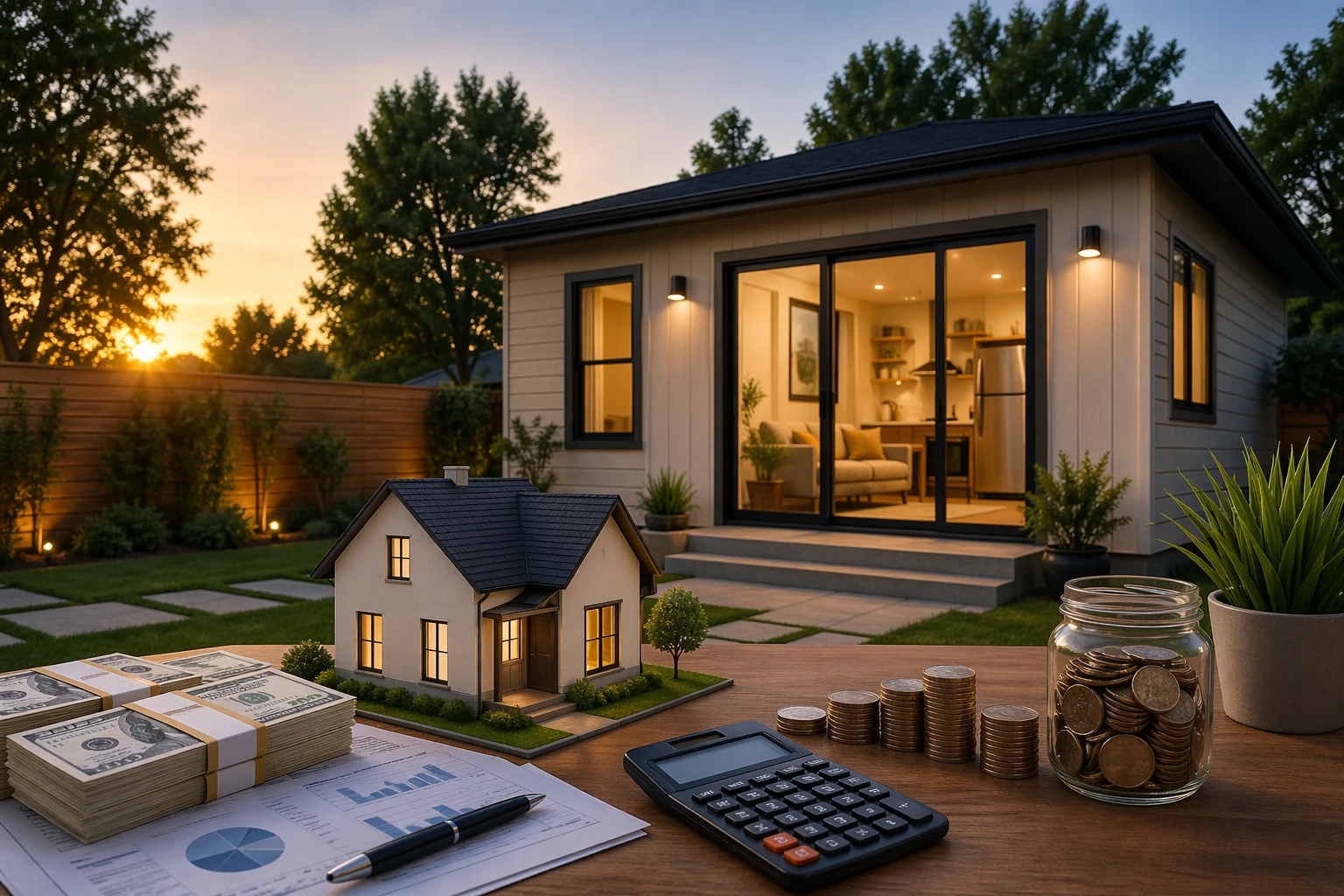
Average numbers in California for a detached backyard build: $280,000 to $400,000 construction cost, $2,400 to $3,400 monthly rent, $180,000 to $290,000 in added home equity at completion. That’s a gross yield between 7.5% and 11% before any tax benefits kick in.
Compare that to a rental duplex in a secondary market. Cap rates on those deals are running 4.5% to 6% and require a separate down payment, a separate mortgage, and a separate property management headache.
Tax Benefits Most Owners Don’t Use
This is where the business framing actually pays. The IRS treats a rented ADU the same as any rental property — which means depreciation, expense deductions, and 1031 exchange eligibility all become available.
Depreciation. The building portion of your ADU (not the land) depreciates over 27.5 years on a straight-line basis. On a $320,000 build, that’s roughly $11,600 a year in paper losses you can write against rental income. For most owners, that wipes out the tax liability on the rental income entirely for the first several years.
Expense deductions. Repairs, utilities (the portion you pay), insurance on the rental unit, property management if you hire it out, even the cost of driving to Home Depot to buy a new disposal — all deductible against rental income. Keep receipts. Most CPAs see homeowners leaving $3,000 to $8,000 of annual deductions unclaimed because they never set up proper bookkeeping.
Cost segregation. On larger ADU builds ($400k+), a cost segregation study can front-load depreciation by breaking out components (appliances, flooring, landscaping) onto shorter depreciation schedules. Moves tens of thousands of dollars of deductions into the first five years.
Passive loss rules. Real estate professional status, if you qualify, lets you apply ADU depreciation losses against W-2 income. For owners near or in retirement who want to reduce taxable income while building passive cash flow, this is the single most powerful lever available.
Airbnb Vs. Long-Term: The Actual Spreadsheet
The surface math favors Airbnb. A studio renting long-term at $2,600/month generates $31,200 a year. The same unit on Airbnb in a strong market could gross $55,000 to $70,000.
The spreadsheet after expenses tells a different story. Airbnb operating costs — cleaning, platform fees, utilities, furnishings, breakage, higher insurance — typically eat 35% to 45% of gross. Occupancy rarely hits the 90%+ required to make the top-line numbers real. Factor in the labor of managing it yourself (or 25–30% to a property manager), and net income often lands within 10–15% of the long-term number — with dramatically more volatility and regulatory risk as cities tighten short-term rental ordinances.
Long-term leasing on an ADU isn’t exciting. It is predictable. Predictable is what makes the depreciation math and the refinance math work.
The Wealth Story Most Owners Miss
Monthly rent is the obvious output. The bigger story is the equity creation and the refinance potential.
A $300,000 ADU that adds $280,000 to home appraisal value, producing $3,000 a month in rent, does three things simultaneously: it pays the debt service on the construction loan, it builds equity through mortgage paydown plus appreciation, and it lets you refinance against the new value to pull capital for the next property.
That’s the model the sophisticated owners use. Build one. Let it season 18 months. Refinance against the new appraisal. Use the cash-out to build or acquire the next. Five years in, you own three income-producing units on what started as one property — with most of the original capital redeployed into the next deal.
This only works if the first build is priced right, designed for rental rather than personal use, and located in a market where demand supports the rent assumptions. Understanding the backyard ADU rental potential for your specific lot and neighborhood is the number that determines whether the whole model works or stalls out.
Where Owners Get It Wrong
Three patterns consistently kill the business case.
Overbuilding for personal taste. A $60,000 kitchen in a rental unit you’re never going to live in. Custom finishes a renter will damage and won’t pay extra for. Every dollar over the rental market comparable is a dollar that won’t come back on appraisal or through rent.
Underestimating vacancy and maintenance. Real operating cost for a well-built ADU runs 18% to 25% of gross rent once you account for vacancy, repairs, capital reserves, insurance, and the portion of utilities you cover. Owners who budget zero operating expense are setting themselves up for a cash flow surprise in year three.
Treating the ADU as separate from the business. Owners who don’t set up a separate bank account, don’t keep proper books, and commingle ADU income with personal finances lose half the tax advantages the IRS makes available. The small amount of effort required to run it as a business — an hour of bookkeeping a month — produces thousands of dollars of tax savings annually.
The Frame That Changes Outcomes
An ADU isn’t a home improvement. It’s a standalone rental business that happens to sit on your existing land. When owners make that mental shift, the decisions change: pricing becomes more disciplined, design becomes more rational, finishes become appropriate to the market, and the financial benefits — tax, income, equity — actually compound the way the math says they should.
Build it as a business. Operate it as a business. The wealth follows.
Frequently Asked Questions (FAQs)
An accessory dwelling unit (ADU) is a secondary housing unit on your property, and when rented out, it functions like a small rental business generating income and tax benefits.
Construction costs usually range from $280,000 to $400,000 depending on size, location, and finishes.
Most ADUs can earn between $2,400 and $3,400 per month in long-term rental income.
Owners can take advantage of depreciation, expense deductions, and potentially 1031 exchanges to reduce taxable income.
The structure depreciates over 27.5 years, allowing owners to deduct a portion of its value annually against rental income.
While Airbnb may generate higher gross income, higher expenses and volatility often make net income similar to long-term rentals.
Typical expenses range from 18% to 25% of gross rent, including maintenance, vacancy, insurance, and utilities.
Yes, a well-built ADU can significantly boost home value, often adding close to its construction cost in equity.
Overbuilding with luxury finishes, underestimating expenses, and failing to treat the ADU as a business are the most common pitfalls.
By renting it consistently, leveraging tax benefits, and refinancing after appreciation, you can reinvest and scale into multiple income-producing units.