Apartment living has changed. Renters are no longer evaluating a community only by square footage, rent, and whether there is a pool downstairs. They are paying attention to how quickly the property responds when something needs to be installed, replaced, upgraded, or adjusted.
A resident might move in on Tuesday and want a smart lock installed before the weekend. Someone working from home may need permission to upgrade a thermostat or add compatible smart-home equipment. Another renter discovers that the dishwasher needs replacing shortly after move-in and wants to know when the work will actually happen.
These situations may sound like ordinary maintenance requests, but they reveal quite a bit about how an apartment community operates.
For renters comparing apartments, responsiveness can be almost as important as the amenity itself. A beautiful fitness center and updated kitchen make a strong first impression, but efficient communication and reliable maintenance often determine how enjoyable the next 12 months will actually be.
For apartment communities, that means rapid tenant upgrades are becoming part of the overall resident experience.
Why Upgrade Speed Matters More to Renters
There was a time when renters expected apartment maintenance to move slowly. You submitted a request, waited for a call, and eventually someone arrived.
Expectations are different now.
People schedule grocery deliveries from their phones, track packages in real time, book appointments online, and receive automatic updates when a driver is approaching. Naturally, some of those expectations carry over into apartment living.
Renters increasingly want to know:
- When was the request received?
- Has it been approved?
- Does the property already have the necessary part?
- When will maintenance enter the apartment?
- Do I need to be home?
- Who is performing the work?
- How will I know when it has been completed?
A property does not necessarily need to provide every upgrade overnight. What renters usually want is clarity.
Being told, “Your replacement appliance has been ordered and installation is scheduled for Thursday between 1 p.m. and 3 p.m.” creates a very different experience from hearing, “Maintenance should get to it soon.”
That difference matters when renters are deciding whether they want to renew.
Apartment Amenities Are Only Part of the Picture
Apartment searches naturally focus on visible amenities.
Renters compare pools, fitness centers, coworking spaces, kitchen finishes, balconies, parking, pet amenities, package lockers, and in-unit washers and dryers. Those features deserve attention.
But there is another category of amenities that is harder to photograph: operational convenience.
Two apartment communities may have nearly identical floor plans and features while providing very different living experiences.
Consider this example:
| Apartment Community A | Apartment Community B |
|---|---|
| Online maintenance requests | Maintenance requests primarily handled by phone |
| Appointment windows provided | Residents wait for an unspecified visit |
| Status updates available | Residents must repeatedly follow up |
| Common replacement parts stocked | Parts ordered after each request |
| Clear policies for resident upgrades | Approval depends on whom the resident asks |
| Completed work documented | Little communication after completion |
On a listing page, these communities might look almost identical.
Six months after moving in, they may feel completely different.
That is why renters should look beyond the amenity list when touring apartments. Asking how the property actually manages repairs, installations, and upgrades can reveal a great deal about everyday life there.
What Counts as a Tenant Upgrade?
Not every upgrade involves a full renovation.
In modern apartments, upgrades can range from small quality-of-life changes to significant appliance replacements.
Common examples include:
- Smart locks
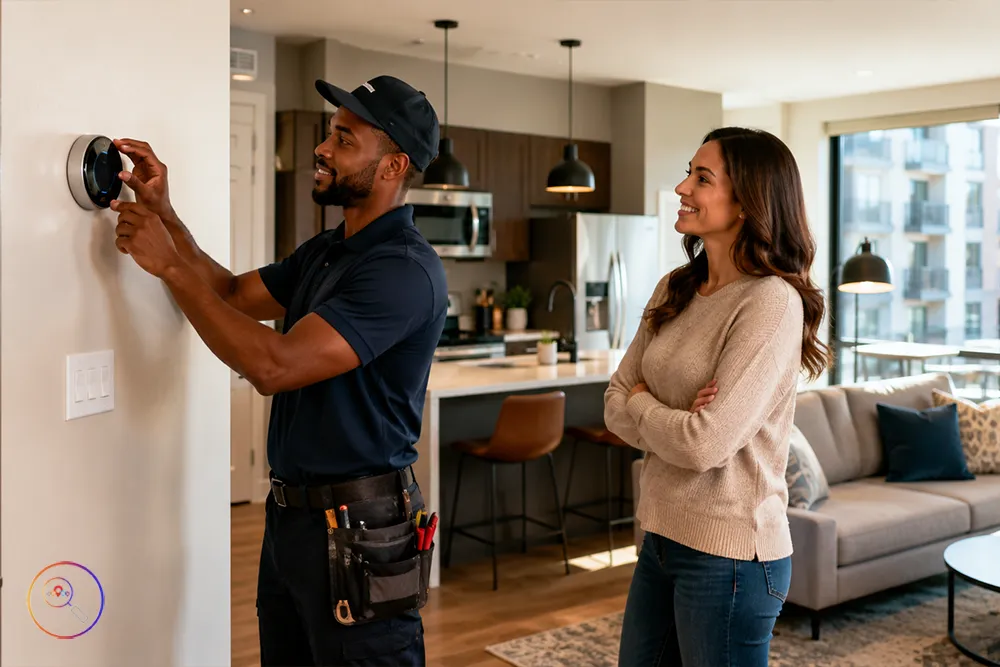
- Smart thermostats
- Ceiling fans
- Updated light fixtures
- New blinds or window treatments
- Dishwasher replacements
- Refrigerator replacements
- Washer and dryer installation
- Water filtration equipment
- Accessibility modifications
- Internet or networking equipment
- Additional shelving or storage systems
- Approved smart-home devices
Some upgrades are initiated by the apartment community. Others begin with the renter asking whether a modification is permitted.
The distinction is important because renters generally should not assume they can permanently alter a rental unit without approval.
Even a seemingly simple installation can affect wiring, plumbing, doors, walls, security systems, warranties, or the condition in which the apartment must eventually be returned.
Always Check the Lease Before Making Your Own Upgrade
It is tempting to treat an apartment like a house once the boxes are unpacked.
You want to make the space comfortable. That is completely reasonable, but renters should remember that permanent modifications are usually governed by the lease.
Before installing anything that changes the apartment, check whether management approval is required.
That can include drilling into walls, replacing fixtures, changing locks, modifying plumbing connections, installing certain electrical devices, or removing property-owned equipment.
A renter considering an upgrade should generally ask four questions:
- Is the modification permitted?
- Does apartment maintenance need to install it?
- Can I hire my own contractor?
- Do I need to restore the original equipment when I move out?
Getting the answer in writing can prevent disagreements later.
The Real Bottleneck Usually Isn’t the Hardware
Many apartment upgrades are surprisingly quick once someone actually starts working.
Installing a compatible smart lock, replacing blinds, mounting approved equipment, or swapping certain fixtures may take relatively little time.
The complicated part is everything around the installation.
Someone has to receive the request.
Someone may have to approve it.
The correct product must be identified.
Parts may need to be ordered.
A technician has to be assigned.
The renter’s permission to enter the apartment needs to be confirmed.
Then the completed work needs to be documented.
In a large community with hundreds of units, these tasks can happen dozens of times each week.
That turns what looks like a simple maintenance issue into a scheduling problem.
Well-organized properties increasingly centralize the process rather than depending on sticky notes, disconnected emails, and group texts. Some operations use installation scheduling software so office staff can assign work, field technicians can see what needs to be completed, and appointment information can be communicated without repeatedly passing messages between several people.
The technology itself is not the important part.
The important part is having a repeatable system.
What Well-Organized Apartment Communities Do Differently
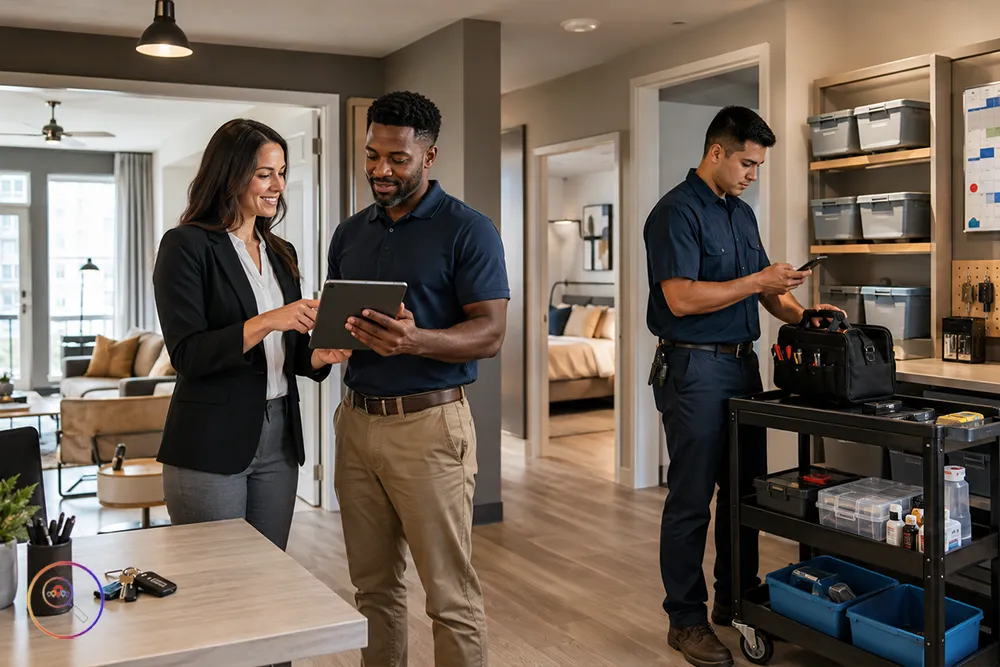
Fast service does not necessarily mean hiring twice as many maintenance technicians.
Often, better organization produces the biggest improvement.
They Standardize Common Requests
If residents frequently request the same types of upgrades, a property can create an established process.
Instead of deciding from scratch whether a certain smart thermostat can be installed every time someone asks, management may already know:
- Which models are compatible
- Whether maintenance must install them
- Who pays for the equipment
- Whether the original thermostat must be stored
- What happens when the resident moves out
The same approach can apply to ceiling fans, water filters, locks, blinds, appliances, or accessibility features.
Consistency saves time for both residents and staff.
They Keep Common Parts Available
Waiting three days for installation may be reasonable.
Waiting three weeks because nobody ordered a commonly used replacement part is much harder to explain.
Properties that know their buildings well can anticipate which components are replaced most frequently and keep reasonable inventory available.
That does not mean storing every possible appliance or fixture.
It means knowing where delays normally occur and planning around them.
They Group Similar Work
Suppose six apartments need new smart thermostats.
Sending a technician to six different buildings on six different days wastes time. Scheduling compatible projects together can make the process considerably more efficient.
Communities may group installations by:
- Building
- Floor
- Equipment type
- Technician skill
- Vendor
- Required parts
The resident still receives individual service, but the property handles the work more efficiently behind the scenes.
They Communicate Before Entering the Apartment
Few maintenance situations frustrate renters faster than uncertainty about access.
Residents want to know whether they must be home, whether maintenance has permission to enter, and approximately when someone will arrive.
Good communication might include:
- Appointment confirmation
- Expected arrival window
- Entry authorization reminder
- Technician or vendor information
- Rescheduling instructions
- Completion notification
This becomes particularly important for renters who work from home, have pets, have young children, or simply prefer to be present when someone enters their apartment.
Fast Doesn’t Mean Rushed
There is an important distinction between working efficiently and rushing.
A property can install something quickly and still do the job properly.
Quality-control steps remain essential, especially when an upgrade involves plumbing, electricity, appliances, doors, locks, or other building systems.
For example, replacing a dishwasher involves more than sliding the old machine out and pushing another one in.
Connections need to be checked.
The appliance should be tested.
Leaks should be ruled out.
The surrounding area should be inspected before the technician leaves.
Cutting those steps to save 20 minutes can create a much more expensive problem later.
The best apartment maintenance operations reduce waiting time, not inspection time.
Documentation Protects Both the Property and the Renter
Another sign of a well-run upgrade process is documentation.
After work is completed, the property may record:
- Date of installation
- Equipment installed
- Model or serial number
- Technician or vendor
- Photos of completed work
- Resident confirmation
- Notes about removed equipment
- Warranty details
That information can become useful months later.
Imagine that a resident moves out and management notices a smart lock instead of the original lock. If the upgrade was properly approved and recorded, there is little confusion about how it got there.
Without documentation, everyone may be searching through old emails trying to reconstruct what happened.
Questions Renters Should Ask While Touring an Apartment
A tour is usually focused on the exciting parts.
You are looking at the kitchen.
Testing the closet space.
Checking the view.
Figuring out whether your sofa will fit.
Those things matter, but it is also worth asking a few practical questions about maintenance and upgrades.
Consider asking:
- How are maintenance requests submitted?
- Is there an online resident portal?
- Can residents track maintenance requests?
- What is the process for emergency maintenance?
- Does the property allow smart-home upgrades?
- Can residents install their own smart locks?
- Who handles appliance installation?
- Are residents notified before maintenance enters?
- Are there fees for certain resident-requested upgrades?
- What modifications have to be reversed at move-out?
You do not need to interrogate the leasing agent.
A few straightforward questions can tell you whether the property has established systems or handles every unusual request as a completely new problem.
Ask About the Upgrades That Matter to You Before Signing
Different renters care about different things.
Someone who travels frequently might consider smart-lock compatibility extremely important.
A remote worker may care more about internet providers, thermostat control, additional lighting, or workspace modifications.
A renter with mobility limitations may need to discuss accessibility changes.
A pet owner may want to know whether a smart doorbell or indoor monitoring equipment is permitted.
If a feature matters enough that it could affect your decision, ask about it before signing the lease.
Do not assume you will be allowed to add it later.
This is especially helpful when comparing several apartment communities with similar rent and amenities. One property may already include the feature you want, while another allows residents to request it and a third prohibits the modification altogether.
Existing Smart Features Can Reduce the Need for Upgrades
One way renters can avoid the upgrade process entirely is to look for apartments that already include the technology or convenience features they want.
Depending on the community, modern units may offer:
- Smart locks or keyless entry
- Smart thermostats
- USB or USB-C outlets
- Built-in high-speed internet infrastructure
- In-unit washers and dryers
- Energy-efficient appliances
- Package-management systems
- Smart access to common areas
- Updated lighting
- EV charging
- App-based resident services
When searching for an apartment, build a short list of features you consider essential versus features that would simply be nice to have.
For example:
| Priority | Example |
|---|---|
| Must have | In-unit washer/dryer |
| Must have | Reliable high-speed internet options |
| Important | Smart thermostat |
| Important | Package lockers |
| Nice to have | Smart lock |
| Nice to have | USB-C outlets |
This makes it easier to compare communities realistically instead of choosing based on whichever model unit looks most impressive during the tour.
Newer Doesn’t Always Mean Better Managed
It is easy to assume that a brand-new luxury apartment will automatically provide better service than an older community.
That is not always the case.
A newer property may have newer appliances and more built-in technology, while an established community may have a maintenance team that has worked together for years and knows every building extremely well.
Both can deliver a great resident experience.
Instead of judging operational quality entirely by the age of the property, renters can pay attention to how the leasing team communicates.
Are questions answered clearly?
Are policies easy to explain?
Does the staff know how maintenance requests work?
Can they explain the approval process for modifications without asking three different people?
Those small signals can help reveal what communication may be like after move-in.
Rapid Upgrades Can Also Help Apartment Communities Stay Competitive
There is a business reason properties pay attention to this.
Renters have choices.
When several communities offer similar floor plans at similar price points, everyday convenience can become a differentiator.
An apartment community that responds efficiently to reasonable resident requests may create a stronger impression than one that offers slightly fancier finishes but makes every maintenance interaction difficult.
Rapid upgrades may also help properties modernize gradually.
Instead of renovating hundreds of units at once, some improvements can happen as apartments become vacant or when equipment reaches the end of its useful life.
Over time, communities can steadily introduce newer fixtures, appliances, controls, and technology without treating every improvement as a massive renovation project.
Renters Should Separate Optional Upgrades From Necessary Repairs
One distinction is especially important.
An optional upgrade is not the same as a repair.
Wanting a smart thermostat when the existing thermostat works properly is different from reporting that the air conditioning is not functioning.
Wanting a newer dishwasher is different from reporting a dishwasher that is leaking onto the kitchen floor.
Residents should describe the situation accurately when contacting management.
If something is broken, leaking, unsafe, or causing additional damage, make that clear in the maintenance request instead of simply describing it as an upgrade.
Likewise, properties may prioritize urgent repairs over cosmetic or optional improvements.
That does not necessarily indicate poor service. It may simply reflect sensible maintenance triage.
How Apartment Locators Can Help Renters Compare More Than Rent
Apartment hunting can quickly become overwhelming because communities often advertise similar features.
Luxury finishes.
Resort-style pools.
Fitness centers.
Pet-friendly amenities.
Coworking lounges.
The differences become clearer when renters start comparing the details that affect everyday living: location, budget, fees, pet policies, floor plans, availability, included appliances, parking, move-in specials, and the amenities that genuinely matter to their lifestyle.
That is where working with an apartment locating service such as Rise Apartments can make the search easier.
Instead of evaluating apartments solely by photos, renters can narrow their options based on the features they actually need and then use tours to investigate the less-visible parts of apartment living, including management communication and maintenance procedures.
The goal is not simply to find the apartment with the longest amenity list.
It is to find the apartment that fits the way you expect to live.
A Simple Checklist for Evaluating a Modern Apartment
Before signing a lease, consider looking at the apartment from three different angles.
The Apartment Itself
Check:
- Appliances
- Storage
- Lighting
- Outlets
- Internet options
- Washer/dryer setup
- Thermostat
- Locks
- Windows
- Fixtures
The Community
Evaluate:
- Parking
- Package handling
- Fitness facilities
- Pool
- Pet amenities
- Coworking areas
- Security and access systems
- Common-area maintenance
The Management Experience
Ask about:
- Maintenance request procedures
- Emergency response
- Entry notifications
- Resident portal features
- Upgrade policies
- Communication methods
- Typical scheduling process
The apartment itself is only one part of the rental experience.
The systems behind it matter too.
The Future of Apartment Upgrades Is About Convenience
Apartment technology will continue changing.
Today’s smart thermostat may eventually feel as ordinary as central air conditioning. Keyless access, connected appliances, energy-monitoring systems, EV infrastructure, automated package management, and app-based resident services are becoming more common in multifamily housing.
But technology alone does not create a good apartment experience.
A building can install every smart device available and still frustrate residents if nobody answers maintenance requests.
The communities that handle rapid tenant upgrades successfully tend to get the fundamentals right first: clear policies, organized scheduling, appropriate quality control, good documentation, and consistent resident communication.
For renters, that creates a useful lesson when comparing apartments.
Look at the countertops and the pool. Check the floor plan. Ask about parking, pets, fees, and move-in specials.
Then look a little deeper.
Ask how the property handles the small things after you receive the keys.
Because once move-in day is over, those everyday interactions can have a much bigger effect on apartment life than the features that originally caught your attention.
Helpful Finds for Apartment Repairs and Upkeep
Most small fixes do not need a maintenance ticket. A compact kit handles them:
- Household Tool Kit – hammer, drivers, pliers and tape in one case.
- Drain Snake – the most common apartment plumbing problem.
- Spackle Repair Kit – patch nail holes before move-out inspection.
- Cordless Drill – for curtain rods, shelves and furniture assembly.
Rise Apartments is a participant in the Amazon Services LLC Associates Program. As an Amazon Associate we earn from qualifying purchases made through the links above, at no extra cost to you.