
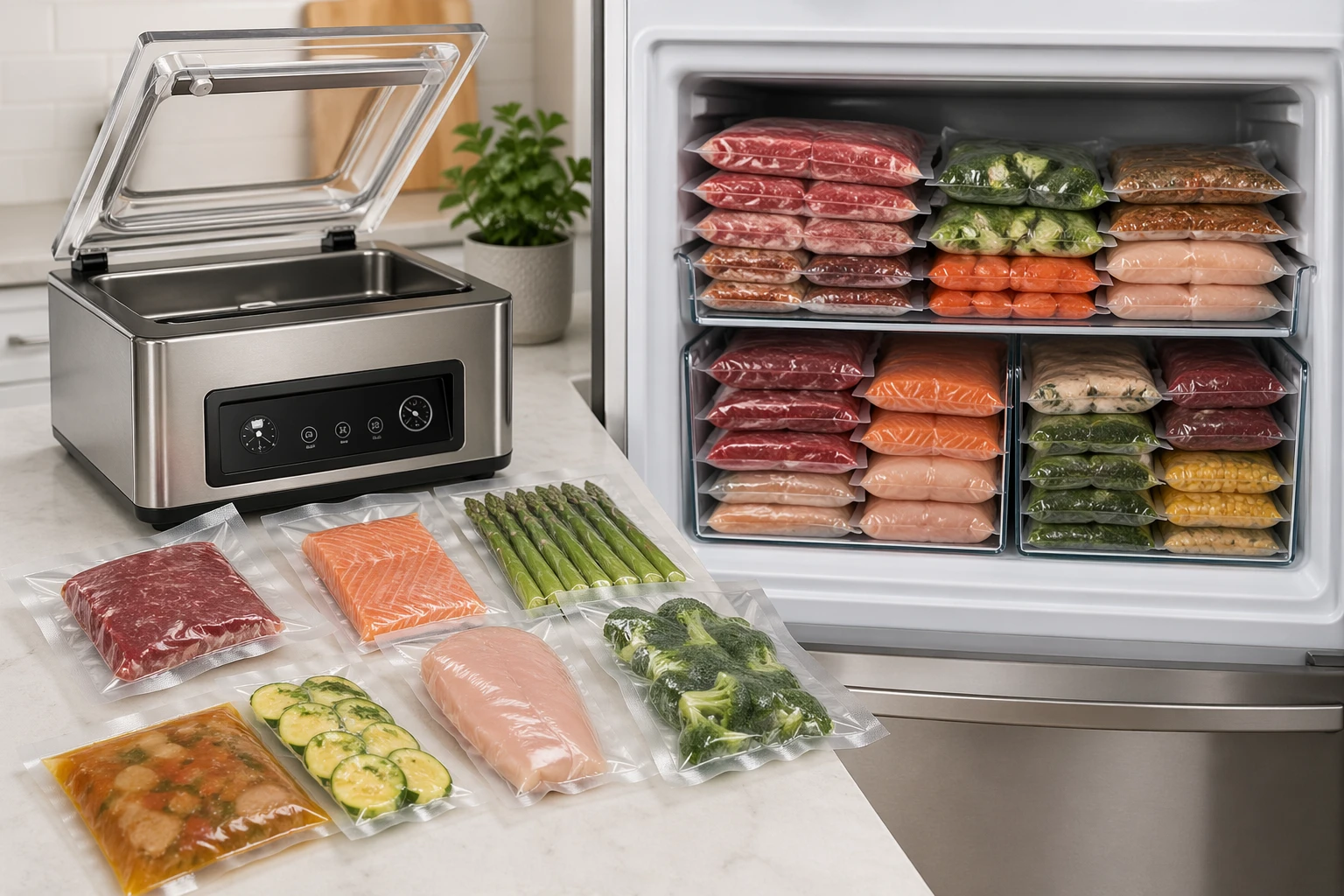

If your freezer looks like a game of Tetris that nobody wins, you’re not alone. Most people stack oddly shaped bags, wrestle with freezer burn, and lose track of what’s buried in the back. The problem isn’t the freezer itself. It’s the packaging. Chamber vacuum sealers offer a fundamentally different approach to food storage, one that change s not just how your food lasts, but how your entire freezer gets organized. Once you understand what these machines actually do, it’s hard to go back.
What Makes Chamber Vacuum Sealers Different From Standard Sealers
Most home sealers work by sucking air out from outside the bag. It’s a simple process, but it has real limitations. Liquids get pulled out along with the air, bags can seal unevenly, and the amount of vacuum pressure applied is inconsistent. The result is packaging that looks sealed but still traps enough air to cause freezer burn over time.
A chamber vacuum sealer works differently. The entire bag sits inside a sealed chamber, and the machine removes air from the whole space at once. Because the pressure inside the bag and outside it drops equally, liquids stay put, the seal forms evenly, and the vacuum level is far more precise. This means you can seal soups, marinades, and wet foods without making a mess or compromising the seal quality.
If you’ve ever searched for a chamber vacuum sealer online, you’ve probably noticed they’re built for consistent, repeatable results. That consistency is exactly what freezer organization depends on. Every bag comes out the same shape, the same density, and with the same level of air removal. That uniformity is what makes them so effective when it comes to maximizing freezer space.
The Science Behind Better Food Preservation and Freezer Space
Freezer burn happens when moisture escapes from food and forms ice crystals on the surface. Air trapped inside a package accelerates that process. A chamber sealer removes a significantly higher percentage of air than standard sealers, which slows oxidation and drastically reduces the chance of freezer burn. The result is food that actually tastes the way it should, even after months in the freezer.
Beyond taste, the reduced air content changes the physical structure of your packages. Bags sealed in a chamber become firm, flat, and compact. They don’t puff up, shift around, or take up more room than necessary. This is where food preservation and freezer efficiency meet in a practical, everyday way.
How Uniform Packaging Stacks and Stores More Efficiently
Flat, firm bags are stackable in a way that loosely sealed bags simply are not. For example, you can line up chamber-sealed portions of chicken breast like files in a drawer, or lay bags of ground beef flat and stack them in neat columns. There’s no guessing, no reshuffling, and no mysterious lumps taking up prime real estate.
This kind of organization also gives you a clearer view of your inventory. You can see at a glance what you have, how much is left, and what needs to be used first. As a result, meal planning becomes less stressful because your freezer actually communicates useful information instead of hiding it. The uniform shape of each package is what makes this possible, and it starts with the sealing process itself.
Organizing Your Freezer System Around Chamber-Sealed Portions
Once you commit to using a chamber vacuum sealer, the smartest move is to build a system around it. That means thinking in portions. Rather than tossing a full package of chicken thighs into the freezer, you divide it into meal-sized units before sealing. Each portion serves a specific purpose, whether it’s a single dinner for two or a batch of protein for meal prep.
Portioning in advance removes the need to thaw more than you need, which is one of the most common sources of food waste in home kitchens. With chamber-sealed portions, you pull out exactly what you plan to use, nothing more. Over time, this habit reshapes how you shop, cook, and think about what’s in your freezer.
Labeling, Portioning, and Categorizing Sealed Bags
A sealed bag without a label is just a mystery. Before anything goes into the freezer, write the contents, the date, and the portion size directly on the bag. A permanent marker works well, or you can use freezer-safe labels if you prefer a cleaner look. Either way, the information on the outside of the bag is just as important as what’s inside.
Beyond labeling, consider a category-based layout for your freezer. Keep proteins in one zone, vegetables in another, and prepared meals in a third. Because chamber-sealed bags are uniform in shape, you can assign physical sections of your freezer to each category without overlap or wasted space. This approach turns a freezer into something that actually functions like a well-organized pantry, where everything has a place, and you always know where to look.
Long-Term Benefits Beyond Organization: Quality and Waste Reduction
The organizational benefits of chamber vacuum sealers are real, but they’re only part of the story. The longer you use one, the more you notice the impact on food quality. Meats sealed in a chamber stay tender and free of ice crystals for months longer than they would in standard packaging. Vegetables, fish, and even pre-cooked meals hold their texture and flavor in a way that makes freezer cooking genuinely worth the effort.
There’s also a direct financial benefit. Food waste is expensive. In fact, studies have shown that the average household discards a notable portion of the food it purchases each year. A chamber sealer addresses that problem at the source by removing the air that causes spoilage and by encouraging a portioned, organized approach to storage from the start.
For people who buy in bulk or batch-cook regularly, this tool pays for itself over time. You spend less money replacing food that went bad, and you get more value from every grocery run. Plus, the discipline of sealing and labeling everything creates a feedback loop. You become more aware of what you have, more intentional about what you buy, and less likely to let food sit forgotten until it’s no longer good.
The combination of better preservation, reduced waste, and smarter storage habits adds up to a freezer that works harder for you, not the other way around.
Why This Matters in Apartment Living
Apartment kitchens often come with one major constraint: space. Freezers are smaller, storage is tighter, and every inch matters. That’s where chamber vacuum sealers become more than just a convenience—they become a strategy. Instead of cramming bulky grocery bags or oversized packaging into a compact freezer, you’re working with flat, stackable portions that fit neatly into limited space.
This is especially useful for apartment residents who rely on weekly grocery runs or bulk buying to save time and money. A well-organized freezer means fewer last-minute takeout decisions, less food waste, and a smoother daily routine—something that matters when your kitchen and living areas are closely connected.
How It Improves Small-Space Living
- Maximizes limited freezer space with flat, uniform packages
- Reduces odor transfer in shared or compact freezer compartments
- Supports meal prepping without overcrowding shelves
- Minimizes waste with better visibility and portion control
Quick Comparison
| Apartment Challenge | Chamber Sealer Solution |
| Limited freezer capacity | Flat, stackable food portions |
| Tight kitchen layouts | Cleaner, more organized storage |
| Busy schedules | Pre-portioned, ready-to-cook meals |
| Food waste concerns | Longer preservation, better tracking |
Helpful Finds for Freezer Organization
Vacuum sealing changes how an apartment freezer works. The essentials:
- Chamber Vacuum Sealer – seals liquids and marinades, not just dry goods.
- Vacuum Sealer Bags – bulk bags cost pennies each.
- Freezer Bin Organizers – keep sealed packs sorted.
- Freezer Labels – know what and when.
Rise Apartments is a participant in the Amazon Services LLC Associates Program. As an Amazon Associate we earn from qualifying purchases made through the links above, at no extra cost to you.
Conclusion
Chamber vacuum sealers don’t just improve how long your food lasts. They change how your freezer functions as a whole. By producing uniform, flat, air-free packages, they give you the foundation for a storage system that’s logical, space-efficient, and easy to maintain. If freezer chaos has been a recurring problem in your kitchen, switching to a chamber sealer is one of the most practical upgrades you can make.
Frequently Asked Questions (FAQs)
A chamber vacuum sealer removes air from the entire chamber, creating a stronger and more consistent seal compared to standard sealers.
It creates flat, uniform packages that are easier to stack, store, and organize in limited freezer space.
Yes, chamber sealers allow you to safely seal liquids like soups and marinades without spills.
It significantly reduces freezer burn by removing air, which slows down moisture loss and oxidation.
Yes, especially in apartments where freezer space is limited and organization is essential.
Divide food into meal-sized portions so you only thaw what you need, reducing waste and saving time.
Absolutely—labeling with contents and dates helps you track inventory and avoid confusion.
Vacuum-sealed food can last significantly longer—often months—compared to standard storage methods.
Yes, it reduces food waste and allows you to buy in bulk without worrying about spoilage.
Not at all—most models are user-friendly and designed for consistent, repeatable results.