
Year One: The Honeymoon Phase
Remember the day you brought that sofa home? The fabric was perfect. No stains, no mysterious smells, no weird indent where someone always sits in the exact same spot. You probably even told guests to be careful with it. Maybe put a throw blanket over the armrest. Just in case.
Fast forward six months. The throw blanket is gone. Someone spilled coffee. The dog has claimed the left cushion as sovereign territory. And that pristine fabric? It now has a subtle patina of daily life embedded in every fiber.
This isn’t a tragedy. It’s furniture doing what furniture does. But here’s where most people make their first mistake – they wait until upholstery looks visibly dirty before doing anything about it. By then, the damage has burrowed deep. Skilled couch cleaners NYC residents trust will tell you the same thing: the best intervention is the one that happens before you think you need it.
What’s Actually Living in Your Sofa
Let’s get uncomfortable for a moment. A study referenced by the American Lung Association points out that upholstered furniture acts as a reservoir for allergens – dust mites, pet dander, pollen, and mold spores accumulate in fabric at rates most people would rather not know about. The Asthma and Allergy Foundation of America estimates dust mites are present in roughly 80% of American homes, and soft furnishings are their preferred habitat.
Charles Eames, the legendary designer, once said: “The details are not the details. They make the design.” He was talking about furniture craft, but the principle extends to maintenance. The invisible details – what’s trapped between the fibers, what’s settled into the foam padding, what’s breeding in the warmth of cushion seams – those details determine whether your sofa ages gracefully or falls apart.
Here’s what accumulates in upholstery over a typical year:
- Dead skin cells (humans shed approximately 1.5 grams daily, and a good portion lands on seating surfaces)
- Dust mite colonies and their waste products – a major trigger for allergic reactions
- Food particles, even in households with strict “no eating on the couch” policies
- Sweat and body oils that gradually break down fabric structure
- Airborne pollutants, cooking residues, and VOCs absorbed from indoor air
Not exactly what the furniture catalog promised.
The Vacuum Isn’t Enough (But It’s a Start)
Most upholstery care guides begin and end with “vacuum regularly.” And yes, running an upholstery attachment across your sofa once a week removes surface debris. That’s valuable. But it’s also like brushing your teeth without ever visiting a dentist – necessary maintenance that doesn’t replace professional intervention.
Standard vacuum cleaners address the top layer. They can’t reach contaminants that have migrated into padding, settled along seam lines, or bonded with fabric fibers through moisture and heat. For that, you need extraction methods – hot water, steam, or specialized solvents applied under controlled pressure.
The Professional Difference
Professional upholstery care typically follows a sequence most homeowners can’t replicate:
- Fabric identification and testing – different textiles react differently to moisture, heat, and cleaning agents. A technique safe for synthetic microfiber could destroy silk or velvet
- Pre-treatment of stains and high-traffic zones with enzyme-based or pH-specific solutions
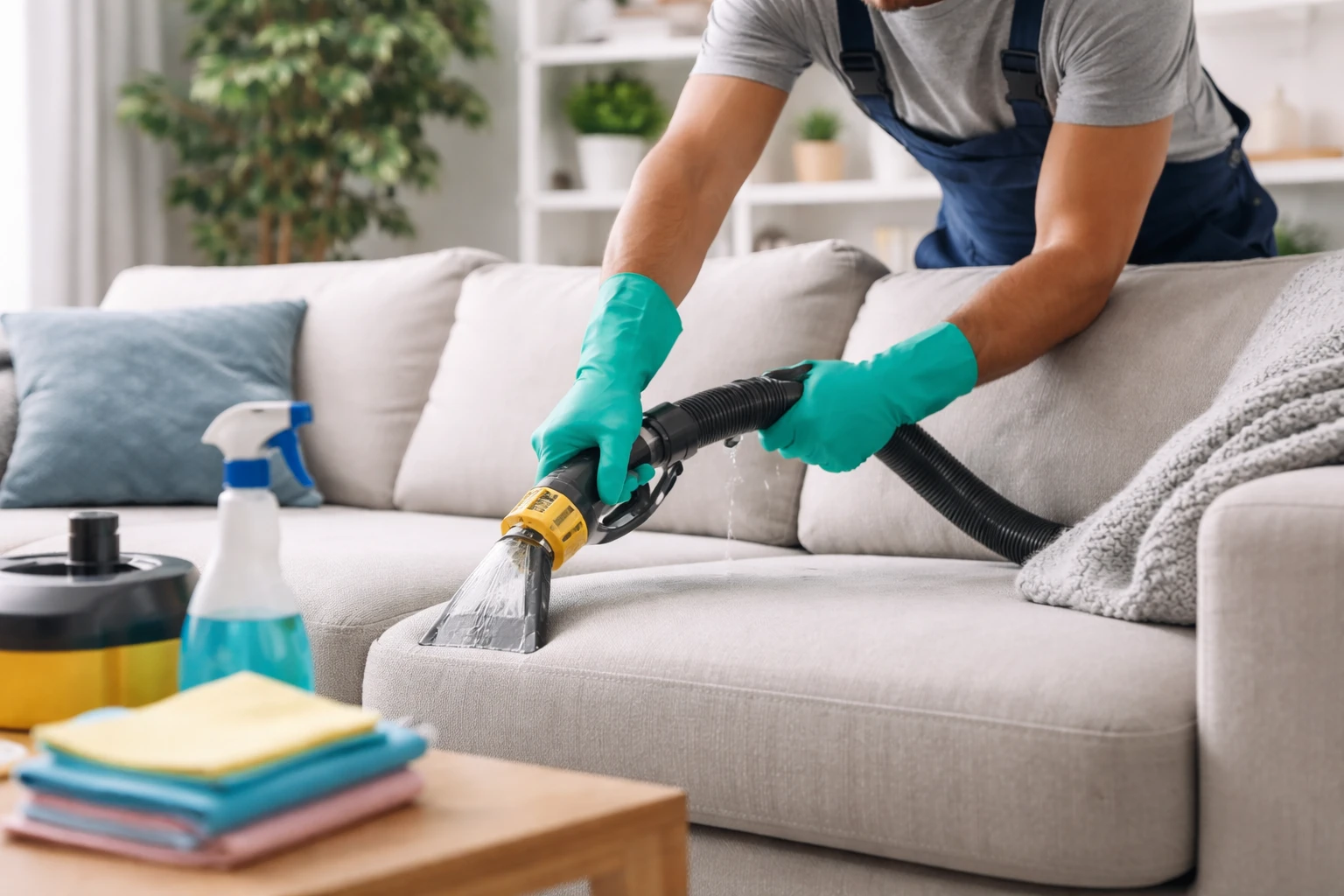
- Deep extraction using truck-mounted or portable units that inject solution and immediately vacuum it out, pulling embedded contaminants with it
- Drying acceleration to prevent mold growth and water damage to frames
- Optional protective treatment – fabric sealants that resist future staining without altering texture
The difference between DIY and professional results isn’t subtle. It’s the difference between rinsing a pan and actually scrubbing it clean.
Timing Is Everything
How often should upholstery get professional attention? The answer depends on variables most people don’t consider:
- Household size. A couple without kids or pets might stretch to 18-24 months. A family of four with a golden retriever? Every 6-12 months.
- Allergy sensitivity. If anyone in the home has asthma or dust mite allergies, frequency matters more than aesthetics. The Mayo Clinic recommends regular deep cleaning of soft furnishings as part of allergen management.
- Fabric type. Natural fibers like cotton and linen absorb more and require gentler, more frequent care. Synthetics resist staining but still trap particulates.
- Usage patterns. A formal living room sofa that gets used twice a month has different needs than the family room sectional that hosts movie night every Friday.
Marie Kondo built an empire around the idea that caring for your possessions is a form of gratitude. “The space in which we live should be for the person we are becoming now,” she wrote, “not for the person we were in the past.” Applied to upholstery care, it’s a surprisingly practical philosophy. Maintaining furniture isn’t about preserving the past – it’s about keeping your living environment functional and healthy for whatever comes next.
The Cost of Neglect vs. the Cost of Care
Here’s where math enters the conversation. A quality sofa runs anywhere from $1,500 to $5,000 or more. Its expected lifespan? Industry data suggests 7 to 15 years, depending on construction quality and – crucially – how well it’s maintained.
Professional upholstery cleaning typically costs between $150 and $300 per piece, depending on size and condition. Run that calculation:
Annual cleaning for 10 years: roughly $1,500 to $3,000 total. Result: a sofa that retains its structure, appearance, and hygiene for the full duration of its lifespan.
No cleaning for 10 years: $0 in maintenance. Result: a sofa that looks and smells tired by year four, develops permanent stains by year six, and gets replaced by year eight. Cost of replacement: another $1,500 to $5,000.
The economics aren’t even close.
Beyond Aesthetics
There’s a conversation happening in interior design circles about “wellness-centered living spaces.” It sounds trendy, maybe even a little precious. But the core idea is practical: the surfaces you touch and sit on every day affect your physical health.
A 2020 report from the National Institutes of Health highlighted the connection between indoor allergen exposure and respiratory conditions, noting that soft furnishings are among the primary accumulation points. Reducing that allergen load through regular deep cleaning isn’t a luxury – for sensitive individuals, it’s a medical recommendation.
And then there’s the comfort factor. Clean upholstery simply feels different. The fabric is softer. Cushions regain some of their original loft. Colors look brighter without that film of accumulated grime dulling them.
Making It Last
The goal isn’t perfection. Furniture is meant to be used, not preserved behind velvet ropes. Scuffs and wear marks tell stories. But there’s a wide gap between “loved and lived-in” and “neglected into early retirement.”
A few habits that extend upholstery life without requiring much effort:
- Rotate and flip cushions monthly to distribute wear evenly
- Blot spills immediately – never rub, which pushes liquid deeper into fibers
- Keep furniture away from direct sunlight, which fades and weakens fabric over time
- Use armrest covers on high-contact zones if you’re not opposed to the look
Small actions, compounding over years. That’s really what deep upholstery care comes down to – not a single dramatic rescue, but a pattern of attention that keeps comfort from quietly slipping away.
Frequently Asked Questions (FAQs)
Most homes benefit from professional cleaning every 12–18 months, but households with pets, kids, or allergies should aim for every 6–12 months.
Vacuuming helps remove surface debris, but it doesn’t reach deep contaminants embedded in the fabric and padding.
Dust mites, pet dander, dead skin cells, food particles, and airborne pollutants gradually accumulate in the fibers.
Odors often come from deep within the padding where moisture, oils, and bacteria have settled.
DIY methods can help with light maintenance, but professional cleaning is needed for deep extraction and long-term care.
Yes, deep cleaning reduces allergens like dust mites and pet dander, improving indoor air quality.
No, trained cleaners test fabrics and use appropriate methods to ensure safe and effective cleaning.
Household size, pets, fabric type, usage frequency, and allergy sensitivity all influence cleaning needs.
Yes, regular cleaning extends furniture lifespan and prevents costly early replacement.
Rotate cushions, clean spills immediately, avoid direct sunlight, and vacuum weekly to keep your upholstery in good condition.