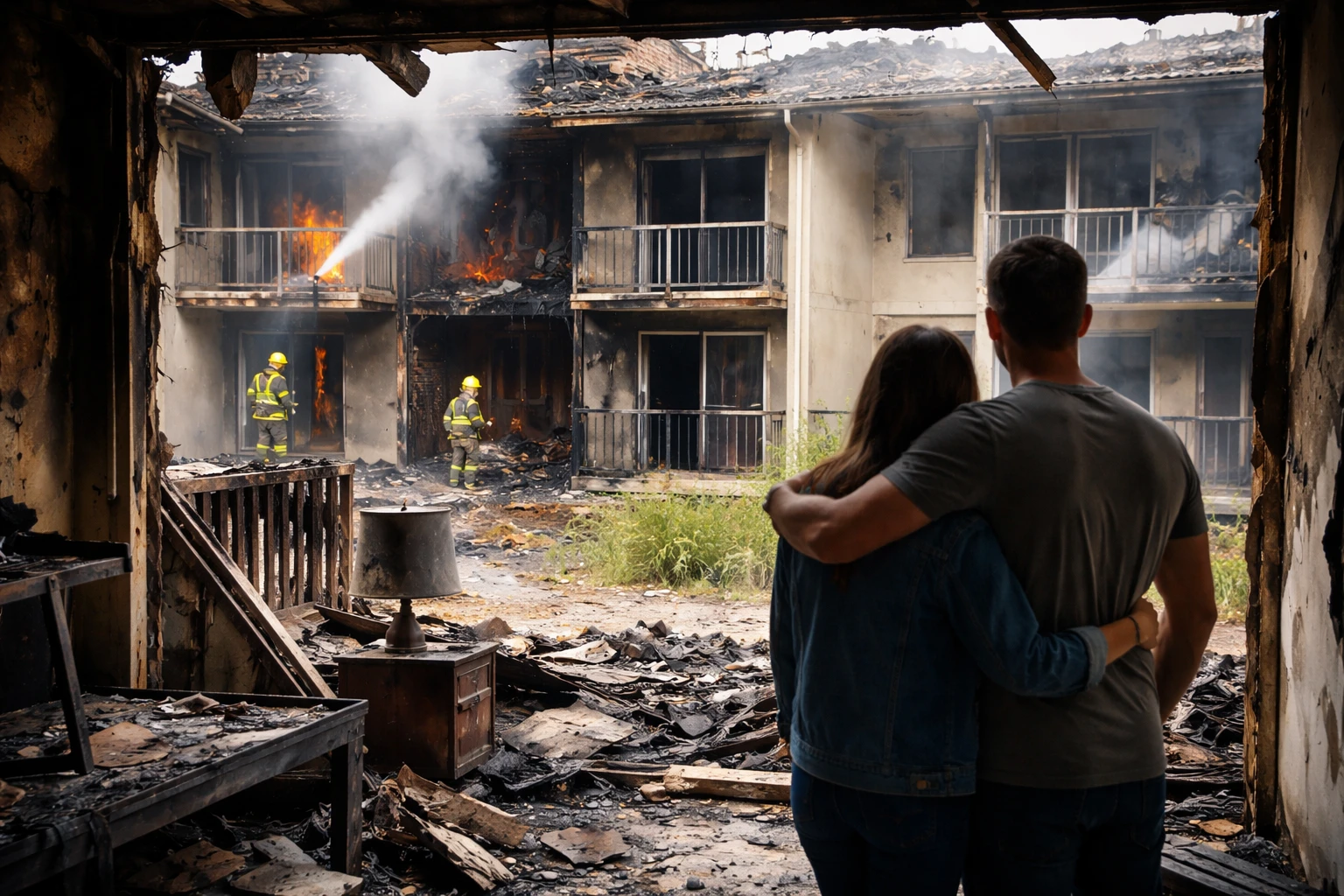
A building fire profoundly disrupts the lives of apartment owners in a multitude of ways that single, family homeowners hardly ever deal with. Here, it’s not only your unit that is damaged in the fire but also you have to interact with your neighbors, the HOA, insurance companies, and perhaps your mortgage lender, all this while you are out of your home.
The course of actions you take in the initial few weeks post, fire really decide if you will be able to financially recover or will be faced with years of hassle. Generally, apartment owners have never been in this situation and hence, don’t understand that the whole process is quite different from simple property damage claims.
Immediate Documentation and Safety Steps
If the fire department permits, enter your unit without delay, even if it is just a brief inspection. Take your smartphone and snap photos of everything from several perspectives before anybody alters anything. These original pictures will be your main evidence when insurance adjustors question the level of damage or the existence of the items at all.
Don’t imagine your unit is safe only because the fire department gave the go, ahead to the building. Smoke damage decreases air quality, and water from firefighting operations results in mold conditions in 24, 48 hours. Get an independent inspector to evaluate your particular unit before deciding to spend a long time inside, especially if you have kids or respiratory issues.
If the doors or windows of your unit are broken, fix them straight away. It’s probable that your insurance contract obliges you to prevent further damage, and a non, secured flat in a building partly emptied is an easy target for burglars. A board, up service is just a few hundred dollars, but it can save you from losses of thousands of dollars.
Understanding Your Insurance Position
Individual unit owners in condominiums and co, ops are in a multi, layered insurance situation that is confusing even for experienced adjusters. The building’s master policy provides insurance for the common areas and structural elements, whereas your HO, 6 policy insures the interior of your unit, any improvements, and personal belongings. Constantly disputes arise at the interface between one policy and the other.
Right away, go through the declarations page of your HO, 6 policy, particularly the loss assessment coverage amount. When the building’s master policy has inadequate limits or the deductibles are too high, the homeowners’ association will make an assessment on the unit owners to cover the difference. Loss assessment coverage is there to save you from these unexpected bills, however, most policies limit it to $1, 000, 5, 000, thus you could be left unprotected for much larger assessments.
Able to help you when displaced, additional living expense coverage is your lifeline. This will cover the cost of hotels, rental apartments, meals at restaurants, and other expenses that go beyond your usual living expenses. Generally, policies will cover a period of 12, 24 months, but extensive rebuilding work can go beyond the limits. Keep a close eye on your expenditure rate and inform your adjuster about the timeline issues before you run out of coverage.
Navigating HOA and Building Politics
Your HOA board will be under tremendous pressure to make decisions after a fire in a building, and almost immediately their decisions will determine your recovery timeline and costs. You must become familiar with every board meeting and request the minutes to all meetings. Sometimes, boards make very quick decisions with contractors, insurance settlements, and repair scopes that individual owners later regret.
Following any major fire in a building, the imposition of special assessments becomes a high probability. The master policy deductible itself can lead to assessments of $5, 000, 25, 000 per unit. In case the building was underinsured or the board decides to make enhancements beyond basic restoration, the assessments can be in six figures. You have the rights to dispute unreasonable assessments; however, the procedure differs depending on the state and your governing documents.
The decision of a contractor doing common area repairs is something that will impact everyone. Some boards are in such a hurry that they make a decision to hire the first contractor who appears, who is often one that has a close relationship with the property management company. Make a strong effort to get competitive bids and do proper vetting. Poor construction work will become everyone’s problem for decades to come.
Evaluating Your Options as an Individual Owner
There are times when it just makes more financial sense to sell your fire, damaged property rather than going through long reconstruction works. If, for example, you have moved to another city for work and, therefore, can’t continue paying the mortgage of an unlivable property from which you have moved, or if you just want to change the situation, then, exploring exit strategies before reconstruction starts, save you money and stress.
The problem is that one has to find buyers for a fire, damaged property in a partially destroyed building. Normal buyers lack the financing and the few cash buyers who are willing to deal with HOA politics and the uncertainty of renovation are very few. Therefore, specialized investors who focus on distressed properties become your realistic market, and they will give you a very low price considering the complexity involved.
Some apartment owners discover that companion services like We Buy Fire Damaged Houses offer the cleanest exit. These companies extend to condominiums and co-ops, providing cash offers that eliminate reconstruction wait times and uncertainty about final costs. The price comes at a discount, but for owners facing financial strain or relocation needs, the certainty and speed justify the trade-off.
Financial and Legal Considerations
Mortgage payments go on without interruption even if the property is not habitable. Your lender does not care that you are unable to stay in the unit; the loan agreement still stands. There might be some lenders who give forbearance or modification programs to fire victims, but you have to be the one to ask for them. If you wait until you have missed payments, you give up a lot of your leverage in negotiations.
In most cases, the insurance payout for structural roof repairs will be made to the HOA’s master policy rather than you personally. You may have to spend a lot of money on temporary fixes or remodeling your unit only to find that the building reconstruction is going to be handled in a totally different way. It is best to get major decisions approved by the HOA before you make expenditure that will be difficult or impossible to recoup.
Many owners are unaware of the tax consequences of fire damage and insurance claims. If, after the cost basis of the unit has been subtracted from your insurance proceeds, there remains a taxable capital gain, then a tax will be owed. You can get some level of relief through the casualty loss deduction, but it has been greatly limited by the newest tax law. Talk to a CPA who is well versed in the rules for casualty loss before you make any big decisions.
When Reconstruction Drags On
Rebuilding fire, damaged buildings can sometimes take 6 to 12 months longer than expected. Besides contractor delays, permit issues, and supply chain problems, change in the project scope can also add months to the length of the work. In fact, you should plan for a longer period both financially and emotionally instead of working on a tight schedule based on optimistic forecasts.
Situations with insurance companies change as time passes. After some initial understanding and willingness to help that may have been shown at the beginning, you may later feel the insurance company is pressuring you to settle and close your case. If you haven’t reached a full settlement yet, don’t hurry; you have the right to be paid the full amount of your policy, and if you accept a low settlement now, you will lose the money you would get for the unexpected expenses later.
Think about if you have the desire to go back to your house when it has been reconstructed. Out of the fires that survivors had escape, many of them associate the burnt house negatively and returning there is psychologically very hard for them. So if you have made a new life somewhere else, going back to the place where the crime happened is not a good idea at all.
Making Your Decision
Funds or creditors, emotions, mobility, and friendships are some factors that contribute to the decision after a building fire for each apartment owner. Some owners successfully go through the process of rebuilding and are happy at the end of the day. Whereas, for some, it is like a battle that keeps on getting tougher due to delays, costs, and complications.
The point is that one should make decisions wisely after gathering all relevant information rather than just hoping for the best. In fact, whether you decide to rebuild the property or sell it to move on, taking decisions helps to avoid the worst scenario that is a combination of a very long period of doubt, the increasing costs, and the final necessity of selling at a very cheap price.
Look at yourself and your situation in the mirror and be truthful, then check out all the alternatives and go for the one that suits your situation the best rather than the one that worked for someone else.
Frequently Asked Questions (FAQs)
Do a quick, careful walk-through of your unit (if allowed) and take photos/video of everything from multiple angles before anything gets moved or cleaned.
Not until you’ve considered smoke residue, compromised air quality, and water intrusion—get an independent inspection if there’s any doubt.
Most policies require you to prevent further damage, and a partially vacant building can attract theft or vandalism fast.
The master policy usually covers common areas and structural elements, while your HO-6 typically covers your unit’s interior finishes, upgrades, and personal property.
It helps pay special assessments the HOA may charge owners for deductibles or gaps in the master policy, but many policies have low limits.
Track spending closely, save every receipt, and keep your adjuster updated on rebuild timelines so you don’t burn through coverage before repairs finish.
Expect fast decisions about contractors, repair scope, and insurance strategy—attend meetings, request minutes, and stay involved early.
Yes—master policy deductibles, underinsurance, and common-area repairs can trigger assessments that apply to all owners.