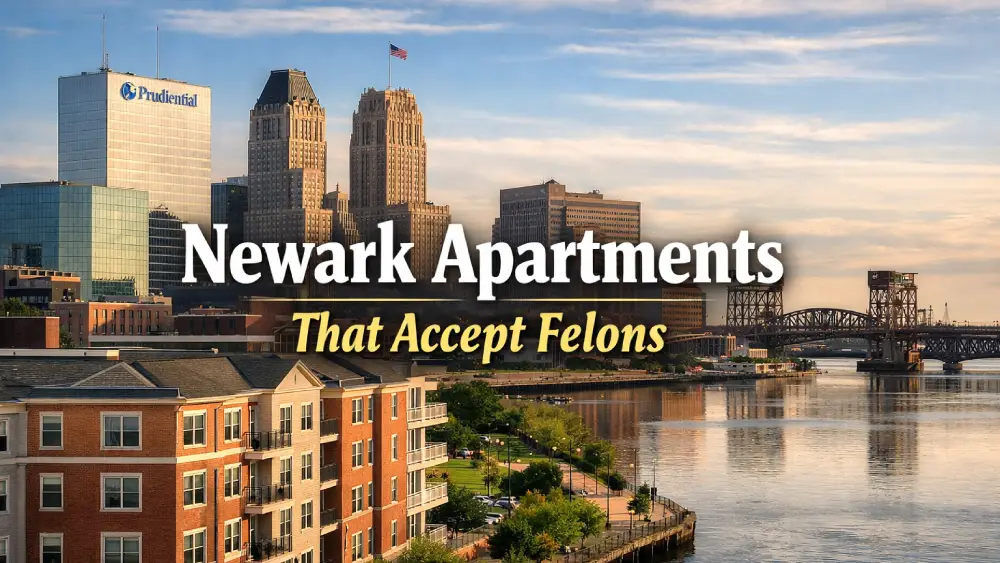

Finding Newark apartments that accept felons can feel overwhelming, especially when rental applications require income verification, credit checks, references, and background screening. However, having a felony conviction does not automatically mean you cannot rent an apartment in Newark, New Jersey.
Newark offers access to employment opportunities, public transportation, privately owned rental properties, and housing support resources. More importantly, New Jersey has specific laws designed to protect housing applicants with criminal records from unfair screening practices.
The key is understanding how the rental process works, knowing your legal rights, preparing a strong application, and targeting properties that meet your budget and housing needs.
Whether you recently completed your sentence, have an older felony conviction, or are helping a family member find housing, this guide explains how to search for Newark apartments that accept felons, improve your application, and navigate potential obstacles.
Can You Rent an Apartment in Newark With a Felony?
Yes. A felony conviction does not automatically disqualify someone from renting an apartment in Newark.
Many people mistakenly believe that every apartment community conducts the same background checks or follows identical approval standards. In reality, rental criteria differ among property management companies, individual property owners, and housing programs.
Additionally, New Jersey’s Fair Chance in Housing Act restricts when housing providers can ask about criminal history and which records they can consider.
While landlords can still evaluate legitimate rental qualifications such as income, credit, and rental history, most covered housing providers cannot simply reject every applicant with a criminal record.
Several factors may influence your overall rental application:
- Income stability: Your ability to demonstrate sufficient income to pay rent.
- Rental history: Previous on-time payments and positive landlord references.
- Credit history: Outstanding collections, unpaid rental debts, or other credit concerns.
- Employment: Current earnings and employment verification.
- Application accuracy: Complete and truthful information when legally required.
- Criminal history: Only certain records may be considered, subject to New Jersey law and applicable exceptions.
Understanding these factors makes searching for Newark apartments that accept felons more manageable.
Understanding New Jersey’s Fair Chance in Housing Act
One of the most important protections for people searching for housing in Newark is the New Jersey Fair Chance in Housing Act (FCHA).
The law, which took effect on January 1, 2022, limits the use of criminal history during rental screening.
Landlords generally cannot ask about criminal history before a conditional offer
For most covered rental properties, housing providers cannot ask about an applicant’s criminal record on the initial rental application, during an interview, or through other inquiries before extending a conditional housing offer.
There are two narrow exceptions involving certain methamphetamine-production convictions in federally assisted housing and lifetime state sex-offender registration requirements.
This means most applicants have an opportunity to establish their basic rental qualifications before their criminal history can be considered.
Certain criminal records cannot be considered at all
Under the FCHA, covered housing providers cannot use the following records to reject an applicant:
- Arrests or charges that did not result in convictions
- Expunged convictions
- Sealed criminal records
- Juvenile adjudications of delinquency
- Convictions erased through executive pardon
- Vacated or legally nullified convictions
These protections apply even after a conditional housing offer.
Only certain convictions may be reviewed after an offer
If a covered housing provider decides to conduct criminal screening after extending a conditional offer, the law limits which convictions may be considered.
| Criminal record category | When consideration may be permitted |
|---|---|
| First-degree indictable offenses | Conviction or release from imprisonment within the previous six years |
| Second- or third-degree indictable offenses | Conviction or release within the previous four years |
| Fourth-degree indictable offenses | Conviction or release within the previous year |
| Certain specifically listed serious offenses | May be considered regardless of these ordinary lookback periods |
| Expunged, sealed, or non-conviction records | Cannot be considered |
The rules contain additional details, including how convictions from other jurisdictions are classified.
Housing providers must also complete an individualized assessment before withdrawing a conditional offer based on a legally reviewable conviction. This assessment considers the nature of the offense, time elapsed, the applicant’s age at the time, rehabilitation evidence, and other relevant circumstances.
Importantly, the law does not guarantee apartment approval. Certain smaller owner-occupied properties are exempt, and applicants must still meet lawful rental requirements.
Official resource: New Jersey Division on Civil Rights, Fair Chance in Housing Act.
Why Newark Can Be a Practical City for Second-Chance Housing
Newark has several characteristics worth considering when searching for an apartment after a conviction.
Its employment centers, transportation connections, and variety of rental building types create different housing opportunities.
However, no particular Newark neighborhood or employment corridor guarantees more lenient criminal screening. Housing providers covered by the FCHA must comply with the same statewide legal requirements.
1. Access to major employment corridors
Newark’s economy includes transportation, logistics, healthcare, education, and professional services.
Important employment areas include:
- Port Newark and the Port Newark–Elizabeth Marine Terminal
- Newark Liberty International Airport
- Downtown Newark
- University Heights
- University Hospital and surrounding healthcare facilities
- Industrial and distribution areas throughout Newark and nearby municipalities
Steady employment can strengthen an apartment application by demonstrating an ability to make consistent rental payments.
For people working shifts or multiple jobs, housing located near these employment areas may also reduce commuting expenses.
2. Public transportation makes more locations accessible
Newark is served by NJ Transit rail and bus services, PATH trains, Newark Light Rail, and other regional transportation connections.
This makes it possible to search beyond the immediate neighborhood surrounding your workplace.
Transit access can be especially useful for renters who do not own vehicles or who want to reduce transportation costs.
When comparing apartments, estimate the actual commute at the times you travel to work, including late-night or early-morning shifts.
3. A variety of rental property types
Newark’s residential market includes:
- Multifamily apartment buildings
- Duplexes and three-family homes
- Privately managed rental units
- Rooms within shared houses
- Older residential properties
- Newly renovated apartments
- Income-restricted and subsidized housing
Different property types offer different price points, lease terms, and application procedures.
Rather than relying on unverified lists of supposedly felony-friendly complexes, compare available units and review each housing provider’s written rental criteria.
Where to Look for Newark Apartments That Accept Felons
Finding suitable housing requires more than searching for the phrase “felony-friendly apartments.”
A better strategy involves locating available rentals, evaluating affordability, and contacting property managers about their standard qualification requirements.
Downtown Newark
Downtown Newark offers strong transportation access, restaurants, offices, and connections to regional employment centers.
It may be convenient for renters working in business districts, healthcare, hospitality, and service industries.
However, rents can vary considerably, particularly in newer developments.
Compare the total monthly cost rather than focusing exclusively on advertised rent.
Ironbound
The Ironbound neighborhood is known for its residential streets, businesses, restaurants, and access to Newark Penn Station.
Renters interested in this area can explore smaller multifamily properties as well as professionally managed apartments.
Parking availability, building age, and proximity to transit are useful considerations.
North Ward
The North Ward includes established residential neighborhoods and a mixture of multifamily rental properties.
Depending on the exact location, renters may find units in smaller buildings or properties managed by local owners.
Check public transportation, utility costs, and lease requirements before applying.
South Ward
The South Ward contains a range of residential housing options, including two- and three-family properties.
Pricing, building condition, and transportation access vary by block and property.
Visit prospective rentals, verify ownership or management, and confirm the unit is legally available for occupancy.
West Ward
The West Ward includes established neighborhoods with small multifamily homes and rental properties.
For renters comparing housing costs, it may be worthwhile to include this area in a broader search.
As with any Newark neighborhood, prioritize affordability, property condition, transit access, and legitimate listings.
Newark neighborhood comparison
| Area | Rental characteristics | Considerations |
|---|---|---|
| Downtown | Apartments near employment and transit | Total rental cost and building fees |
| Ironbound | Multifamily housing and transit connections | Parking and unit availability |
| North Ward | Established neighborhoods and mixed building types | Commute and utility costs |
| South Ward | Multifamily houses and residential rentals | Property condition and transportation |
| West Ward | Smaller residential rental buildings | Availability and commute reliability |
These are general housing characteristics, not rankings of neighborhoods by willingness to accept applicants with convictions.
Employment Stability Can Strengthen Your Rental Application
Although New Jersey limits criminal history screening, financial qualifications remain important.
A landlord may legally evaluate whether an applicant has sufficient income to meet the rent, provided the requirements comply with applicable laws.
Newark’s employment market provides several potential sources of documented income.
| Employment sector | Examples of income documentation |
|---|---|
| Logistics and warehousing | Pay stubs, employment verification |
| Healthcare | Offer letter, pay statements |
| Transportation | Employment records, bank deposits |
| Higher education | Payroll statements, employment letter |
| Hospitality and retail | Pay stubs, schedules, verified earnings |
| Self-employment | Tax returns, invoices, bank statements |
You do not necessarily need a particular type of job to qualify for an apartment.
What matters is demonstrating that the rent fits your actual financial situation and that you can provide the documentation requested under lawful screening criteria.
If you have recently started a job, ask whether an employment offer letter and recent pay statements are acceptable.
How to Prepare a Strong Rental Application
Preparation can make a major difference in your apartment search.
When searching for Newark apartments that accept felons, organize your documents before scheduling showings or paying application fees.
Step 1: Calculate an affordable rental budget
Start by determining how much rent you can consistently afford.
For example, a household earning $3,600 in gross monthly income might target an apartment costing approximately $1,200 per month under a three-times-the-rent screening formula.
However, this is only an example. Not every landlord uses the same income requirement.
Also account for:
- Electricity, gas, and water
- Transportation
- Groceries
- Phone and internet
- Insurance
- Existing debt payments
- Savings and emergency expenses
A lower-cost unit with reliable transportation may be more sustainable than a more expensive apartment closer to work.
Step 2: Gather your documents
Prepare a digital folder containing:
- Government-issued identification
- Recent pay stubs
- Employment verification
- Recent bank statements when appropriate
- Rental references
- Contact information for previous landlords
- Documentation of other lawful income sources
- A list of properties you have contacted
Do not send Social Security numbers, bank statements, or sensitive identity documents to unverified landlords or through unsecured messaging.
Step 3: Review your credit report
Many rental applications include credit screening.
Before applying, review your credit reports for incorrect information, outstanding rental collections, or accounts you may need to address.
Credit problems do not necessarily eliminate all rental opportunities, but they can affect the application process.
If a credit report contains errors, dispute them through the appropriate reporting agency.
Step 4: Prepare rehabilitation evidence if relevant
If a covered housing provider makes a conditional offer and lawfully requests information concerning a reviewable conviction, you may have an opportunity to provide mitigating evidence.
Depending on your circumstances, useful documents might include:
- Employment history since the conviction
- Education or vocational training certificates
- Completion of relevant programs
- Community involvement
- Positive professional references
- Evidence showing inaccuracies in a criminal record
You generally do not need to volunteer criminal history on an initial application when the FCHA prohibits such inquiries.
Prepare supporting information so it is available if a lawful review occurs after a conditional offer.
Step 5: Apply strategically
Submit applications for apartments that fit your income, household size, desired location, and transportation needs.
Before paying a fee, ask about availability, deposit requirements, credit qualifications, income requirements, and the housing provider’s criminal-history disclosure policy.
Keep a spreadsheet of applications and follow-ups so you can avoid duplicate fees and missed opportunities.
Rental Application Assistance and Newark Apartment Locators
Working with a knowledgeable real estate professional can make the search more organized.
An agent may help identify current listings, explain standard rental requirements, arrange showings, and communicate with property owners.
However, a real estate professional cannot guarantee approval or override a landlord’s lawful screening criteria.
Approved locators provided for Newark
The following contacts were provided as possible real estate resources. Their current services, availability, and experience handling applications involving criminal histories have not been independently verified.
Tara Verlin – Cedarcrest Realty | Century 21
Phone: (646) 873-0808
Real estate support across buying, renting, and property stewardship.
Stanton Company Realtors
Phone: (973) 746-1313
Established Newark-area real estate company offering residential and commercial property services.
Altagracia R. Diaz Hernandez, Realtor® – United Real Estate North Jersey
Phone: (732) 638-9487
Residential real estate professional serving Central and North New Jersey, with English- and Spanish-language support.
Before working with an agent, ask whether they assist renters looking for apartments in Newark, what fees apply, and whether they can help you understand the screening procedures used by properties they represent.
Alternative Housing Options in Newark
Not every renter needs to begin with a conventional 12-month apartment lease.
Temporary housing, shared rentals, and other arrangements may provide additional time to save money, establish employment, or locate an appropriate long-term home.
The following options are worth exploring.
Airbnb
Short-term rentals may provide a temporary place to stay during an apartment search.
Some listings offer extended-stay pricing, although availability, total costs, and local rules vary.
A short-term rental should not be assumed to bypass all identity or background-related requirements.
Furnished Finder
Furnished Finder lists furnished rental accommodations, including properties marketed for medium-term stays.
These may be suitable for people relocating for employment or needing temporary housing.
Each property owner may have different screening standards, payment requirements, and minimum stay periods.
Facebook Marketplace Rooms for Rent
Facebook Marketplace may contain room rentals, shared housing arrangements, and individual apartment listings.
Rooms can sometimes be less expensive than renting a full apartment.
Before sending money, inspect the property, verify the person offering the rental has authority to rent it, and obtain written terms.
Private Landlords
Privately owned apartments are another option for renters searching for Newark apartments that accept felons.
Some owners manage their properties independently, while others work through agents or property management companies.
Do not assume a private landlord is exempt from the FCHA simply because they own a small building. The law’s exemptions depend on specific property characteristics.
The Guarantors
Lease-guarantee services may help some renters satisfy participating properties’ financial requirements.
However, participation is not universal, and a guarantee does not necessarily resolve criminal-history screening concerns.
Verify whether the property accepts the service, whether you qualify, and how much it costs.
Second Chance Apartment Locators
Second-chance housing resources may provide general education, application strategies, and information about rental obstacles.
The referenced service is presented here as an educational resource rather than a verified Newark apartment placement service.
What to Do If a Landlord Denies Your Application
Receiving a rental denial can be discouraging, but it is important to understand the reason before assuming your felony conviction caused it.
An application may be denied because of income requirements, credit concerns, incomplete documentation, or another lawful qualification.
If a covered housing provider withdraws a conditional offer based on criminal history, New Jersey law imposes specific requirements.
Request the reason for the decision
Ask whether the denial resulted from a financial qualification, rental-history issue, or review of criminal records.
If the conditional offer was withdrawn under the FCHA because of criminal history, the provider must issue the required notice explaining its decision.
Review the criminal-history information
You have the right to request the information the provider relied upon in withdrawing a conditional offer.
Under the FCHA, an applicant generally has 30 days after receiving the withdrawal notice to request this information, and the provider must respond within 10 days of a timely request.
Review the information carefully for incorrect dates, mistaken identity, expunged records, or offenses that cannot legally be considered.
Provide relevant additional evidence
If you believe a landlord improperly evaluated your record, follow the appeal instructions and submit any relevant supporting materials.
A housing provider must consider new information submitted through the FCHA appeal process and provide a determination within 30 days.
Consider filing a discrimination complaint
If you believe your rights were violated under the FCHA, you may file a complaint with the New Jersey Division on Civil Rights.
The agency generally requires complaints to be filed within 180 days of the incident.
For assistance, consult the official state guidance or a qualified housing attorney.
How to Avoid Rental Scams When Searching for Second-Chance Housing
Applicants concerned about background checks may be especially vulnerable to misleading advertisements promising guaranteed approval.
Be cautious of anyone offering an apartment without confirming that a real unit is available.
Common warning signs include:
- Demanding money before allowing you to view the property
- Advertising an unusually low price without a reasonable explanation
- Refusing to provide a lease or written rental terms
- Claiming guaranteed approval in exchange for a large upfront payment
- Asking for payment through gift cards or unusual money-transfer methods
- Refusing to confirm property ownership or management authority
- Requesting sensitive documents before you can verify the listing
A legitimate apartment search should involve clear rental terms, identifiable property management, and transparent fees.
Never pay someone merely because they claim to have a secret list of Newark apartments that accept felons.
Common Mistakes That Can Delay Apartment Approval
Even qualified renters sometimes run into unnecessary problems during the housing search.
Applying without checking the total cost: An apartment may appear affordable until utilities, fees, and transportation are included.
Submitting incomplete paperwork: Missing pay stubs, identification, or employment details can slow an otherwise straightforward application.
Assuming every felony is treated the same: New Jersey law distinguishes among types of records, specific convictions, and applicable time periods.
Believing every private landlord has different legal rights: Many private landlords remain subject to the FCHA.
Paying multiple fees without understanding eligibility criteria: Confirm financial qualifications and review the legally required disclosures before applying.
Ignoring transportation needs: Lower rent may not actually save money if commuting is expensive or unreliable.
Relying on outdated apartment lists: Available units, pricing, and management can change frequently. Verify listings directly.
Frequently Asked Questions About Newark Apartments That Accept Felons
1. Are there apartments in Newark that accept people with felony convictions?
Yes. Having a felony does not automatically prevent someone from renting an apartment in Newark. Approval depends on lawful rental qualifications and applicable New Jersey housing protections.
2. Can Newark landlords reject everyone with a criminal record?
Most housing providers covered by New Jersey’s Fair Chance in Housing Act cannot advertise blanket exclusions for applicants with criminal histories. The law also limits when criminal records can be reviewed and how they may be used.
3. Can a landlord ask about my felony on the initial application?
Generally, no. Covered housing providers cannot ask about criminal history before a conditional offer, except for two narrow statutory exceptions.
4. How far back can an apartment background check go in New Jersey?
The law establishes different consideration periods for certain categories of convictions, including one, four, and six years, measured by conviction or release from imprisonment. Some specifically enumerated serious offenses are treated differently. These are restrictions on what a covered housing provider may consider, not necessarily technical limits on what a background report may display.
5. Can I rent an apartment in Newark with an old felony?
Potentially, yes. Depending on the conviction and whether the property is covered by the FCHA, an older offense may be outside the period a housing provider is legally permitted to consider.
6. Are private landlords more likely to accept applicants with felonies?
Not necessarily. Private landlords may use different management procedures, but many must follow the same statewide housing laws as larger rental companies. Individual approval rates are not publicly established.
7. Does having a job help me qualify for an apartment?
Stable, verifiable income can strengthen your financial qualifications. However, employment does not guarantee approval or eliminate other lawful application requirements.
8. Can I rent an apartment in Newark with both bad credit and a felony?
It may be possible, but credit concerns can create additional challenges. Focus on properties whose financial requirements you can meet, correct reporting errors, and ask about acceptable documentation of income.
9. Can I use a guarantor to qualify for an apartment?
Some properties accept guarantors or third-party lease-guarantee services. These arrangements generally address financial concerns rather than guaranteeing approval after a criminal-history review.
10. Can I apply for affordable housing with a felony?
You may be eligible for some affordable or subsidized housing programs, but eligibility depends on the particular program and applicable federal and state regulations. Certain federally assisted housing programs have specific restrictions involving particular criminal conduct. Contact the housing administrator for accurate eligibility criteria.
11. Can a landlord use an arrest that never resulted in a conviction?
Under the FCHA, covered housing providers cannot consider arrests or charges that did not result in a conviction.
12. What if my criminal record has been expunged?
Covered housing providers cannot use expunged convictions when evaluating an application under the FCHA.
13. Are rooms for rent easier to obtain than regular apartments?
Room rentals may involve different financial requirements and lease arrangements, but they are not automatically easier to obtain. Screening practices and legal protections depend on the circumstances.
14. Can a Newark landlord withdraw an apartment offer after checking my record?
In limited circumstances, yes. A covered provider must follow the law’s requirements, including permissible record consideration, individualized assessment, and appropriate written notice.
15. Where can I get help if I believe a landlord discriminated against me?
The New Jersey Division on Civil Rights provides information about the Fair Chance in Housing Act and procedures for reporting possible violations. Legal aid organizations may also help eligible renters understand their rights.
Final Thoughts: Finding Second-Chance Housing in Newark
Searching for Newark apartments that accept felons requires patience, preparation, and a clear understanding of the rental process. However, a previous conviction does not necessarily have to prevent you from finding a safe and stable home.
Newark provides access to a variety of rental housing types, employment opportunities, and regional transportation connections. New Jersey’s Fair Chance in Housing Act also establishes meaningful protections intended to make the housing application process more equitable.
The most effective approach is to prepare your financial documents, research available apartments, understand lawful screening procedures, and take advantage of legitimate housing resources.
Instead of relying on unverified promises of guaranteed approval, concentrate on properties that meet your needs and housing providers that follow transparent, lawful application standards.
With consistent effort and accurate information, finding Newark apartments that accept felons can become a more structured and manageable process.