If you live in Georgia, you know the red clay. It’s everywhere. You see it on hiking boots, car tires, and definitely in your backyard. That distinctive rusty color comes from iron oxide, and while it gives the state character, it’s a nightmare when you’re trying to build a deck.
I’ve talked to homeowners who thought building a deck would be straightforward. Dig some holes, pour concrete, done. But Georgia’s red clay has other plans. This soil expands when it rains and shrinks when it dries out. That constant movement can crack concrete footings, shift deck posts, and turn your dream outdoor space into a slanted mess within a few years.
The problem isn’t just expansion. Red clay holds water like a sponge but drains poorly, creating all sorts of issues around your foundation. And if you’re on a slope? Even worse. Professional deck builders in Georgia deal with these challenges daily, and they’ve developed specific techniques to make sure your deck doesn’t become a safety hazard down the road.
Let’s break down what makes Georgia’s soil so tricky and how the pros handle it.
What Makes Georgia’s Red Clay Different
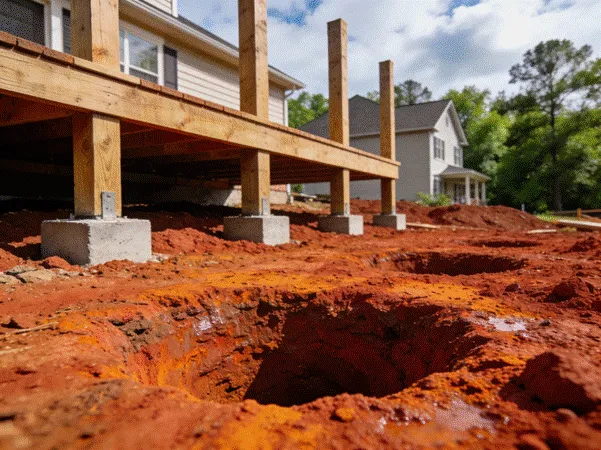
Red clay isn’t just dirt. It’s made up of super fine particles that pack together tightly. Think of it like flour versus sand. Sand has gaps between grains where water can flow through. Clay particles are so small they stick together, blocking water from passing through easily.
The iron content gives it that signature red color you see across Atlanta, Savannah, and up into North Georgia. But here’s the kicker: when water does get into clay soil, it doesn’t leave. The clay absorbs moisture and can expand up to 10% or more in volume. That might not sound like much, but imagine the ground under your deck swelling by 10%. That’s enough force to crack concrete and push posts out of alignment.
When summer heat dries everything out, the clay shrinks back down. This constant cycle puts serious stress on anything built on top of it. Different areas of Georgia have slightly different clay compositions. The red clay around Atlanta is particularly dense. Up in North Georgia’s hills, you might find a mix of clay and rocky soil. Down near Savannah, the clay can stay wetter longer due to higher humidity and more rainfall.
The soil also tends to be acidic, with a pH between 5.5 and 6.5. This acidity can affect certain building materials over time if they’re not properly treated or protected.
Three Big Problems Clay Creates for Deck Foundations
Expansive Movement
Clay soil moves. A lot. When it rains, the soil swells vertically and horizontally. When it’s dry, it contracts. This isn’t a one-time thing either. It happens with every weather change, and Georgia gets plenty of those. Hot summers, rainy springs, the occasional winter freeze.
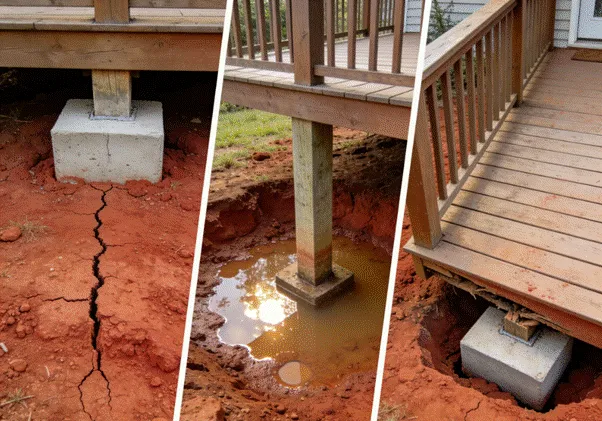
This movement puts constant pressure on concrete footings. You might not see cracks right away, but over months and years, those forces add up. I’ve seen deck posts that started out perfectly level end up tilted because the soil underneath shifted unevenly.
Water Retention Issues
Here’s where clay really causes headaches. Because the particles are so tightly packed, water can’t drain through. After a heavy rain, you’ll see puddles sitting on clay soil for hours or even days.
When water pools around your deck footings, two things happen. First, wood components near the ground start to rot, even if they’re pressure-treated. Second, if you’re in North Georgia where it actually freezes, that standing water can freeze and cause frost heave. The ice pushes upward on the footings, which can crack them or shift the entire structure.
And if your yard has any slope to it, poor drainage leads to erosion. The water runs across the surface instead of soaking in, carving channels and washing away soil from around your deck posts.
Settlement and Stability Problems
Settlement happens when the ground under your deck compresses unevenly over time. With clay soil, this is super common if the foundation wasn’t installed correctly.
DIY deck builders often make the mistake of just digging down a foot or so and pouring concrete. But if that clay wasn’t properly compacted first, or if water gets underneath, the footing can sink. And it rarely sinks evenly. You’ll get one corner dropping while the others stay put.
Long term? You’re looking at a deck that bounces when you walk on it, visible gaps between boards, doors on screened porches that don’t close right, and in worst cases, structural failure. I wouldn’t want my family grilling on a deck that’s slowly tilting off its foundation.
How Professionals Handle Georgia Clay
This is where experience really matters. Deck contractors who know Georgia’s soil don’t use the same approach as someone building in sandy Florida or rocky Colorado. Here’s what actually works.
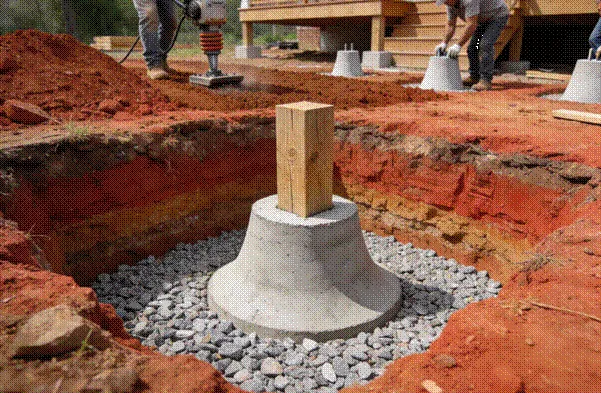
Going Deep with Footings
Georgia building codes require footings to be at least 12 inches below grade, but many pros go deeper, especially in areas with frost concerns. The goal is to get below the active zone where soil movement is most dramatic.
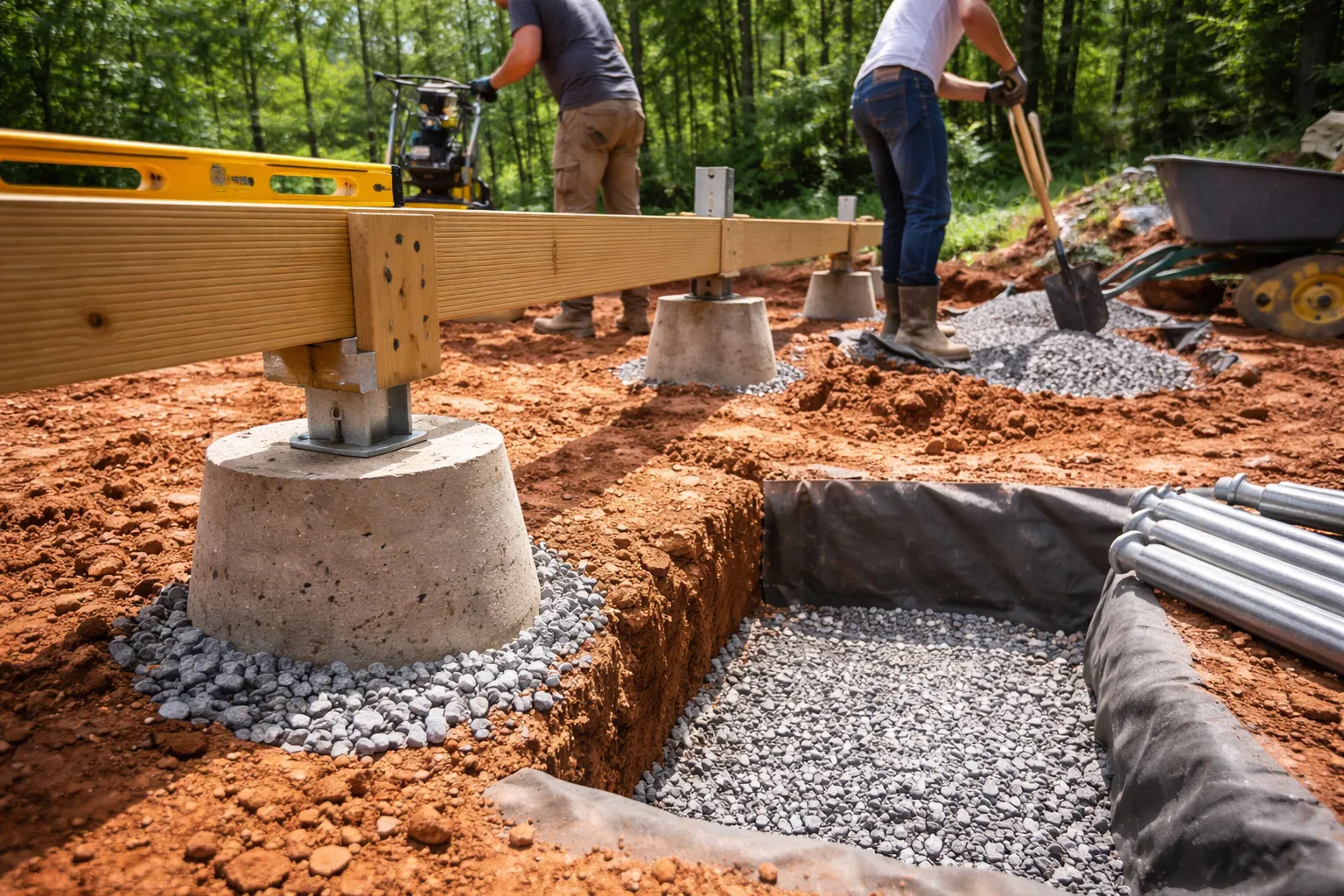
Bell-shaped footings are popular here. Instead of a straight cylinder of concrete, the bottom flares out wider. This does two things: it increases the surface area supporting the load, and it helps prevent the footing from getting pushed up when clay swells.
Typical specs you’ll see? Footing diameter of 16 to 20 inches at the base, with depth ranging from 12 to 24 inches depending on the deck size and local conditions. Larger decks need more support, obviously.
Soil Prep That Actually Matters
Any loose or disturbed soil needs to come out before concrete goes in. If you just dig a hole and pour, you’re building on unstable ground.
Good contractors use mechanical compactors or tampers to pack down the bottom of the hole. Then they add a layer of gravel, usually 4 to 6 inches thick. This gravel base serves multiple purposes. It helps with drainage, provides a stable platform for the concrete, and reduces direct contact between concrete and acidic clay.
The gravel also gives water somewhere to go instead of pooling directly under your footings.
Drainage Systems You Can’t Skip
Proper grading around the deck is non-negotiable. The ground should slope away from the foundation so water runs off instead of collecting. Even a slight grade of 1-2% makes a difference.
For decks in particularly wet areas or on slopes, French drains are common. These are perforated pipes buried in gravel trenches that collect and redirect water away from the deck perimeter.
Geotextile fabric (basically a sturdy landscape fabric) gets laid down to separate gravel from clay soil. Without it, the fine clay particles migrate up into the gravel over time, clogging it and defeating the whole drainage system.
Some contractors also install surface channels or create swales to handle heavy runoff during Georgia’s thunderstorms.
Alternative Foundation Options
For really problematic sites, helical piers (also called screw piles) are game changers. These are steel shafts with spiral blades that get screwed deep into the ground, past the unstable clay layer to more stable soil below.
The advantages? They don’t rely on the top soil at all. They have immediate load-bearing capacity (no waiting for concrete to cure). And they work great on slopes or in areas where you can’t easily dig deep holes.
Helical piers cost more upfront, but when you’re dealing with severe clay issues or hillside construction, they can save you from future repair costs. Contractors typically recommend them when soil tests show high expansion potential or when there’s evidence of past foundation problems in the area.
Choosing the Right Materials
Not all building materials handle clay soil environments equally well.
Pressure-treated lumber needs the right rating. Look for wood rated for ground contact, which has higher preservative retention. Even then, smart builders use plastic sleeves around posts that go into concrete. This creates a barrier between the treated wood and the concrete, plus it protects against moisture wicking up from the ground.
The concrete mix itself matters too. In Georgia’s acidic clay, contractors often use concrete with additives that improve resistance to sulfate attack and reduce permeability. Standard mix is 3,000 PSI minimum, but many use 4,000 PSI for deck footings.
Bitumen coating or tar can be applied to the outside of footings for extra moisture protection. It’s an old-school technique that still works.
And honestly? Composite decking makes sense in Georgia. It costs more than wood, but it’s not going to rot from moisture exposure. Given how much water clay soil retains, that extra durability pays off.
Warning Signs Your Deck Has Foundation Problems
Here’s a quick list of red flags that suggest your deck wasn’t built with clay soil in mind:
- Visible gaps appearing between deck boards – If boards that used to be tight together now have gaps, your deck frame is probably shifting from uneven settling.
- Cracks in concrete footings – Look at the visible portions of your footings or piers. Vertical or horizontal cracks mean the soil movement has stressed the concrete.
- Bounce or flex when walking – A little give is normal, but if your deck feels springy or bouncy, the foundation may be compromised.
- Standing water underneath – After rain, water should drain away, not pool under your deck. If it does, you’ve got drainage issues that will get worse.
- Separation from the house – If your deck was attached to your home and there’s now a gap where it pulls away, that’s a serious structural concern.
If you spot any of these, get a professional inspection. The longer you wait, the more expensive repairs become.
Why Local Experience Counts
Building codes are one thing. Real-world experience with Georgia’s specific soil conditions is another.
A contractor from out of state might follow the building code to the letter and still end up with a deck that fails in five years. Why? Because they don’t know that the red clay in your Decatur backyard behaves differently than the soil they’re used to working with.
Experienced local builders know which neighborhoods have the worst clay. They know how deep the water table sits. They’ve seen what works and what doesn’t over 10, 20, 30 years.
When you hire someone to build your deck, ask about their experience with Georgia clay specifically. Ask to see examples of decks they built 5+ years ago. A deck that still looks good after several Georgia summers and rainy springs? That’s proof they know what they’re doing.
Quick Comparison: Foundation Options
| Foundation Type | Best For | Pros | Cons |
| Standard concrete footings with bell shape | Flat yards, moderate clay | Cost-effective, meets code requirements | Vulnerable to severe clay movement |
| Deep footings (18-24 inches) with gravel base | Most residential decks | Better stability, good drainage | Requires more excavation work |
| Helical piers | Sloped lots, severe clay expansion areas | Bypasses problem soil, immediate load capacity | Higher upfront cost |
| Sonotube forms with French drains | Wet areas with drainage challenges | Combines foundation with water management | More complex installation |
Final Thoughts
Georgia’s red clay is part of what makes this state unique, but it definitely complicates deck construction. The soil’s tendency to expand, contract, and hold water means you can’t just use standard building techniques and hope for the best.
A properly built deck foundation on clay soil requires deeper footings, careful soil preparation, effective drainage systems, and the right materials. Sometimes it means using specialized foundation methods like helical piers.
The difference between a deck that lasts 30 years and one that starts failing in 3 years often comes down to foundation work you can’t even see once the deck is finished. That’s why working with experienced contractors who understand Georgia’s soil conditions is so important.
If you’re planning a deck project, start with the foundation. Talk to licensed contractors who’ve been building in your area for years. Get multiple opinions on the best foundation approach for your specific yard. It might cost a bit more upfront to do it right, but you’ll save thousands in repairs and have peace of mind knowing your deck is built to last.
Don’t let Georgia’s beautiful red clay become a foundation nightmare. With the right approach, you can have an outdoor space that stays level and solid for decades.
Frequently Asked Questions (FAQs)
Red clay expands when wet and shrinks when dry, creating constant ground movement that can crack footings and shift deck posts over time.
In wet conditions, red clay can expand by 10% or more in volume, which is enough to stress concrete and cause structural misalignment.
Often no—standard footings may meet code but still fail long-term unless they’re deeper, properly shaped, and supported with drainage measures.
Deeper footings reach below the most active soil layer, reducing the effects of seasonal expansion and contraction.
Gravel improves drainage, provides a stable base, and prevents water from pooling directly beneath the concrete.
Yes, standing water leads to rot, frost heave in colder areas, erosion, and long-term footing instability.
Helical piers are steel screw-like supports driven into stable soil below the clay layer and are ideal for slopes or severe soil movement.
Yes, its acidity and moisture retention can degrade untreated materials, which is why ground-rated lumber and higher-strength concrete are important.
Common signs include uneven boards, cracked footings, bouncing when walked on, standing water underneath, or separation from the house.
Local builders understand how Georgia’s red clay behaves in different regions and use proven methods that outperform generic, code-only approaches.