
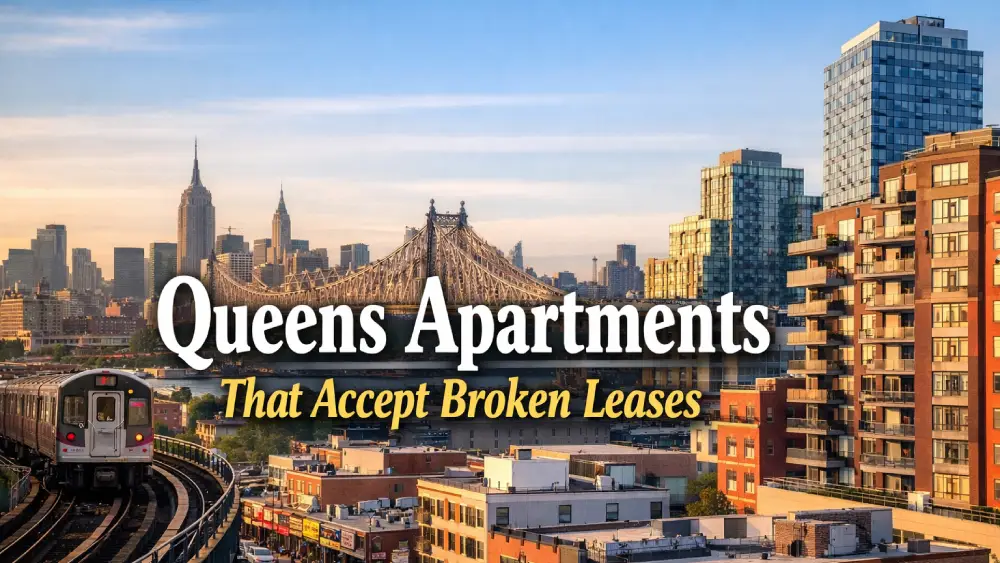
A broken lease in Queens does not function as a universal rejection stamp the way many renters fear. Instead, it becomes a signal that landlords interpret through ownership structure, neighborhood turnover speed, and the reason the lease ended early. Understanding Queens Apartments That Accept Broken Leases requires shifting focus away from blame and toward how risk is priced at the property level.
Queens is not one rental market; it is hundreds of micro-markets stitched together by transit lines and zoning history. In many of these pockets, broken leases are evaluated pragmatically, not emotionally. This article approaches Queens Apartments That Accept Broken Leases through the lens of ownership incentives and lease-break context rather than forgiveness narratives or generic second-chance framing.
Why broken leases are viewed differently than evictions
In Queens, a broken lease is often considered a financial interruption rather than a behavioral failure. Many landlords distinguish between tenants who stopped paying entirely and tenants who left early due to job relocation, family changes, roommate loss, or rising rent pressure.
Owners are primarily concerned with whether the lease break created unpaid balances or legal action. A clean break with documented notice is often treated as a solvable risk rather than a permanent red flag.
Ownership incentives shape approval outcomes
Smaller Queens landlords operate under tighter margins than institutional operators. When a unit has already absorbed renovation costs or missed a leasing cycle, the incentive shifts toward stabilizing income quickly. In these cases, a broken lease becomes less important than current readiness.
Large buildings tend to follow standardized screening tied to insurance underwriting. Smaller owners weigh vacancy loss against applicant stability, often arriving at different conclusions for the same background.
Lease-break context matters more than the record itself
Queens landlords frequently ask why the lease ended early, even if unofficially. Tenants who can clearly document employment changes, family restructuring, or rent increases are often treated differently than those who abandoned units without communication.
The clearer the paper trail, the lower the perceived risk.
Neighborhood turnover and flexibility
| Area Type | Typical Turnover Speed | Broken Lease Flexibility |
| Transit-heavy hubs | Fast | Moderate if income is strong |
| Residential side streets | Slow | Higher if vacancy lingers |
| Mixed-use corridors | Variable | Context-driven |
| Outer Queens neighborhoods | Moderate | Often flexible |
Income continuity outweighs past lease length
In Queens, landlords frequently prioritize forward stability over backward history. Applicants with broken leases who demonstrate uninterrupted income, predictable pay cycles, and realistic rent ratios often outperform applicants with perfect records but unstable earnings.
Predictability reduces perceived risk more effectively than explanations.
Application completeness as a decision signal
Incomplete applications signal uncertainty. Queens owners often interpret missing documents as future payment issues rather than clerical mistakes. Applicants with broken leases who submit clean, organized packages tend to shift attention away from the lease break itself.
Clarity communicates seriousness.
Documentation that improves approval odds
| Document | Timeframe | Why It Helps |
| Proof of income | Last 2–3 months | Confirms current affordability |
| Bank statements | Recent | Shows liquidity |
| Reference from later housing | After lease break | Signals resolution |
| Written explanation | Concise | Frames the lease break context |
Broker use without overexposure
In Queens, brokers can be effective when they manage timing carefully. Introducing a broken lease too early can halt momentum, while addressing it after owner interest is established often results in neutral outcomes.
Less explanation, delivered later, is often more effective.
Practical housing paths to consider
For renters navigating Queens Apartments That Accept Broken Leases, the following housing paths are commonly used either as transitions or alternatives:
- Airbnb — Short-term housing can provide stability while rebuilding lease history.
- Furnished Finder — Monthly furnished rentals often involve simplified screening.
- Facebook Marketplace Rooms for Rent — Room rentals frequently bypass lease-history scrutiny.
- Private Landlords — Individual owners may evaluate circumstances rather than defaults.
- The Guarantors — Third-party guarantors can reduce concerns tied to lease breaks.
- Second Chance Locators — In New York, these services provide education and strategy, not placement.
Local real estate professionals
- Jeff Stineback – Long Island Home Team
(631) 627-1780
Residential and investment representation with property management experience across Long Island. - Lisa Boncich – Long Island
(631) 838-7898
Buyer and seller representation with a focus on preparation and negotiation. - The Braswell Team at Compass
(646) 535-6865
Led by Grant Braswell, providing buyer representation and listing marketing across Manhattan and nearby boroughs.
Official work email: gbraswell@compass.com
Why Queens remains viable after a broken lease
Queens rewards transparency, readiness, and timing more than perfection. Broken leases are not ignored, but they are contextualized within a market that values occupancy and consistency. When approached strategically, Queens Apartments That Accept Broken Leases remain attainable because decisions are localized and economically grounded.
Frequently Asked Questions
Yes, many landlords consider the reason and outcome of the lease break rather than rejecting automatically.
No, broken leases are often viewed as less severe, especially without legal action.
Yes, clear documentation significantly improves credibility.
Yes, individual owners often exercise more discretion.
In many cases, yes.
Yes, guarantors are commonly used to offset risk.
Yes, applying during slower leasing periods improves odds.
They can when disclosure is handled carefully.
Yes, they typically involve lighter screening.
Yes, consistent payments strengthen future applications.