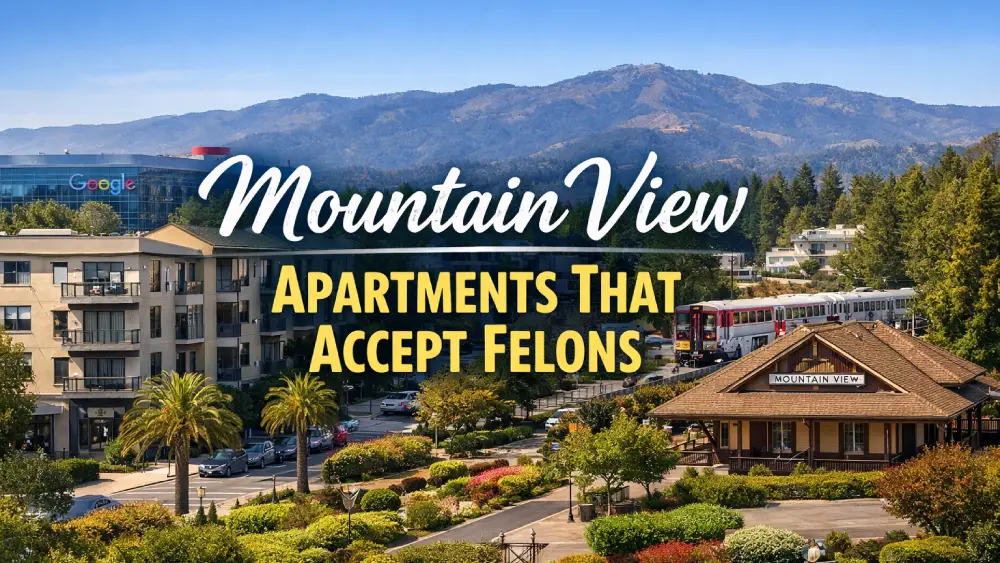
Mountain View Apartments That Accept Felons exist within a city shaped heavily by legal pressure, not leniency, marketing language, or surface-level screening criteria. In Mountain View, criminal history decisions are governed by overlapping state laws, local enforcement risk, and ownership liability calculations that quietly influence who gets approved and who does not. For renters with felony records, understanding this legal environment matters more than focusing on individual properties.
California’s fair housing framework forces landlords to justify denials with documented, job-related, and safety-based reasoning rather than blanket exclusions. In Mountain View, where enforcement scrutiny is higher and owners are acutely aware of compliance exposure, felony history is rarely treated as an automatic rejection. Instead, it becomes a legally sensitive data point that must be handled carefully, often resulting in more nuanced decision-making than renters expect.
Legal scrutiny as a market force
Mountain View landlords operate under heightened awareness of fair chance housing enforcement. Denying an applicant based solely on a felony record can trigger legal risk if the denial is not narrowly tailored, consistently applied, and supported by objective reasoning. As a result, many owners adopt cautious, individualized review processes—not out of generosity, but out of necessity.
This legal pressure shifts the rental conversation. Rather than asking whether an applicant has a felony, owners focus on whether the record presents a current, demonstrable risk that can be defended if challenged. The burden subtly moves from the renter proving worthiness to the landlord proving justification.
How compliance reshapes screening behavior
Screening systems still exist, but their outputs are not always final. In Mountain View, criminal background results often trigger secondary review rather than immediate rejection, especially when ownership understands the compliance implications of overly broad exclusions.
| Screening Stage | Owner Concern | Practical Outcome |
| Automated check | Consistency | Flag, not denial |
| Manual review | Legal defensibility | Context evaluation |
| Final decision | Liability exposure | Conditional approval or explanation |
This layered approach is why outcomes vary so widely. Two renters with similar records may receive different decisions depending on how clearly a landlord can articulate risk within legal bounds.
Why felony type and recency matter differently here
Mountain View owners are less concerned with labels and more concerned with relevance. Offenses unrelated to property safety or tenant relations are harder to justify as disqualifiers, particularly when time has passed. Recent, directly relevant offenses carry more weight, but even then, owners must balance enforcement risk against vacancy and compliance exposure.
This environment creates a narrow but real opening for renters whose records are older, non-violent, or clearly disconnected from housing risk. The decision is not emotional; it is defensive.
Ownership size and legal sensitivity
Larger operators tend to be more conservative because they face greater aggregate exposure, while smaller owners often rely on legal caution paired with discretion. Ironically, this can make some mid-sized properties more flexible than either end of the spectrum.
| Ownership Scale | Legal Risk Awareness | Felony Flexibility |
| Large corporate | High, policy-driven | Low to moderate |
| Mid-sized portfolios | High, case-based | Moderate |
| Individual owners | Variable, personal | Variable |
Understanding where a property sits on this spectrum helps explain why Mountain View Apartments That Accept Felons appear inconsistently rather than predictably.
The indirect role of Realtors in private rentals
California Realtors do not provide apartment locating services, but they frequently interact with private owners whose rentals are governed by discretion rather than corporate policy. The professionals below work in Mountain View and surrounding cities and may offer insight into privately owned housing paths, though they do not place renters.
Mini Kalkat – Intero Real Estate Services
Phone: (650) 823-7835
Serving Los Altos, Mountain View, Sunnyvale, Palo Alto, Cupertino, and nearby areas, Mini works with buyers and sellers and is known for negotiation strength and close client involvement.
Ron Laserna – Coldwell Banker Realty
Phone: (408) 484-4413
Licensed since 2005, Ron serves Santa Clara County and is recognized for professionalism, integrity, and detailed transaction guidance.
Alex Wang – Rainmaker Real Estate
Phone: (650) 800-8840
Covering Mountain View and Silicon Valley, Alex focuses on negotiation psychology and ownership dynamics in high-stakes markets.
These contacts are informational resources, not placement services, and are most relevant when exploring privately owned rentals.
Housing paths that reduce legal friction
When direct approvals are slow or uncertain, alternative housing paths can preserve stability while avoiding repeated screening exposure.
Airbnb monthly stays allow housing without criminal background evaluation during transitions.
Furnished Finder connects renters to mid-term housing often managed by individual owners.
Facebook Marketplace Rooms for Rent facilitate direct agreements where legal screening is informal.
Private Landlords may assess current stability rather than historical records.
The Guarantors can help offset perceived risk where allowed by the owner.
Second Chance Apartment Locators may be referenced for education only in non-Texas markets, not placement.
Why silence sometimes works better than confrontation
In Mountain View, renters often undermine themselves by challenging policies instead of understanding constraints. Landlords respond better to clear documentation and compliance-aligned communication than to arguments about fairness. The goal is not to demand acceptance, but to make denial harder to justify.
Mountain View Apartments That Accept Felons are found where legal pressure, ownership discretion, and risk calculus intersect—not where policies promise flexibility.
Frequently Asked Questions
Yes, depending on offense relevance, timing, and ownership discretion.
Only if the denial is legally justified and narrowly applied.
Yes, fair chance housing laws significantly influence how records are evaluated.
Most do, but outcomes vary by ownership and review process.
Older records generally carry less weight.
They are often harder to justify as housing-related risks.
Yes, especially when they understand compliance boundaries.
Some owners accept them to reduce perceived risk.
Yes, they are frequently used during longer housing searches.
They exist, but require timing, strategy, and legal awareness.