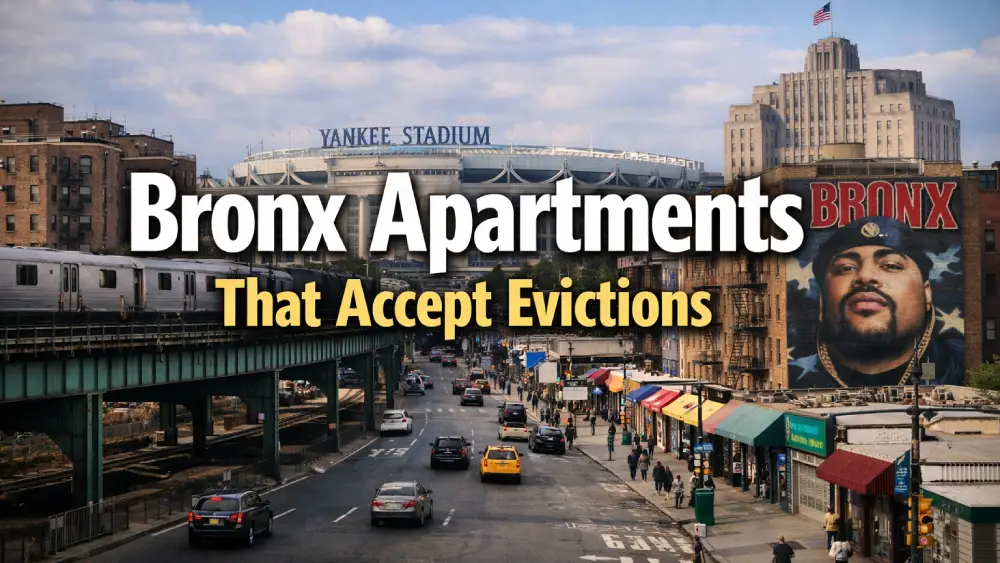
Securing Bronx Apartments That Accept Evictions requires understanding a legal environment that functions very differently from most U.S. rental markets. In the Bronx, eviction history is interpreted through court congestion, case resolution outcomes, and administrative delay rather than moral judgment or blanket disqualification. This borough’s housing decisions are shaped less by what happened and more by how the case moved—or stalled—through the system.
This article analyzes Bronx Apartments That Accept Evictions through the lens of housing court mechanics and legal pressure, showing how procedural reality often overrides stigma.
The Bronx Housing Court backlog effect
Bronx Housing Court carries one of the largest eviction caseloads in New York State. Cases often stretch for months or even years due to adjournments, legal aid intervention, and procedural protections for tenants. As a result, many evictions on record do not represent sudden nonpayment or abandonment, but drawn-out disputes that were eventually settled or resolved administratively.
Landlords reviewing applications are often aware of this context. An eviction filing alone does not automatically signal risk when the system itself is known for delay and complexity.
Filed vs. executed evictions
A critical distinction in the Bronx is whether an eviction was merely filed or actually executed. Many cases end in stipulations, payment plans, or dismissals without a marshal’s removal ever occurring.
Owners who understand the court process often weigh outcomes more heavily than filings. An eviction that never resulted in physical removal can carry significantly less impact during screening.
How legal reforms changed screening behavior
Recent tenant protection laws altered eviction timelines and notice requirements, increasing both legal cost and duration for landlords. These changes have subtly shifted risk calculations.
Some owners now prioritize current compliance and income certainty over past legal disputes, particularly if those disputes occurred during periods of widespread hardship or regulatory transition.
Documentation that reframes eviction history
In the Bronx, paperwork can neutralize stigma. Court disposition records, proof of satisfaction, or evidence of dismissal often change how an eviction is perceived.
The table below illustrates how different eviction outcomes tend to be interpreted:
| Eviction Outcome | Typical Landlord Interpretation | Approval Impact |
| Filed, dismissed | Procedural dispute | Low |
| Settled with payment | Resolved risk | Moderate |
| Executed eviction | High caution | Significant |
| Old case (5+ years) | Limited relevance | Low |
This is not policy—it is pattern recognition shaped by legal familiarity.
Income verification under legal scrutiny
Because eviction cases are expensive and slow, landlords often focus on avoiding future court involvement. Stable income verified through pay stubs, tax returns, or benefits documentation can outweigh prior eviction history.
The emphasis shifts from punishment to prevention: can this tenancy avoid court entirely?
Real Estate Professionals Who Can Help Navigate Evictions
While New York doesn’t offer “apartment locators” in the traditional sense, working with licensed real estate agents and property advisors who understand the local market and eviction contexts can drastically improve your housing prospects. These professionals know where personal landlord review matters and where exceptions are possible.
RPPM LLC (PPM)
📞 (973) 380-0467
RPPM LLC offers full real estate services including leasing and property management. Their team can connect you with smaller rental owners and opportunities where human evaluation can override automated rejections. Their approach focuses on stable placements and clear client communication.
Jeff Stineback – Long Island Home Team
📞 (631) 627-1780
A seasoned residential and investment professional with decades of experience. Jeff’s tech-forward strategies and deep Long Island and NYC market knowledge help renters identify properties where application discretion is possible. This helps applicants with eviction records show income strength and rental readiness.
NY Online Realty
📞 (516) 798-3000
In business since 1999, NY Online Realty operates throughout New York with rental, property management, and REO expertise. Their long practice history and emphasis on communication enable them to advocate for renters in nuanced application scenarios, including those with eviction histories. They focus on landlords willing to consider the full context of an applicant’s story.
Why timing still matters, legally
Court calendars influence leasing decisions indirectly. During periods of increased filings or staff shortages, owners may become more selective. Conversely, after moratoriums or backlog clearances, some landlords relax screening to stabilize occupancy quickly.
Applicants with eviction records often find more openness during post-backlog leasing periods when units must be filled to offset accumulated losses.
Neighborhood legal exposure
Different Bronx neighborhoods experience varying levels of court activity, which affects landlord tolerance. Areas with historically higher filing rates often normalize eviction records as part of the local rental ecosystem.
The following table shows how legal exposure can vary by area:
| Area | Court Filing Frequency | Eviction Record Sensitivity |
| Highbridge | High | Lower |
| Morrisania | High | Lower |
| Riverdale | Lower | Higher |
| Pelham Bay | Moderate | Moderate |
This is not about leniency—it reflects familiarity with the system.
The role of legal aid involvement
Many Bronx eviction cases involve tenant legal aid. Landlords reviewing records often recognize these cases as procedural battles rather than financial collapse.
An eviction associated with legal advocacy is frequently viewed as less predictive of future nonpayment than one involving abandonment or default without engagement.
Silence versus clarity
Applicants who ignore eviction history often fare worse than those who address it cleanly. Bronx landlords are accustomed to court records and usually prefer straightforward acknowledgment supported by documentation.
Silence can appear evasive in a borough where records are easily accessible.
Why Bronx Apartments That Accept Evictions actually exist
Bronx Apartments That Accept Evictions exist because the legal system itself produces records that do not always reflect tenant behavior. Owners who operate daily within this system understand its noise and adjust accordingly.
The market does not reward ignorance of legal nuance—it rewards those who can interpret it.
Housing options to consider
- Airbnb – Short-term housing can provide stability while distancing from recent eviction records.
- Furnished Finder – Medium-term rentals often avoid formal screening tied to housing court history.
- Facebook Marketplace Rooms for Rent – Individual room rentals may rely on informal agreements rather than court-based screening.
- Private Landlords – Small owners familiar with Bronx court realities may evaluate evictions contextually.
- The Guarantors – Lease guarantees can reduce landlord concern tied to prior eviction cases.
- Second Chance Apartment Locators – Educational guidance is available, but no placement services are offered in New York.
What this means for renters
Understanding the legal backdrop transforms the search. Instead of chasing vague promises, renters who prepare documentation, verify income, and choose timing strategically often succeed even with an eviction on record.
That is the quiet reality behind Bronx Apartments That Accept Evictions, and why informed strategy consistently outperforms desperation.
Frequently Asked Questions
Yes, many Bronx landlords consider applications with evictions depending on case outcome and income.
Most screening reports show filings, but landlords often focus on how cases ended.
Yes, dismissals usually carry far less weight than executed evictions.
Older evictions, especially over five years, often lose significance.
Some landlords view legally contested cases as less predictive of future issues.
Consistent, verifiable income can significantly improve approval chances.
Yes, neighborhoods with higher court activity often show greater tolerance.
Yes, transparency with documentation is usually preferred.
Yes, third-party guarantees can reduce perceived legal risk.
No, outcomes and context matter more than the filing itself.