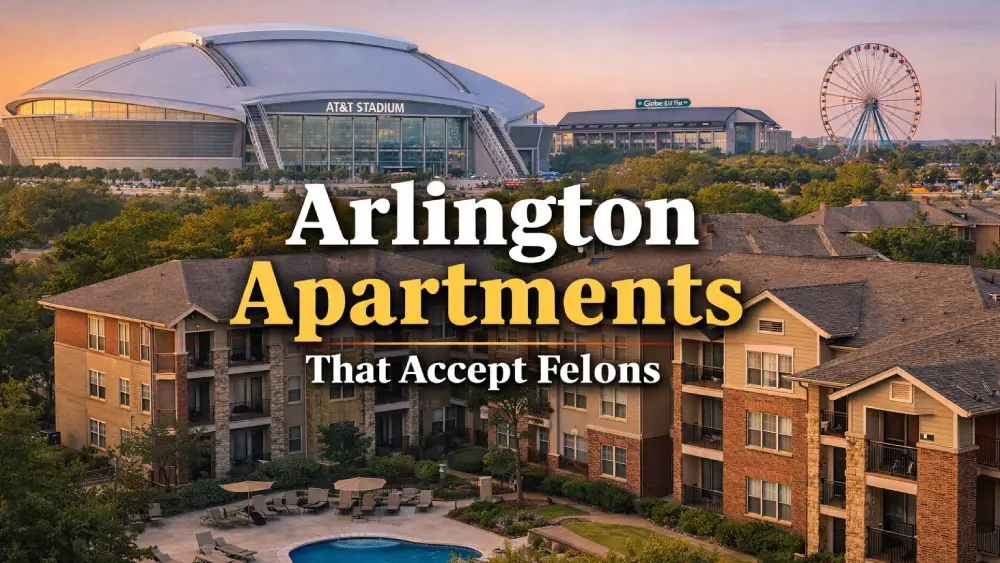

Finding Arlington Apartments That Accept Felons can feel intimidating, isolating, and discouraging. I’ve worked with people who assumed one mistake permanently shut the door on stable housing. That assumption is wrong. Arlington remains one of the more navigable Texas cities for renters with felony records—if you move with intention instead of desperation.
This article exists for one reason: to show you how people actually secure Arlington Apartments That Accept Felons without wasting money, burning time, or getting crushed by repeated denials. There are paths forward. Several of them, in fact.
The Reality of Renting With a Felony Record
A felony record changes how landlords evaluate risk. That’s the honest truth. Background checks are standard, and many large apartment communities rely on automated screening systems that flag criminal history immediately.
Still, not all felonies are treated the same. Time matters. Severity matters. Patterns matter.
Most Arlington landlords consider:
- How long ago the offense occurred
- Whether the charge was violent or nonviolent
- Evidence of rehabilitation or stability
- Current income and employment
One charge from years ago is not viewed the same way as multiple recent offenses. Arlington Apartments That Accept Felons often focus more on who you are now than who you were then.
How compliance risk shapes screening rules
Most Arlington apartments do not create screening rules in-house. Policies are assembled from insurer exclusions, lender language, and third-party screening vendors, then enforced by management teams who rarely have authority to deviate.
This matters because felony screening is not about morality; it is about whether an approval could later be challenged by an insurer, investor, or attorney. If the risk can be defended on paper, approval becomes possible. If not, the file is rejected regardless of vacancy or income.
Understanding this framework explains why some felonies are functionally invisible while others trigger automatic denial.
The difference between prohibited and reviewable offenses
In Arlington, felonies tend to fall into two operational categories:
- Prohibited offenses, which insurers or lenders explicitly exclude
- Reviewable offenses, which require time-based or context-based evaluation
Violent offenses involving bodily harm, arson, or sexual crimes are more likely to be contractually prohibited. Non-violent, non-property felonies—especially financial or drug-related convictions—often sit in reviewable territory.
What renters experience as “accepting felons” is usually a property allowing reviewable offenses past a defined lookback window.
Lookback windows are legal shields, not favors
Many Arlington properties apply felony lookback periods of 5–10 years. These windows are not designed to be forgiving; they are designed to be defensible.
A lookback window allows an owner to demonstrate consistent policy enforcement if challenged. Once an offense ages past the window, denying based on that record alone becomes harder to justify legally, especially if the applicant meets all other criteria.
This is why time since conviction often matters more than the conviction itself.
Why arrest records and dismissed cases matter less
Arrest records without convictions present higher legal risk for owners to rely on. Using them can invite fair-housing scrutiny, particularly if applied inconsistently.
As a result, many Arlington properties either:
- Ignore non-conviction records entirely, or
- Use them only when combined with other disqualifying factors
Applicants are often surprised to learn that a dismissed case may carry less screening weight than a minor conviction, purely because of compliance exposure.
Management discretion exists—but within narrow bounds
Leasing teams in Arlington are not free to approve at will. Discretion usually exists only after a screening vendor returns a “review” status rather than a “fail.”
At that point, managers may evaluate:
- Time elapsed since conviction
- Evidence of rehabilitation or stable housing since
- Whether the offense conflicts with property-specific risk policies
This discretion disappears when a screening report flags a prohibited category.
How insurance quietly controls who gets housed
Property insurance is one of the most powerful, least visible forces in felony screening. Insurers may refuse coverage or raise premiums if certain offenses are housed on-site.
Owners do not debate these rules. If approving an applicant risks insurance non-renewal, the application stops there.
This is why two otherwise identical properties in Arlington can have completely different felony policies depending on their insurer.
Income stability as a secondary filter
Income does not override felony restrictions, but it influences review outcomes. Once an applicant clears the compliance threshold, strong income reduces perceived operational risk.
Applicants with felonies who demonstrate consistent, documentable income and recent rental stability are more likely to pass discretionary review stages.
Income cannot fix a prohibited offense, but it can tip the scale for reviewable ones.
Why policies are rarely advertised
Advertising “felon-friendly” housing increases application volume from high-risk categories and raises internal compliance concerns. Most Arlington properties avoid this entirely.
Instead, acceptance happens quietly through policy mechanics. Renters who understand how these mechanics work are less likely to self-disqualify prematurely.
How Apartment Locators Shift the Odds
Apartment locators do more than send listings. The good ones act as gatekeepers and advocates.
They already know:
- Which properties have flexible background criteria
- Which managers will consider exceptions
- What documentation strengthens an application
For renters searching for Arlington Apartments That Accept Felons, locators reduce blind risk. They prevent wasted fees. They protect momentum.
I’ve seen renters approved in weeks with a locator after months of failure alone.
When felony records are hardest to overcome
Approval becomes extremely difficult when:
- The offense falls into an insurer-excluded category
- The conviction is recent and within the lookback window
- Multiple convictions appear across different timeframes
- The offense conflicts with property use (e.g., child-related crimes near family housing)
These situations present legal risk that most owners will not assume.
What “accepting felons” actually means in Arlington
It does not mean open approval. It means the property’s compliance framework allows certain convictions to age out or be reviewed without violating policy.
For renters with felonies, access exists—but only where legal exposure remains manageable.
Tables That Clarify Felony Screening in Arlington
Table 1: Common Felony Categories and Typical Review Status
| Felony Type | Typical Screening Outcome |
| Non-violent drug offense | Reviewable after lookback |
| Financial crimes | Often reviewable |
| Property damage | Case-dependent |
| Violent offenses | Frequently prohibited |
| Sexual offenses | Usually prohibited |
Table 2: Screening Inputs Ranked by Legal Weight
| Screening Factor | Influence Level |
| Insurer restrictions | Very High |
| Conviction age | High |
| Offense category | High |
| Income stability | Moderate |
| Personal explanation | Low |
Housing Options for Renters With Felonies
Airbnb
Monthly Airbnb stays can provide immediate housing without criminal background screening.
Furnished Finder
Furnished Finder offers mid-term rentals that often avoid formal felony screening processes.
Facebook Marketplace Rooms for Rent
Room rentals on Facebook Marketplace are typically decided by individual owners rather than corporate policies.
Private Landlords
Private landlords may evaluate felony records contextually and rely more on references and income.
The Guarantors
The Guarantors can reduce owner risk by backing lease obligations when screening concerns exist.
Second Chance Locators
Second chance locators can explain Arlington-area felony screening rules and approval constraints without guaranteeing placement.
Frequently Asked Questions
Yes, some Arlington apartments approve applicants with certain felony convictions depending on offense type and age.
No, properties differentiate heavily between violent, non-violent, and financial offenses.
Many properties apply lookback windows ranging from five to ten years.
Dismissed or non-conviction records often carry less screening weight due to legal risk.
Income helps only after compliance thresholds are met and cannot override prohibited offenses.
Newer properties often follow tighter insurer and lender rules with less discretion.
Private landlords frequently use informal or individualized screening approaches.
Yes, screening policies vary widely by insurer, lender, and portfolio structure.
A guarantor may help with financial risk but cannot override prohibited offense rules.
Sometimes, if the conviction is outside the lookback window and not flagged by screening.