You get your electric bill. It’s higher than last year. The house is either too hot or too cold. You’re closing doors to unused rooms and trying to control the temperature. You’re opening every blind at sunrise, hoping natural light will cut your electricity use.
Here’s the real problem: you’re trying to solve 2026 problems with 1995 solutions.
Modern homes don’t waste energy on climate control. They don’t rely on central heating for every room. They don’t ignore natural light during the day, then blast artificial lights at night. And they work smarter.
Creating a truly comfortable, energy-efficient home isn’t about expensive technology or major renovations. It’s about understanding how homes actually function and making strategic changes that compound over time. Some take days. Some take months. All of them save money from day one.
Stop Heating and Cooling Rooms You Aren’t Using
Most homes are designed like it’s still 1960. One thermostat controls the entire house. You heat all 2,000 square feet to 68 degrees even though you’re working in a 200-square-foot office. You cool the master bedroom at night to the same temperature as the guest rooms, nobody’s in.
That’s not comfort. That’s a waste.
Here’s why most people get this wrong: they think they need to replace their entire HVAC system. You don’t. A 3-zone mini-split system lets you independently control the temperature in three areas. Your bedroom stays at 65 degrees. Your office stays at 70. And your living room stays at 68. Unused rooms? You’re not paying to heat or cool them.
According to the U.S. Energy Information Administration, heating and cooling account for roughly 48% of residential energy use. Zone-based systems cut that by 30–40% because you’re only conditioning the spaces you actually use. That’s not a marginal improvement. That’s transformational.
The installation takes a few days. The savings start immediately on your next bill.
Use Natural Light as Your First Strategy
People spend money on lighting before they’ve even optimized what they already have.
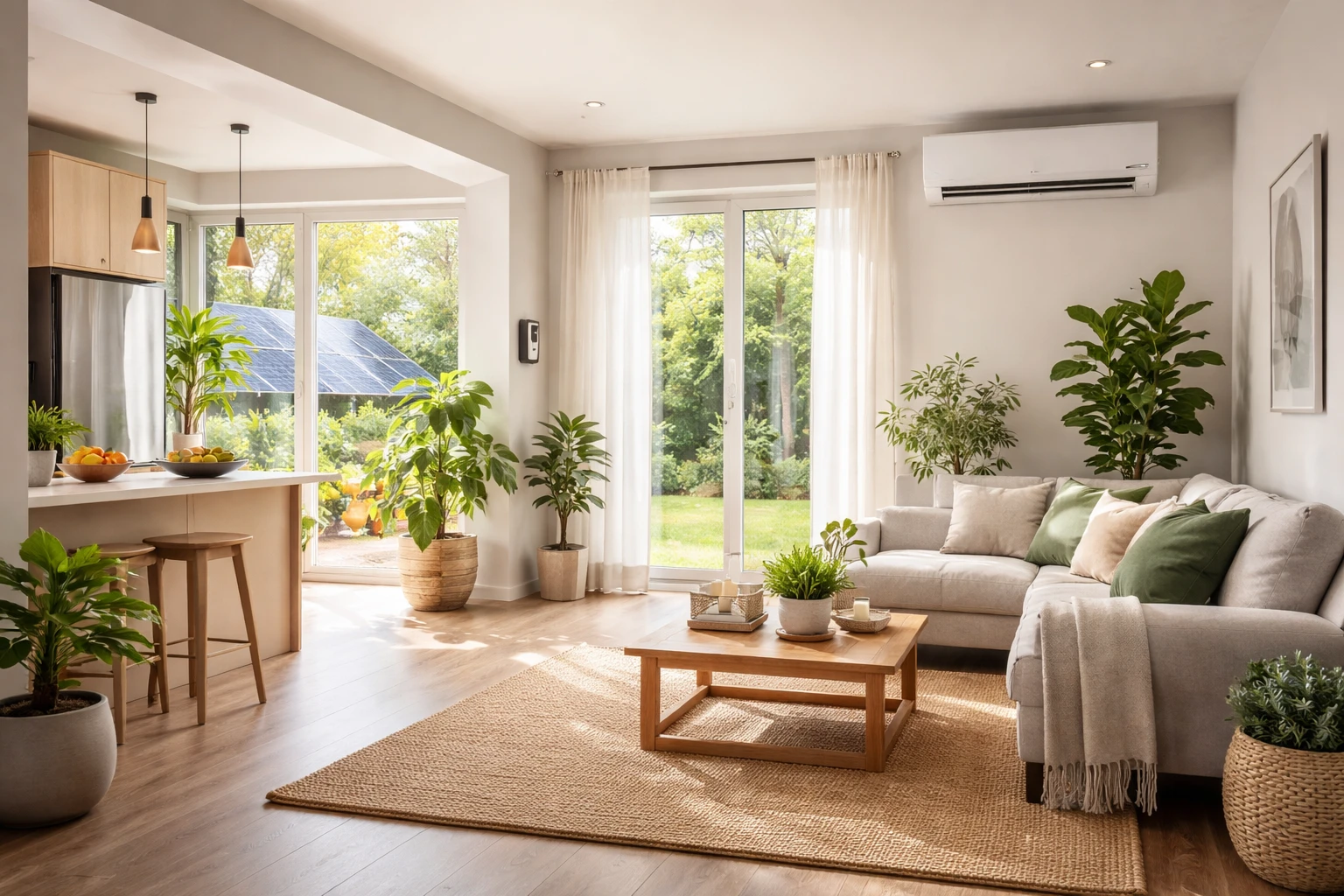
Your home gets free light from the sun. Most people waste it. They keep the blinds closed. And they position furniture to block windows. They leave interior doors closed, trapping light in one room. Then, at 10 AM, they flip on the lights that cost money, which makes them feel worse.
Here’s the insider secret: natural light doesn’t just save money. It improves your mood, regulates your sleep cycle, and makes spaces feel bigger. You’re not just cutting electricity costs, you’re improving your health.
Start here:
- Open all your blinds during the day. Full stop. This costs nothing.
- Rearrange furniture away from windows. Light travels farther when it’s not blocked.
- Add mirrors opposite windows. Even cheap mirrors bounce light throughout rooms.
- Paint walls lighter colors. Light paint reflects light. Dark paint absorbs it.
- Open interior doors. Let light travel from room to room instead of getting trapped.
These changes take an afternoon and cost under $100. Your electricity use drops noticeably.
After you’ve optimized natural light, then upgrade artificial lighting. LED bulbs. Dimmers. Motion sensors for spaces you use occasionally. Color-tuning lights that adjust throughout the day.
Design Flexible Spaces So You’re Not Maintaining Empty Rooms
Here’s the uncomfortable truth: most homes have wasted space.
A four-bedroom house with two people means two rooms sitting empty most of the year. You heat them. And you cool them. You clean them. And you maintain them. But you use them 20 days a year.
The real problem is fixed rooms. A bedroom is a bedroom. A guest room is a guest room. An office is an office.
Modern homeowners think differently. They design spaces that transform in response to actual needs.
The best cabinet bed disappears into your office wall when you’re working. When family visits, it becomes a real bed. Your office stays an office 300 days a year and becomes a guest bedroom 20 days a year. You’re not maintaining wasted space. You’re using every square foot.
This matters because smaller, well-used homes cost less to heat, cool, and maintain than large homes with empty rooms. A 1,000-square-foot home with smart design feels larger and costs 40% less to condition than a 1,400-square-foot home with extra bedrooms nobody uses.
Insulate Better Than You Think You Need To
Most people assume insulation is expensive and complicated. It’s not. And it’s the foundation of everything else.
Good insulation keeps heat in during winter and out during summer. It works 24/7 without electricity. It doesn’t wear out. And it pays for itself.
Start with the biggest energy leaks:
- Attic insulation – Heat rises. If your attic isn’t properly insulated, you’re throwing money away. Most homes need more attic insulation than they have.
- Air sealing – Cracks around windows, doors, outlets, and pipes leak conditioned air. Caulk and weatherstripping cost $50–$200 and significantly reduce air leakage.
- Basement/crawlspace – If you have an unfinished basement or crawlspace, insulate the rim joist and walls. This stops cold air from rising into your home.
These upgrades cost $1,000–$3,000, depending on your home size. They reduce heating and cooling costs by 15–25%. On a $150/month climate control bill, that’s $22–$37/month in savings forever.
Do this before you add anything else. Insulation is the foundation of efficiency.
Consider Renewable Energy as a Long-Term System, Not a One-Time Project
People think about solar wrong. They see a $20,000 bill and assume it’s an investment that either happens now or never.
That’s not how modern homeowners do it.
According to the National Renewable Energy Laboratory, residential solar costs have dropped 70% in the last decade. A modern home doesn’t need to go all-in on solar. It builds toward energy independence gradually.
Year one: insulation and air sealing. Your baseline efficiency improves. Costs: $1,000–$3,000. Savings: 15–25%.
Year two: solar panels plus a solar-powered aerator for pond and other solar applications to see how the technology works. Savings: 40–60% of your electricity.
Year three: add battery storage so you use solar power at night. Cost: $5,000–$10,000. Benefit: energy independence and grid backup.
This isn’t all-or-nothing. You’re building a system. Each step compounds on the last. After three years, you’ve invested $14,000–$28,000 and cut your energy costs by 60–70%. Over 20 years, that’s $60,000+ in savings.
The Order Actually Matters
Most people do this backwards. They buy solar panels before they’ve insulated. They buy fancy lighting before they’ve optimized natural light. And they add a heat pump before they’ve sealed air leaks.
Here’s the actual progression:
Phase 1: Foundation (Months 1–2)
- Assess your home’s energy use
- Optimize natural light (rearrange, clean windows, add mirrors)
- Seal air leaks and add weatherstripping
- Upgrade the thermostat to a programmable model
Cost: $200–$500. Savings: 10–15%.
Phase 2: Core Efficiency (Months 3–6)
- Add attic insulation if needed
- Install a zone-based climate system like a 3-zone mini-split
- Upgrade lighting to LEDs with dimmers
- Improve water heater efficiency
Cost: $4,000–$8,000. Savings: 25–35%.
Phase 3: Renewable Energy (Months 6–18)
- Install solar panels
- Add battery storage if desired
- Upgrade to high-efficiency appliances
- Implement smart home controls
Cost: $15,000–$25,000. Savings: 60–70%.
Phase 4: Optimization (Ongoing)
- Monitor and adjust based on usage
- Add flexible spaces (convertible furniture)
- Maintain systems
Each phase builds on the last. You can’t skip steps without wasting money.
Frequently Asked Questions (FAQs)
Most homeowners save 30–40% on heating and cooling costs with a zone system. If you’re spending $150/month on climate control, expect to save $45–$60/month. A 3-zone mini-split costs $3,000–$5,000 installed. You hit payback in 5–7 years, then it’s pure savings forever. The real win though? Better comfort. Your work area is exactly the temperature you want, not a compromise for the whole house.
Probably not. Solar payback is typically 6–8 years on average. If you’re moving in 5 years, you don’t recoup the investment before you leave. Even if homes with solar theoretically sell for more, the data is mixed. If you’re staying 10+ years, it makes sense. If you’re not sure, focus on insulation and zone climate control first, those savings follow you regardless of when you move.
Yes, it matters. Optimizing natural light (mirrors, cleaning windows, moving furniture) costs under $100 and saves 5–10% on lighting costs immediately. If you’re paying $100/month in electricity, that’s $5–$10/month. Times 12 months, it’s $60–$120/year. Do it right and add other efficiency upgrades, and the savings compound. None of these individual changes are massive. Together, they cut your energy costs by 60–70%.
Seal air leaks. Caulk around windows, weatherstrip doors, seal electrical outlets. Spend $50–$200 on materials and do it yourself or hire someone for a day. This stops you from paying to heat or cool air that’s leaking outside. It’s the fastest ROI and foundation for everything else. After air sealing, add insulation. Then climate control optimization. Then lighting. And then renewable energy. Do them in order.