Outdoor lighting plays a big role in home security, increasing the value of the property, safety around the home, and the extension of the use of outdoor spaces even at night. The trouble is that most residential outdoor lighting systems are built up bit by bit over a period, with fixtures selected primarily based on the look rather than the efficiency, so the end result is often a system that wastes electricity without really giving the best quality or coverage of light. Being deliberate with outdoor lighting can bring you benefits in various areas all at once.
The transition to energy, efficient outdoor lighting has been made more easy and cheap today than it was a few years ago. LED technology has been significantly improved, the variety of fixtures available has been increased to almost every residential application, and the price difference between efficient and inefficient options has been mostly eliminated. Choosing to be efficient is now mainly a matter of knowing what to get rather than having to pay extra for it.
It is more important than people think to do this well. Since outdoor lighting fixtures are usually illuminated for 6 to 10 hours per night, every night that the lighting is on at the same time means that even small efficiency improvements result in significant savings over the year, and bad decisions can have a similarly fast negative impact.
Understanding What Makes Outdoor Lighting Truly Efficient
Efficiency in outdoor lighting goes beyond merely using LED bulbs instead of incandescent ones, although that’s certainly the starting point. It’s about the entire system: how much light the fixture actually delivers to the area where it’s needed, how much energy it takes to produce that light, how well it’s controlled, and how long it will last before requiring replacement or maintenance.
If you get a budget LED fixture that’s badly designed, it can waste as much light through poor optics as a less efficient source would waste through the higher wattage. Lumens per watt referred to as luminous efficacy is the primary efficiency metric.
Outdoor LED fixtures that are of good quality should produce at least 80 to 100 lumens per watt, while the top products can even reach 120 to 150 lumens per watt. This is important because it determines how much actual useful light you get from each watt of electricity consumed. Higher efficacy implies that you can use less energy to achieve the same illumination levels.
The Right Fixtures for Each Outdoor Application
The various outdoor applications indeed have different lighting needs, and by selecting the appropriate fixture type for each setting, you’ll get better results as well as higher efficiency. For example, a pathway light has very different requirements from a security floodlight or a decorative wall sconce. So, if you treat them all the same, you will either end up over, lighting some areas and under, lighting others or purchasing more fixtures than each application actually needs.
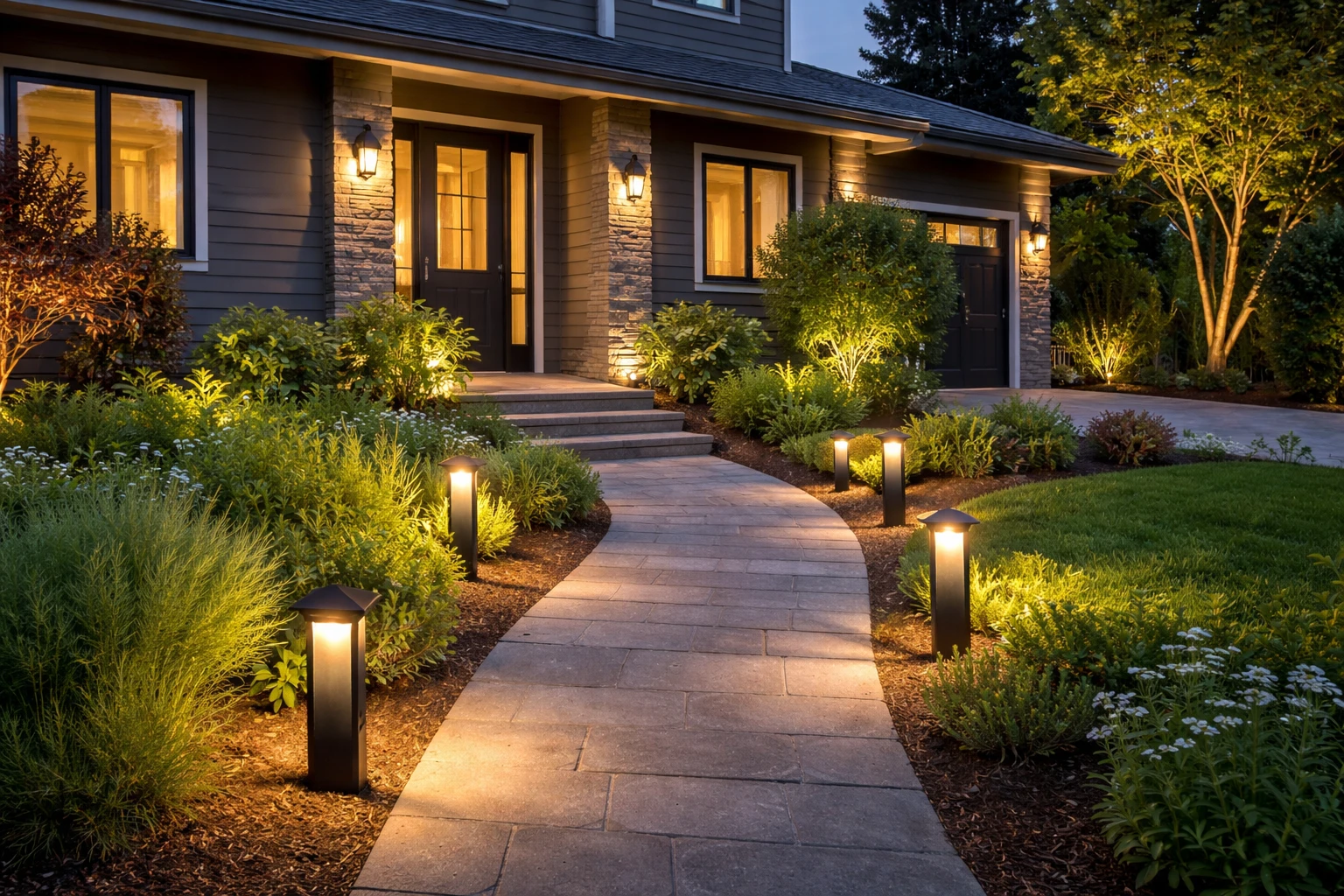
In general, path and step lights should have a relatively low lumen output, enough to make safe the transition areas without causing glare. Lighting fixtures with a lumen count between 100 and 400 will typically be suitable, and solar, powered options are excellent choices for such applications since the power requirement is low enough that even a small panel is able to provide reliable performance.
What matters most with pathway lighting is having the lights evenly spaced and of such height as to put the illumination onto the walking surface, rather than shining into people’s eyes.
For larger properties or those with more complex outdoor lighting needs, the principles used in commercial LED lighting solutions translate directly to residential applications particularly around zoning, control systems, and ensuring fixture specifications actually match the demands of each location. Understanding how professionals approach lighting design for demanding applications is genuinely useful context when planning a thorough residential outdoor lighting upgrade.
Smart Controls and Automation
Controls is one area where residential outdoor lighting is often criticized. Still, most homeowners are using manual switches or simple timers, which result in lights running longer than necessary or being left on accidentally. Outdoor lighting automation could provide homeowners with a great deal of convenience but the main advantage is that such controls collaboratively resulting in direct energy saving and less wear and tear thus longer life of the lamps.
Automatically up and down controlled by light, considering the presence of nature (using photocell), outdoor lighting fixtures is the easiest improvement and also one of the highest value ones. These sensors make sure that outdoor lights only operate at nighttime without the need for any manual management, and they also change automatically during the year as the length of the day varies. Most outdoor fixtures can be given photocell capability, either built into the fixture or through an external sensor at the switch.
Installation, Weatherproofing, and Longevity
Outdoor fixtures are subjected to various environmental factors such as rain, humidity, temperature fluctuations, UV exposure, and in the case of coastal areas, salt air. It is wise to choose lighting fixtures with suitable ingress protection ratings so that they can reliably operate over their rated lifespan instead of getting worn out prematurely.
Generally, an IP65 rating is acceptable as a minimum for outdoor usage. It means the fixture is fully protected against dust and can withstand water jets from any direction. For lighting devices located in very open areas, in regions that receive a lot of rain, or are close to sprinkler systems, the usage of IP66 or IP67 certified products is recommended. UV resistance is even more important than most people realize.
Plastic parts in lighting fixtures such as lenses, housings, and mounting hardware that are not UV, stabilized, will soon be yellowed, cracked, and degraded after a few years of exposure to sunlight, thus reducing both the efficiency and attractive look of the fixture. Outdoor lighting of high quality employ materials that are UV, stabilized or have undergone UV, resistant treatment which keeps the appearance, optical, and structural properties of the fixture unchanged throughout the entire rated lifespan.
Frequently Asked Questions (FAQs)
Energy-efficient outdoor lighting lowers electricity bills, reduces environmental impact, and improves safety without excessive power consumption.
High-quality outdoor LED fixtures typically deliver at least 80–100 lumens per watt, with premium models reaching 120–150 lumens per watt.
LEDs are generally the most efficient choice, but overall fixture design, optics, and control systems also determine real-world efficiency.
Most residential outdoor lighting systems operate between 6 to 10 hours per night, making efficiency crucial for long-term savings.
Path and step lights typically perform best between 100 and 400 lumens, providing safe visibility without glare.
Solar lights can work well for low-lumen applications like pathways, especially when panels receive adequate daily sunlight.
Photocells, motion sensors, and timers ensure lights operate only when needed, reducing wasted energy and extending fixture lifespan.
An IP65 rating means the fixture is dust-tight and protected against water jets, making it suitable for most outdoor conditions.
Yes, coastal environments often require IP66 or IP67-rated fixtures to withstand heavy rain, humidity, and salt exposure.
UV-stabilized materials prevent yellowing, cracking, and degradation, helping fixtures maintain performance and appearance over time.