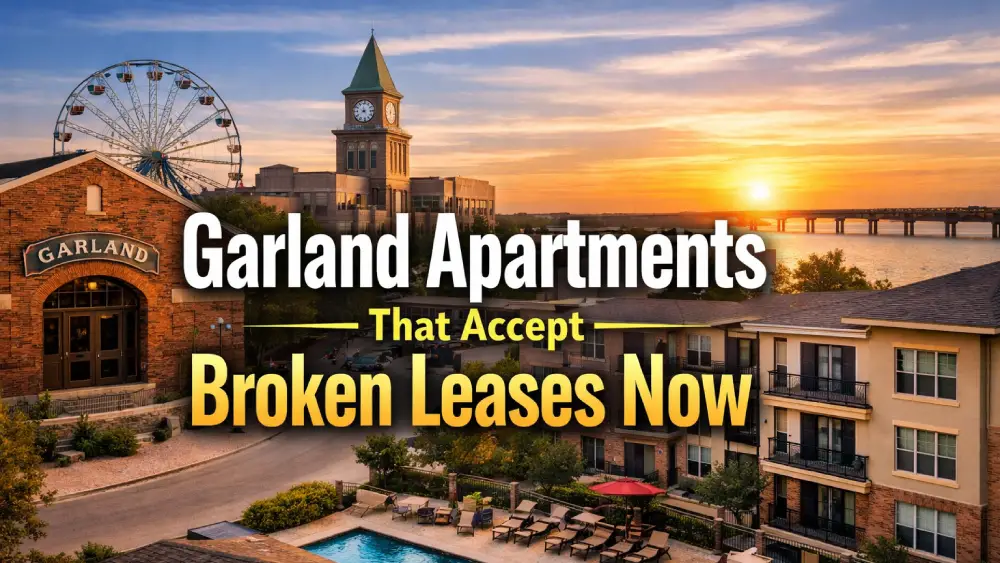

Broken leases change how renters are evaluated, but in Garland the impact is shaped less by moral judgment and more by ownership behavior. This article examines Garland Apartments That Accept Broken Leases through an ownership-cost lens—how different property owners assess the financial and operational cost of enforcing, reporting, or overlooking a prior lease break.
In Garland, broken leases are common enough that most owners have internal categories for them. What matters is not simply that a lease was broken, but whether the prior owner incurred real loss, pursued collection, or absorbed the vacancy quietly. Those decisions ripple forward into how future applications are screened.
Not all broken leases trigger the same response
A broken lease that resulted in immediate re-renting is treated very differently than one that left a unit vacant for months. Garland owners pay close attention to whether the prior landlord suffered measurable downtime.
When losses were minimal, the record often exists only as an internal note or soft collection entry. When losses were severe, the broken lease becomes a proxy for projected future risk.
Ownership scale changes tolerance
Garland’s rental market includes national operators, regional portfolios, and small local owners. Each category responds to broken leases differently because their cost structures differ.
Table 1: Ownership type vs. broken lease tolerance
| Ownership type | Primary concern | Typical response to broken lease |
| Large national operators | Portfolio consistency | Strict automated screening |
| Regional owners | Turnover cost control | Conditional approvals possible |
| Local owners | Cash flow continuity | Context-driven decisions |
This explains why two properties on the same street can reach opposite conclusions about the same applicant.
The role of lease termination reason
Garland owners often distinguish between “voluntary” and “forced” breaks. Relocations, job loss, or medical disruptions tend to be evaluated as situational. Lease breaks tied to disputes, unauthorized occupants, or repeated late payments trigger more resistance.
What matters most is whether the prior lease ended cooperatively or contentiously. Cooperative exits signal predictability, which owners value more than a perfect rental record.
How balances owed reshape approvals
Outstanding balances don’t automatically disqualify applicants in Garland, but they do change the structure of approval. Owners may require higher deposits, shorter initial lease terms, or proof that balances are being resolved.
Table 2: Broken lease balance status and common outcomes
| Balance status | Typical requirement | Approval likelihood |
| Paid in full | Standard deposit | Higher |
| Payment plan active | Conditional approval | Medium |
| Unresolved balance | Elevated deposit | Lower |
This is less about punishment and more about offsetting potential exposure.
Lease age matters, but differently than evictions
Broken leases age out more slowly than many renters expect. While evictions often lose weight after several years, broken leases remain relevant until the market can see a pattern of stability afterward.
Garland owners frequently look for at least one completed lease since the break, even if it was with a private landlord or informal arrangement.
Neighborhood competition shifts enforcement
In submarkets where multiple properties compete for the same renter demographic, enforcement softens. Owners adjust standards when they risk losing applicants to nearby communities offering similar units.
In quieter pockets with low turnover, broken leases carry more weight simply because owners can afford to wait.
Documentation that reframes the risk
Broken leases are easiest to overcome when documentation reframes them as closed chapters. Proof of stable employment, savings equal to several months’ rent, and evidence of on-time housing payments since the break all matter.
Short explanations work best when they focus on resolution rather than justification.
Application pacing reduces friction
Submitting applications in rapid succession can amplify the visibility of a broken lease across shared screening systems. In Garland, pacing applications—starting with properties more exposed to turnover—often yields better outcomes.
This strategy doesn’t hide history; it places it where it’s more likely to be weighed pragmatically.
Housing options that complement traditional apartments
- Airbnb: Monthly stays can bridge housing gaps while allowing time to resolve or age a broken lease.
- Furnished Finder: Mid-term rentals often emphasize income verification over prior lease outcomes.
- Facebook Marketplace Rooms for Rent: Room rentals frequently rely on personal interviews instead of formal lease history.
- Private Landlords: Individual owners may prioritize current stability over a past lease break.
- The Guarantors: Lease guarantees can reduce owner risk tied to prior broken leases.
- Second Chance Locators: Educational guidance on how broken leases are evaluated and how to present your application.
Why Garland remains navigable after a broken lease
Garland Apartments That Accept Broken Leases exist because enforcement costs money. Owners constantly balance the certainty of a qualified renter against the uncertainty of waiting. For applicants who understand how ownership decisions are made, Garland offers paths that don’t rely on exceptions—only alignment.
Garland Apartments That Accept Broken Leases reward renters who present stability clearly, and Garland Apartments That Accept Broken Leases are most accessible when preparation replaces urgency.
Frequently Asked Questions
Yes, many Garland properties review broken leases contextually rather than automatically denying.
Broken leases can influence approvals for several years, especially without a completed lease afterward.
Yes, paid or actively resolved balances significantly improve approval chances.
Local owners often weigh current stability more than historical lease outcomes.
Some do, depending on whether the balance was sent to collections.
Strong income and reserves can reduce perceived risk.
Newer properties typically enforce uniform screening more rigidly.
Yes, concise explanations paired with documentation reduce uncertainty.
Lease guarantees can offset risk for participating properties.
Garland often offers more owner-level discretion than higher-demand markets.