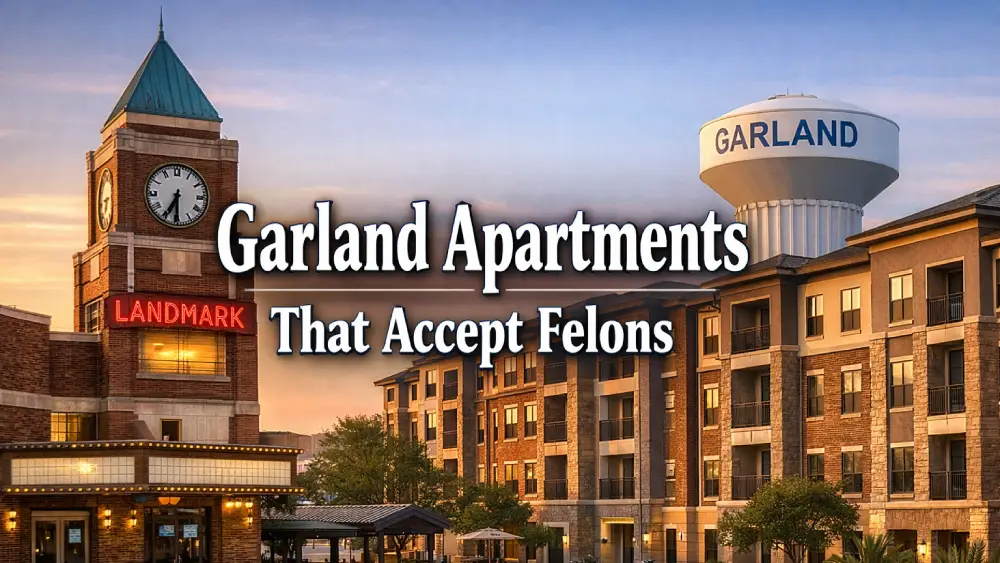

Housing access after a felony conviction in Garland is shaped less by opinion and more by compliance. This article approaches Garland Apartments That Accept Felons through a regulatory-pressure lens—how federal guidance, insurance rules, municipal exposure, and ownership liability influence who gets approved, when, and under what conditions.
In Garland, criminal background screening is not a single rulebook. It is a layered system where owners weigh legal risk, insurer requirements, and consistency obligations against operational realities. Understanding those pressures explains why some applications move forward quietly while others stop immediately.
Federal guidance quietly reshaped local screening
Over the past decade, federal fair housing guidance pushed owners to justify criminal screening with business necessity rather than blanket exclusion. While this guidance does not force approvals, it does require consistency and relevance.
Garland properties that operate under national compliance frameworks tend to adopt offense-specific lookback policies rather than lifetime bans. Smaller owners, by contrast, may rely on broader discretion but carry more personal liability.
The result is not leniency—it’s stratification.
Crime type matters more than crime label
In Garland, screening decisions rarely hinge on the word “felony” alone. Owners categorize offenses based on risk relevance to the property.
Table 1: Common offense categories and screening impact
| Offense category | Typical lookback window | Approval impact |
| Non-violent financial | 3–5 years | Often reviewable |
| Drug possession | 5 years | Case-by-case |
| Violent non-sexual | 7+ years | High friction |
| Sexual offenses | Extended or permanent | Rare approval |
This categorization is driven by insurer underwriting and resident safety obligations rather than moral judgment.
Insurance requirements drive rigidity
Many Garland apartment owners are bound by insurance policies that restrict who can reside on-site. These policies often specify disqualifying offenses regardless of management preference.
When an application is denied “by policy,” it frequently reflects insurer language rather than owner intent. Properties with self-insured structures or alternative carriers sometimes have more room to evaluate context.
Time since conviction functions as risk decay
Garland screening systems often treat time as a proxy for reduced risk. The longer the gap between conviction and application—with no new offenses—the less weight the record carries.
However, time alone is insufficient. Owners look for evidence that the risk environment has changed: employment stability, consistent housing, and structured routines.
Ownership structure influences discretion
Who owns the property matters as much as what’s on the record.
Table 2: Ownership structure and felony review flexibility
| Ownership model | Screening method | Context consideration |
| REIT / national firms | Automated matrix | Minimal |
| Regional portfolios | Hybrid review | Moderate |
| Individual owners | Manual review | Higher |
This explains why Garland Apartments That Accept Felons are more commonly found among smaller or regionally managed communities, even within the same neighborhood.
Resident profile shapes enforcement
Properties serving families, seniors, or vulnerable populations often enforce stricter screening to meet duty-of-care expectations. Communities with higher renter turnover or younger demographics may apply narrower restrictions focused on offense relevance.
This isn’t preference—it’s exposure management.
Documentation that addresses compliance concerns
Effective applications don’t argue fairness; they address liability. Certificates of rehabilitation, completion of supervision, employer letters, and proof of long-term housing stability all signal reduced risk in compliance language owners understand.
Over-explaining can backfire. Precision matters.
Why denials feel inconsistent across Garland
Two applicants with identical records can receive different outcomes because each property’s legal exposure is different. Zoning density, resident mix, and insurer rules vary block by block.
This inconsistency is frustrating, but it also means opportunities exist where compliance thresholds align with your history.
Housing options to consider alongside apartments
- Airbnb: Monthly stays can provide compliant housing while criminal records age and documentation improves.
- Furnished Finder: Mid-term housing often applies narrower background screening focused on recent behavior.
- Facebook Marketplace Rooms for Rent: Individual room rentals may rely on interviews rather than formal criminal matrices.
- Private Landlords: Small owners may evaluate rehabilitation and current stability more directly.
- The Guarantors: Lease guarantees can mitigate perceived risk for participating properties.
- Second Chance Locators: Educational guidance on how felony screening works and how to prepare documentation, not guaranteed placement.
Why Garland remains navigable
Garland Apartments That Accept Felons exist because compliance systems are designed to measure risk, not to enforce permanent exclusion. When applicants understand how those systems operate, they can position themselves within allowable boundaries rather than colliding with them.
Garland Apartments That Accept Felons are most accessible when applications speak the language of liability and resolution, and Garland Apartments That Accept Felons reward preparation more than persuasion.
Helpful Finds for a Stronger Rental Application
Getting approved with a past eviction, broken lease or thin credit comes down to preparation. These help you walk in ready:
- Accordion Document Organizer – keep pay stubs, references and ID copies together for every application.
- Every Tenant's Legal Guide (Nolo) – know your rights and what landlords can legally ask.
- Monthly Budget Planner – shows a landlord you have a plan for rent.
- Portable Door Lock – extra security in a new place from day one.
Rise Apartments is a participant in the Amazon Services LLC Associates Program. As an Amazon Associate we earn from qualifying purchases made through the links above, at no extra cost to you.
Frequently Asked Questions
Yes, some Garland properties approve felons depending on offense type, age, and compliance rules.
No, offenses are categorized by relevance and risk, not just severity.
Lookback periods commonly range from three to ten years depending on offense.
Violent offenses face higher scrutiny but are not universally disqualifying.
Stable employment significantly reduces perceived risk.
Some private owners evaluate rehabilitation more personally.
Yes, clear proof of rehabilitation and stability matters.
Insurance underwriting often dictates screening limits.
Newer or luxury properties usually apply tighter compliance rules.
Garland often offers more owner-level discretion than higher-density markets.